Photos courtesy of authors
Editor's Note: This article originally appeared in the July 2025 print edition of Greenhouse Management under the headline “Layer by layer.”

large air spaces. When there is strong
root-particle contact, it triggers the root
to stimulate root hairs or branch into
more lateral roots (green). If a root
encounters an airgap (like in bark
substrates), root hair and lateral root
initiation is inhibited (red).
Roots are the unseen engines of a plant, controlling productivity from below. Flowers and foliage attract our attention, though roots may be in the driver’s seat, so to speak. A closer look reveals that the three most basic management programs are designed to manage healthy root systems: delivering water to the plant (irrigation), supplementing essential nutrients (fertilizer) and a media to support upright growth and store the two aforementioned resources (substrate).
Management of irrigation schedules to fertilizer loads is coordinated by the sensitivities and demands of the roots; if we apply these resources too gratuitously or sparingly, the root system will be the first to notice and respond.
The substrate in practice supports the efficiency of irrigation and fertilizer applications. Substrates are often tailored for the root system, storing healthy amounts of the “golden trio” (water, fertilizer and oxygen). Substrate formulations have been created, extensively studied and incorporated into the production line for decades, yet the sophisticated relationship between root growth and the substrate is still not fully explored.
Growers have followed standard container filling practices for decades: filling the entire container with a single substrate. While effective, there is always room for improvement. This conventional potting style requires growers to irrigate frequently, fertilize heavily and draw enormous volumes of peat and other substrate components. This can cost growers a great deal of time and money. As regulations become stricter and supply chain uncertainty grows with each passing year, it’s time to explore new opportunities to improve productivity — not necessarily reinventing the wheel, but reimagining the container system.
Substrate stratification is a technique that allows growers to cut back on irrigation and fertilizer applications, reduce peat use and significantly boost root development. You may have heard about substrate stratification already: layering substrates with unique characteristics within a container to redistribute water, nutrients and oxygen. The concept of stratified substrates is relatively simple, but its impact can be sizeable.
In a stratified container, we place finer-textured substrates in the top half, with coarser substrates in the bottom. While this may go against many of the historical teachings, we are in the midst of a substrate revolution, where we seek to challenge all preexisting concepts. As our growing requirements change, so must our management procedures.
In stratification, fine-textured substrates utilized in the top have smaller pores. This significantly helps, as small pores store more water and nutrients; fine-texture substrates have higher surface area, promoting particle-root contact (roots prefer a “snug” environment to grow, Figure 1); and the elevated water table encourages root growth, maintaining a more optimal growing environment. The coarse substrates utilized on the bottom reduce the perched water table effect that occurs at the container base, improve more air storage and generate a healthier root environment, mitigating occurrences of root disease.
By improving this moisture balance in the container, the stratified system can quickly resupply depleted oxygen zones with fresh new supplies of oxygen molecules. This is incredibly important, since oxygen is more influential for root development than moisture.

In standard substrate systems, rapid water loss occurs near the surface, controlling where roots grow and how roots develop. This fast drying drives establishing roots to grow downward in a narrow channel, or “down-and-out” (Figure 2).
The root tips detect this decrease in moisture, encouraging downward growth in search of water. When this dry rooting environment is detected, the plant shifts its energy to slow down shoot growth. Remember, this is the industry standard. Roots growing in the upper portion of the container also become thicker. However, this may not necessarily be desirable when the goal is to produce a strong and healthy container plant with a full root zone.
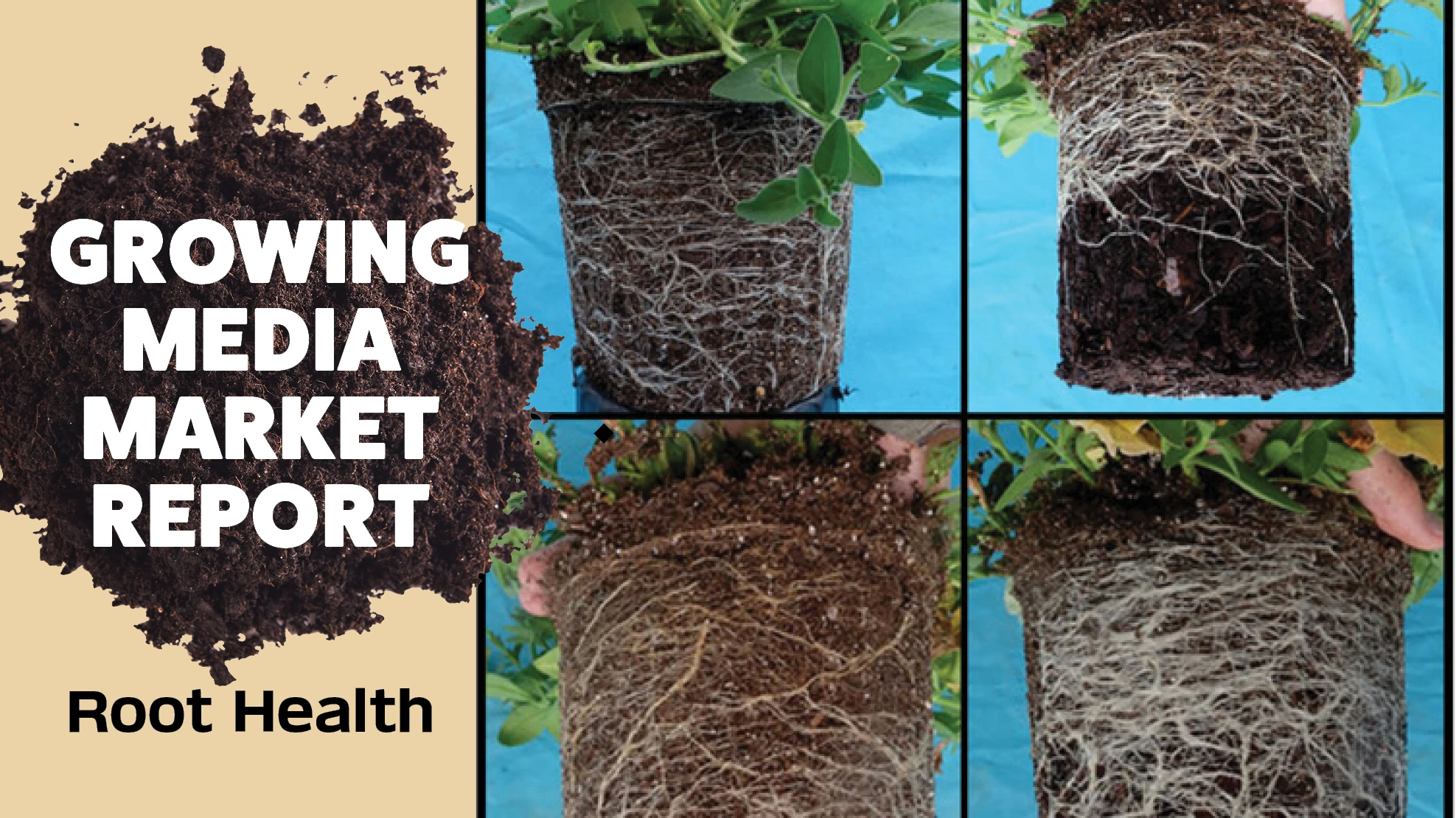
Stratified-grown roots establish out of the plug quickly. However, when roots begin exploring a stratified container, they take their time by growing in a more “scenic route.” The finer-textured substrates and improved water availability in the upper strata result in a unique sequential pattern of root growth. Stratified-grown roots grow layer by layer, growing laterally to fully explore the upper strata volume (Figure 3).
Roots emerging from the plug are not immediately signaled to search for resources; instead, the improved moisture uniformity encourages an outward growth habit, similar to establishment in the landscape. We’ve measured double the root biomass in the top stratified layer in some studies and triple the root growth throughout the entire container.
Roots in the top half of the stratified container are thinner, with more fine root length. Fine roots are cheaper to build by the plant and sharply increase the exploration surface area. Remember, fine roots account for nearly all water and mineral nutrient uptake by plants.
Since these fine roots are growing in a resource-abundant environment, it facilitates continuous root elongation, with a reduced need to thicken. This is advantageous for growers, as we conventionally apply resources “top-down,” with irrigation and fertilizer coming from above.

substrates. Notice the “sequential rooting”
that occurs, but in the end, the stratified
root systems are fuller and higher quality.
In other words, stratified substrates stimulate root growth where first contact with water and fertilizer occurs and in locations engineered to store more water and mineral nutrients and enhance root-substrate contact. This allows quick capture of mineral nutrients, improving nutrient efficiency and reducing waste.
This explains the improved root growth in the top, but what about the bottom? We attribute the improved lower strata rooting to the reduced perched water table and faster oxygen supply to the lower container layers, where oxygen deficiency commonly occurs. When coarser substrate materials are used, we observe an overall shift in root thickness. These thicker roots improve carbon storage, water and nutrient transport and structural support.
We often take the plant out of the container to monitor root health and gauge salability. While stratified-grown roots may take longer to get to the bottom, they fill the container faster. This added time to the bottom is worth the wait. Stratified systems can produce stronger plants with greater biomass in a similar timeframe. Stratified substrates have further been observed to improve overall success of transplants.
We have achieved a better understanding of how roots grow in stratified substrates. Armed with this knowledge, we can start to engineer our container roots by manipulating their environment.
Root engineering will allow growers to manage their resources more efficiently. Increasing root biomass can help with establishment in the landscape. Improving root morphology can aid with efficient resource uptake. Faster and stronger establishments can result in shorter production times. A healthier root system means a better-quality plant.
More from the Growing Media Market Report:
From the Sponsor: A shared passion for growth

Explore the July 2025 Issue
Check out more from this issue and find your next story to read.
Latest from Greenhouse Management
- Blue Grass Farms acquires Brehob Nursery
- OHP expands sales team with new hire and internal promotion
- Seed Your Future aims to double 2025 total for 'Round-Up at the Register' 2026 campaign
- Beacon Impatiens partners with Roots for Youth in 2026
- Inner visions
- New internship data empowers horticulture employers
- American Horticultural Society announces winners of 2026 Great American Gardeners Awards
- Sustainabloom releases new sustainability template for wholesale florists