Editor's Note: This article originally appeared in the July 2025 print edition of Greenhouse Management under the headline “Strong foundation.”

The quality and management of your growing media significantly influences crop outcomes. Here’s a concise guide to effectively handling growing media and navigating common issues.
Use growing media promptly after blending or delivery
Growing media does not spoil; however, it changes over time. Aged growing media may undergo nutrient depletion, activation of limestone or degradation of wetting agents. Microorganisms in the growing media can degrade wetting agents or consume nitrogen and iron from fertilizer charges, potentially slowing plant growth. These changes are exacerbated by high-temperature storage. Use packaged growing media within 12 months of the manufacturing date shown on the package. Keep records if you make your own.
Adjust watering techniques when switching growing media
Select a growing medium with similar water retention and drying characteristics to lessen the learning curve. Also consider the impacts on your fertility program, pH levels and applications of plant growth regulators. Changing growing media is not the solution for every growing issue.
Understand the starter fertilizer charge
Most growing media include a starter fertilizer designed to promote initial plant growth, typically lasting one to two weeks, depending on water application frequencies, plant uptake and age of the growing medium. Some growers apply water-soluble fertilizer immediately after planting, while others wait a few weeks. If you immediately fertilize an old growing medium, adjust the nutrient levels to account for nutrient loss.
Verify the pH
Sphagnum peat moss, used in most growing media, has a naturally acidic pH of 3.5 to 4.5. Manufacturers add limestone to raise the pH to 5.5 to 6.2. Depending on the type of limestone and the substrate’s moisture, it can take up to three weeks to obtain the desired pH. To determine the true starting pH and verify the pH rises to the normal range, saturate a sample of growing medium with deionized water and take pH readings on days 1, 3 and 7.
Don't panic over mold growth on surface
These molds do not harm plants; they feed on dead organic matter such as bark, compost, coir or peat moss. More common in high-humidity or stagnant air environments, mold growth rarely persists in the typically dry and well-ventilated conditions of a greenhouse.
Get rid of offensive odors
Occasionally, growing media — especially bulk products or those sealed in plastic — may emit unpleasant odors due to anaerobic microorganisms naturally found in organic components such as peat moss or bark. Opening the package will introduce oxygen, causing these anaerobic microorganisms to go dormant, and the odors should dissipate within days. Watering also helps leach out odor-causing byproducts.
Prevent uneven growth
Uneven crop growth can result from fertilizer charge loss or inconsistencies, or the inconsistent size of media components. This often creates a wavy appearance in seedlings or trays. To prevent this, apply 25 to 100 ppm nitrogen fertilizer immediately after seeding or transplanting. Additionally, ensure the fertilizer injector is functioning correctly and the stock solution was properly mixed.
Select a growing medium that dries properly
If your growing medium remains too wet, especially early in the crop cycle during cloudy, cool weather, consider using a high-porosity or bark-based medium. Install horizontal airflow fans to promote dry down of the medium surface. Elevate plants on benches to improve airflow and regulate root-zone temperature. Reduce the number of hanging baskets above the crop to limit shading and humidity.
Discourage algae growth
Algae often originate from irrigation water, especially from ponds or lakes. Algae require light, nitrogen and water to thrive, just as plants do. To control algae without affecting the plants, minimize the time the media surface stays wet between waterings. You can also opt for faster-drying growing media or apply peroxide-based drenches to control algae growth.
Remove weeds inside and outside the greenhouse
Weed seeds, rarely introduced through growing media, often blow into greenhouses during the summer or fall, settling in soil mixers, planting benches, fan jet tubes or attaching to supplies stored outdoors. Remove or mow all weeds near greenhouses and clear weeds under benches to prevent seed production that could contaminate next year’s crops.
More from the Growing Media Market Report:
From the Sponsor: A shared passion for growth
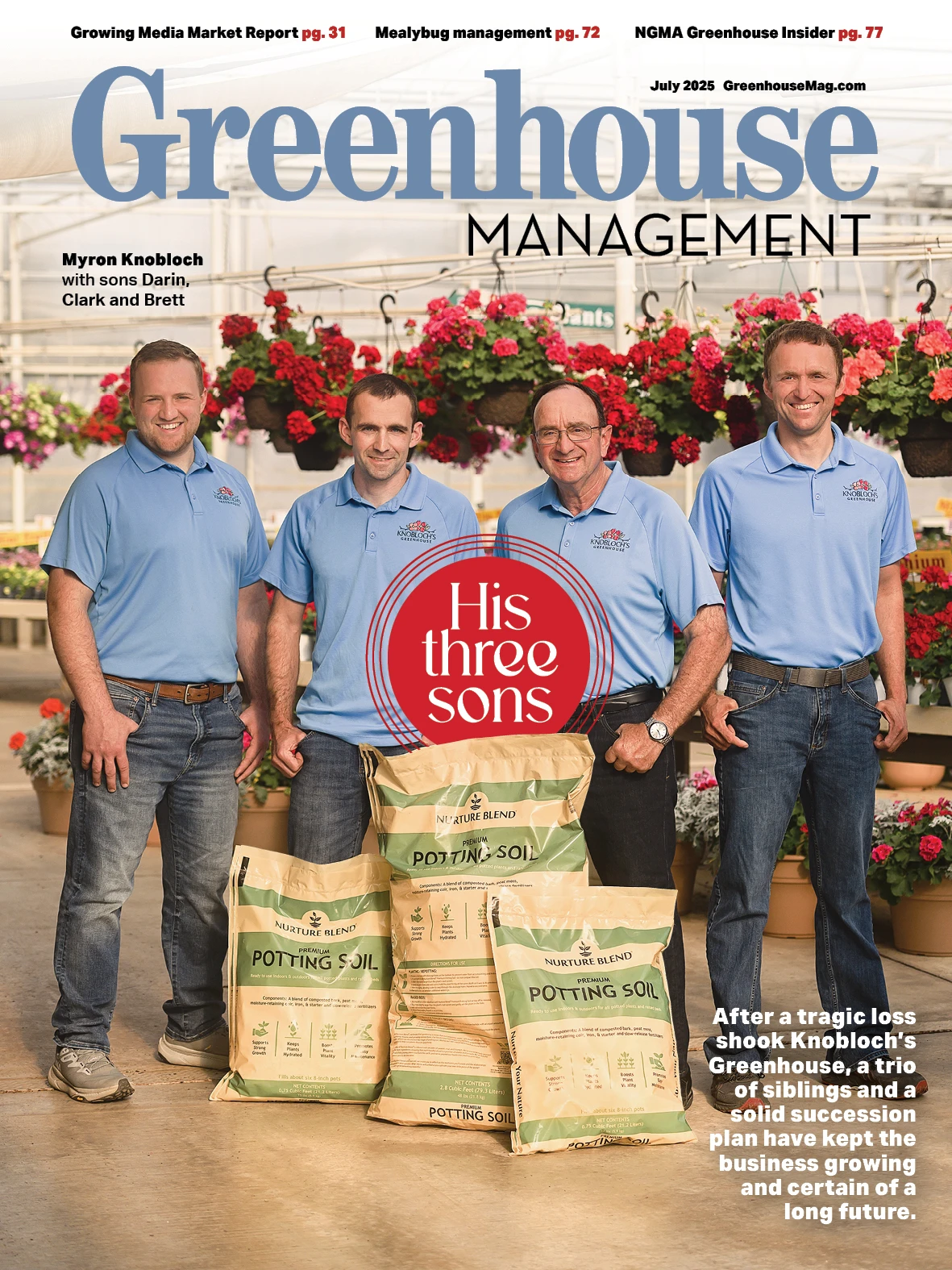
Explore the July 2025 Issue
Check out more from this issue and find your next story to read.
Latest from Greenhouse Management
- Blue Grass Farms acquires Brehob Nursery
- OHP expands sales team with new hire and internal promotion
- Seed Your Future aims to double 2025 total for 'Round-Up at the Register' 2026 campaign
- Beacon Impatiens partners with Roots for Youth in 2026
- Inner visions
- New internship data empowers horticulture employers
- American Horticultural Society announces winners of 2026 Great American Gardeners Awards
- Sustainabloom releases new sustainability template for wholesale florists