In commercial greenhouses, several strategies can be used to help properly manage light levels throughout the day and seasonally.
Some of the primary reasons why greenhouses manipulate light levels include temperature and irrigation management, photoperiod control, minimizing crop stress and optimizing photosynthesis.
Supplemental lighting can increase the light intensity a crop receives and improve and accelerate its growth and development. Retractable shade curtains and whitewash can reduce and scatter light intensity to create a more desirable growing environment during high-light periods.
Measuring light
Until recently, the most common units for measuring light are the foot-candle (primarily in the United States) and lux (primarily in Europe). It is important for growers to understand the limitations of these units. Both units provide an instantaneous light intensity at the time the reading is taken.
As we all know, natural light levels are continuously changing, and a single measurement in time does not accurately represent the amount of light a plant has received in a day. Just as important, foot-candles are “photometric” units based on the amount of visible light detected by the human eye (primarily green light). That means foot-candles are focused on people and not appropriate for indicating plant photosynthesis.
Today, most growers measure instantaneous light in micromoles (μmol) per square meter (m-2) per second (s-1), or: μmol·m-2·s-1 of photosynthetically active radiation (PAR). This “quantum” unit quantifies the number of photons (individual particles of energy) used in photosynthesis that fall on a square meter (10.8 square feet) every second. However, this light measurement also is an instantaneous reading.
Daily light integral
Daily light integral (DLI) is the amount of PAR received each day as a function of light intensity (instantaneous light: μmol·m-2·s-1) and duration (day). It is expressed as moles of light (mol) per square meter (m-2) per day (d-1), or: mol·m-2·d-1 (moles per day). The DLI concept is like a rain gauge. Just as a rain gauge collects the total rain in a particular location over a period of time, DLI measures the total amount of PAR received in a day. Greenhouse growers can use light meters to measure the number of light photons that accumulate in a square meter over a 24-hour period.
James Faust and his colleagues developed (and updated) maps of monthly outdoor DLI throughout the United States. These maps illustrate how latitude, time of year, length of day (photoperiod) and cloud cover influence DLI and vary from 5 to 60 mol∙m-2∙d-1. Access the maps here.
Click on a location in the map to open a table with annual and monthly values. In a greenhouse, values seldom exceed 25 mol∙m-2∙d-1 because of greenhouse glazing materials and superstructure, the season (which affects the sun’s angle), cloud cover, day length (photoperiod), shading and other greenhouse obstructions, such as hanging baskets.

The importance of DLI in greenhouse production
DLI is an important variable to measure in every greenhouse because it influences plant growth, development, yield and quality. For example, DLI can influence the root and shoot growth of seedlings and cuttings, finish plant quality (characteristics such as branching, flower number and stem thickness) and timing.
Commercial growers who routinely monitor and record the DLI received by their crops can easily determine when they need supplemental lighting or retractable shade curtains. This is especially true for growers in northern latitudes, where the majority of crops are propagated from December to March and naturally occurring outdoor DLI values are between 5 to 30 mol·m-2·d-1.
Furthermore, these values can be 40 to 70% lower because of shading from greenhouse glazing, structures and hanging baskets. These obstructions can result in an average DLI as low as 1 to 5 mol·m-2·d-1. There are devices that automatically measure and calculate the DLI your greenhouse crops are receiving.
Another method to measure DLI is to use a light quantum sensor connected to a data logger or computer. The sensor measures instantaneous light intensity (preferably in µmol∙m-2∙d-1) at some defined interval (such as once every 15 to 60 seconds), which allows you to calculate DLI.
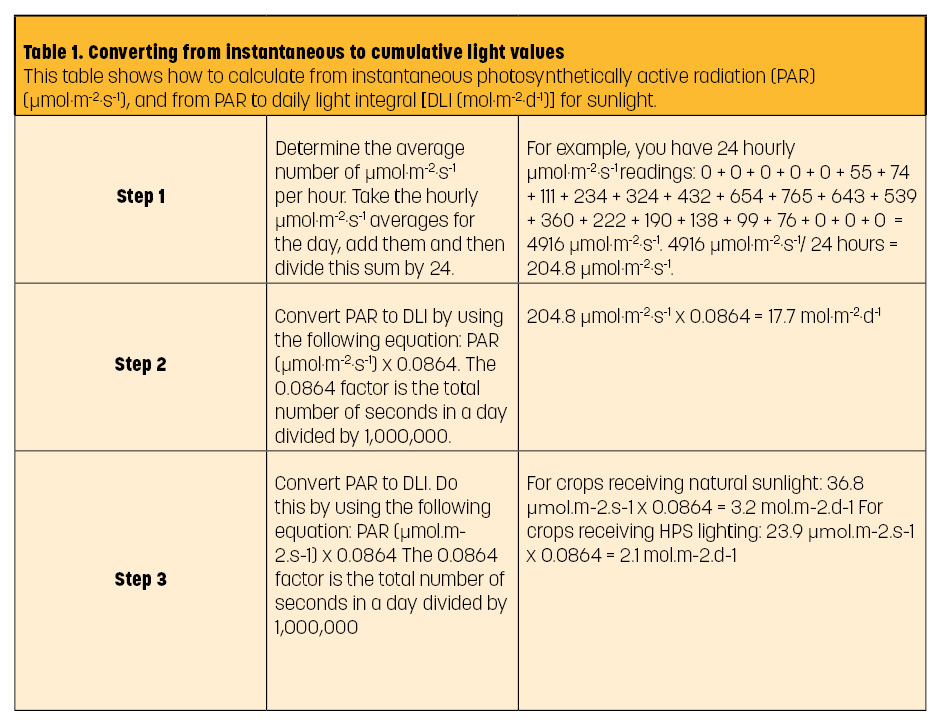
Table 1 provides DLI calculations based on average hourly μmol·m-2·s-1 of PAR measurements. No matter which sensors you use, it is important to keep all light sensors level and clean to assure accurate readings.
DLI recommendations
Plants grown under light-limiting conditions (a low DLI) typically have delayed growth and development. Research conducted at Michigan State University indicated that maintaining a DLI between 4 to 11 mol·m-2·d-1 during stage 2 (callusing) and stage 3 (root development) accelerates propagation of petunia and New Guinea impatiens cuttings.
Experiments with these petunias and New Guinea impatiens have shown that, as propagation DLI increases, rooting, biomass accumulation (root and shoot growth) and quality (reduced stem elongation) generally increase, while subsequent time to flower generally decreases.
Similarly, experiments with seedlings of celosia, impatiens, salvia, marigold and viola showed that quality parameters at transplant increased when DLI increased up to 12 mol·m-2·d-1.
Based on this research, we recommend that greenhouse growers provide a minimum of 10 to 12 mol·m-2·d-1 of light during the finishing stage to produce many shade-intolerant floriculture crops.
But remember, DLI requirements differ among greenhouse crops. Some growers separate their floriculture crops by DLI requirements. Crops with a DLI requirement of 3 to 6 mol·m-2·d-1 are considered low-light crops, 6 to 12 mol·m-2·d-1 are medium-light crops, 12 to 18 mol·m-2·d-1 are high-light crops and those requiring more than 18 mol·m-2·d-1 are considered very high-light crops.
More from the 2025 Lighting Market Report:
From the Sponsor: Growing together
Explore the August 2025 Issue
Check out more from this issue and find your next story to read.
Latest from Greenhouse Management
- Blue Grass Farms acquires Brehob Nursery
- OHP expands sales team with new hire and internal promotion
- Seed Your Future aims to double 2025 total for 'Round-Up at the Register' 2026 campaign
- Beacon Impatiens partners with Roots for Youth in 2026
- Inner visions
- New internship data empowers horticulture employers
- American Horticultural Society announces winners of 2026 Great American Gardeners Awards
- Sustainabloom releases new sustainability template for wholesale florists