Editor's Note: This article originally appeared in the September 2025 print edition of Greenhouse Management under the headline “Job loss or job growth?.”

The AI & Advanced Robotics Working Group convened by the Resource Innovation Institute has reached a clear consensus: The controlled environment agriculture industry won’t face major workforce reductions in the coming decade. It is more likely that some CEA operations will disappear due to labor shortages than that jobs will disappear due to AI or advanced robotics.
AI technology will enhance grower capabilities rather than eliminate positions, allowing experienced staff to oversee expanded production areas. While future expansion projects may require fewer new hires due to these productivity gains, existing growers can expect job security. The technology serves as a force multiplier for skilled greenhouse professionals rather than a replacement.
Other reports contradict this finding. According to a 2023 European Parliamentary Research Service report, “For untrained workers or farmers, automated technologies may bring risks or diminished job opportunities.”
The RII working group believes that hourly employees will generally be shifted away from repetitive tasks that have been robotized toward plant care tasks that improve quality, facility maintenance tasks or sanitation tasks for food safety. Growers and managers say that these tasks could improve operations and quality, yet they often go undone.
Many workers will prep areas for robot use, much like many homeowners clear the clutter before running their robotic vacuums. Some will help train and maintain robotic systems and may take that training to work for robotics companies that serve CEA operations. Likewise, AI companies will create entry-level jobs, such as installing and maintaining smart sensors and helping collect, label or analyze data from IoT systems.
We have seen this before in traditional agriculture. History supports this transition of jobs shifting to a new sector of the same industry. As mechanized farming reduced the need for manual farm labor, many farmworkers transitioned into roles in agribusiness, machinery maintenance and agricultural technology.

Growing pains
While AI and robotics offer promising solutions for greenhouse operations, industry leaders should prepare for implementation challenges that could undermine these benefits. AI and advanced robotics will not be a panacea for the industry’s labor challenges — things will go wrong, and growers risk trading familiar labor headaches for unfamiliar technology headaches.
The human element presents particularly complex hurdles. Foisting new technology on workers who may not trust the motive, or may not feel comfortable around automated systems, will likely create resistance that hampers productivity gains. Similarly, experienced growers who have relied on their instincts for years may resist relinquishing control to AI-enhanced systems. Hourly workers may interpret the arrival of robots as a judgment on their work quality or productivity, breeding resentment rather than cooperation.
Even willing adopters face practical frustrations. Workers may grow impatient with the extensive training periods and lengthy setup processes that robotics require. The robots’ methodical but slow pace for most tasks can test patience when urgent production deadlines loom. These implementation realities suggest that successful automation requires as much attention to change management and worker integration as it does to the technology itself.

Potential benefits
Below are some compelling reasons for considering AI and advanced robotics to alleviate some of the production challenges from labor shortages and work conditions:
- Improved uniformity of decision-making and task completion.
- Improved product quality through timely, uniform completion of cultivation tasks.
- Improved accuracy of counting tasks like inventory count and IPM scouting.
- Improved employee satisfaction from reduced drudgery and repetitive tasks.
- Improved learning rate for young growers.
- Improved recruitment of young workers who want to work with cutting-edge technology.
- Improved worker productivity and retention by making work lighter and more interesting.
- Improved worker health by avoiding back injuries from bending, lifting and carrying.
- Improved worker health by avoiding heat stress in hot, humid greenhouses.
- Improved worker eye health by reducing the strain of close inspection during IPM scouting.
- Improved worker health by reducing cutting injuries from prolonged use of sharp tools.
- Improved disease detection prior to being visible to humans.
- Reduced exposure to pesticides by using robotic sprayers and UV units.
- Reduced crop loss from pests.
The rise of the cobots: 'Take the robot out of the human.'
Collaborative robots, or cobots, represent a middle ground between fully manual and fully automated operations. While the promise of complete automation captures headlines, the reality is that many agricultural tasks remain too complex for robots alone. This is where human-robot collaboration offers practical advantages.
Simply put, cobots let humans and machines each do what they do best. Humans excel at perception, quick decision-making and adaptive problem-solving — particularly in complex, variable environments like a greenhouse. Robots excel at repetitive tasks, heavy lifting and consistent operation without fatigue. When properly coordinated, these complementary strengths can enhance both productivity and working conditions.
Consider the example of selective harvesting: Robots work through the night harvesting the easily accessible fruit — about 80% of the crop — while human workers perform the complex picking the next morning but finish before the afternoon heat sets in. This task-sharing approach maximizes productivity while playing to each partner’s strengths. Similarly, in sanitation tasks, robots can handle regular cleaning of open floor spaces and tables or benches, while humans focus on hard-to-reach areas and detailed cleaning that requires dexterity.
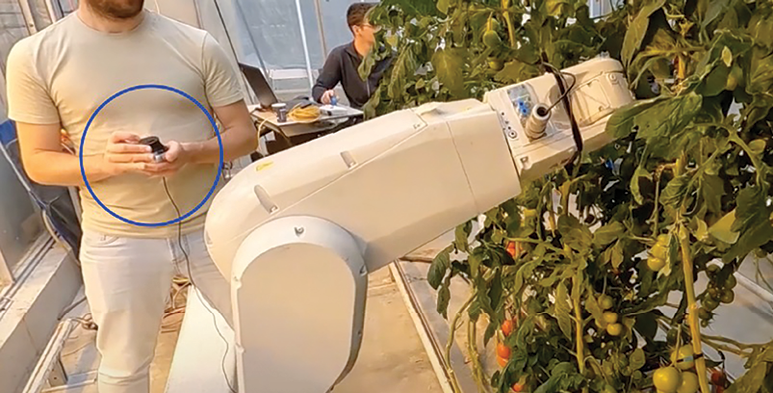
In one fascinating example in a research setting, the training of a robotic system was assisted through human demonstration. Also called “imitation learning,” human operators physically guide the robot through desired movements using a controller. This demonstrates how to choose the best path to the desired object, such as a fruit.
Virtual reality interfaces allow operators to demonstrate complex tasks in a safe, virtual environment before the robot attempts them in the real world. This combination of human insight and robotic precision is proving particularly valuable for complex tasks like selective harvesting.
The benefits of collaboration extend across many cultivation tasks. For example:
Robots scan upper leaf surfaces and monitor sticky traps for pests, while humans inspect leaf undersides where insects often hide.
Humans prepare growing areas for robotic operations.
Robots handle repetitive monitoring and data collection while humans interpret complex patterns and make strategic decisions.
But implementing cobots is not without challenges. Success requires careful consideration of:
- Safety protocols for human-robot interaction
- Coordination between human and robot work schedules
- Training programs for workers to effectively complement robot operations
- Clear protocols for task hand-offs between humans and machines.
Current research shows that human-robot teams can achieve better results than either humans or robots working alone, particularly in variable environments like CEA. While a human might tire after hours of repetitive work and a robot might fail at complex tasks, a collaborative approach maintains both consistency and adaptability.
Looking ahead, cobot integration offers a practical pathway toward increased automation. Rather than waiting for perfect robotic solutions, operations can begin implementing collaborative systems today, gaining benefits now while building future capabilities. As artificial intelligence and robotics continue to advance, these human-robot partnerships can evolve naturally, with robots gradually taking on more complex tasks as their capabilities improve.
For CEA operators considering automation, starting with collaborative solutions may provide the most realistic path forward. The key is setting appropriate expectations. Cobots will not eliminate the need for skilled labor, but they can make that labor more effective and less physically demanding. This balanced approach acknowledges both the power and limitations of current technology while delivering real benefits to greenhouse operations.
Rob Eddy is the horticulture manager at the Resource Innovation Institute; Bryce Carleton is manager of market development at RII; and Shreyas Kousik, Ph.D., is an assistant professor at the Georgia Institute of Technology. Contact Eddy at rob@resourceinnovation.org.

Explore the September 2025 Issue
Check out more from this issue and find your next story to read.
Latest from Greenhouse Management
- Blue Grass Farms acquires Brehob Nursery
- OHP expands sales team with new hire and internal promotion
- Seed Your Future aims to double 2025 total for 'Round-Up at the Register' 2026 campaign
- Beacon Impatiens partners with Roots for Youth in 2026
- Inner visions
- New internship data empowers horticulture employers
- American Horticultural Society announces winners of 2026 Great American Gardeners Awards
- Sustainabloom releases new sustainability template for wholesale florists