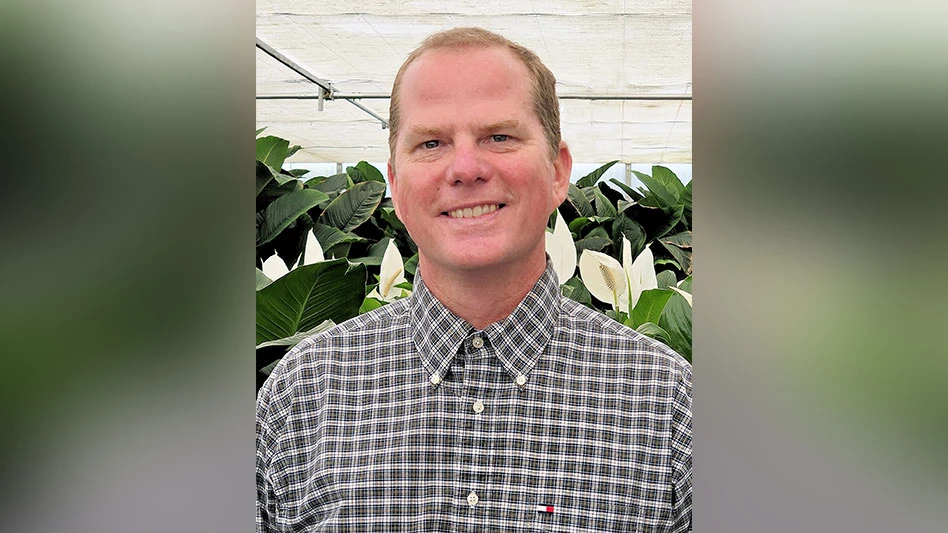
Editor's Note: This article originally appeared in the January 2026 print edition of Greenhouse Management under the headline “Amy Padolf.”

This year, Amy Padolf, director of education at Fairchild Tropical Botanic Garden, received the American Horticultural Society’s Jane L. Taylor Award. The achievement honors an individual who inspires and nurtures future horticulturists through efforts in youth gardening.
Padolf pioneers educational initiatives like the award-winning Fairchild Challenge, which engages more than 125,000 students in STEM-based programs.
Other contributions include launching the Million Orchid Project dedicated to the flowers’ conservation and Growing Beyond Earth, a research project collaborating with NASA in support of indoor agriculture.
We caught up with the educator for a few questions about the impact of her work.
Anthony Elder: Your work involves connecting with botanists, horticulturists and students of all ages. How do you make it work?
Amy Padolf: It’s all about authentic experiences. The Fairchild Challenge, a multidisciplinary environmental science competition, has been around for 25 years, and it’s for kindergarten through grade 12. At each level, these kids are engaging in programs that have them thinking about their place in nature, specifically around plants.
We work with scientists at Fairchild but also scientists at local universities and nationally where we have these students engaged in being a part of actual research projects. Right now, we have about 400 schools locally and probably about 100,000 students every year participate in this. We’re giving them the opportunity to think of their role in their environment.
AE: What about initiatives within indoor farming?
AP: Growing Beyond Earth is a program where the students are testing edible plant varieties to feed astronauts for long-distance-based travel. And all the data that they’re collecting is being shared with NASA scientists, so the NASA scientists can determine what they’re going to grow next. And the beauty of that is that we have kids doing indoor agriculture from the time they’re in sixth grade.
AE: What does that look like for the kids?
AP: The idea is that we’re testing all kinds of different varieties of plants to figure out which are the most robust, that will grow the best on the International Space Station to augment the astronauts’ diets. It’s not supposed to be all of their food. It’s supposed to augment their diet because there’s not enough space to grow enough to feed them.
What we’re testing is indoor agriculture with gravity issues, things that grow well in small spaces under LED lighting with high vitamin content, because the astronauts’ diets lose vitamin content over a long period of time. And there is also a social-emotional component for the astronauts — that connection back to Earth. It’s something for them to care for.
We’ve tested probably about 275 different varieties of plants. And that’s the point of Growing Beyond Earth: We’re doing all of the replications that NASA doesn’t have the time or the person power to do. And the NASA scientists are taking all that data and then shortlisting the things that would be good candidates for them to test at Kennedy Space Center.
AE: Do you see any way to connect the work you’re doing with NASA to the broader greenhouse industry?
AP: Oh, yeah. It’s infinite, right? (Growing Beyond Earth) is one thing that allows us to think about indoor agriculture and about different ways of growing things. Our issues are not just about varieties; they’re also about ways to grow the technology of food production. NASA funded our makerspace that is dedicated to the technology of food production.
So, we use 3D printers and CNC machines so we can look at how we’re growing things and then test it out. Water delivery is an issue that we’re playing with in tandem with fertilizer placements. But mostly what we’re doing is testing crops and different varieties of plants.
Explore the January 2026 Issue
Check out more from this issue and find your next story to read.
Latest from Greenhouse Management
- Jackson & Perkins expands into Canadian market
- Green & Growin’ 26 brings together North Carolina’s green industry for education, connection and growth
- Marion Ag Service announces return of Doug Grott as chief operating officer
- Cincinnati Zoo & Botanical Garden debuting new perennial section at 2026 Breeder Showcase
- The Garden Conservancy hosting Open Days 2026
- Registration open for 2026 Perennial Plant Association National Symposium
- Resource Innovation Institute and North Dakota State University explore co-location of data center and greenhouses
- Fred C. Gloeckner Foundation Research Fund calls for 2026 research proposals