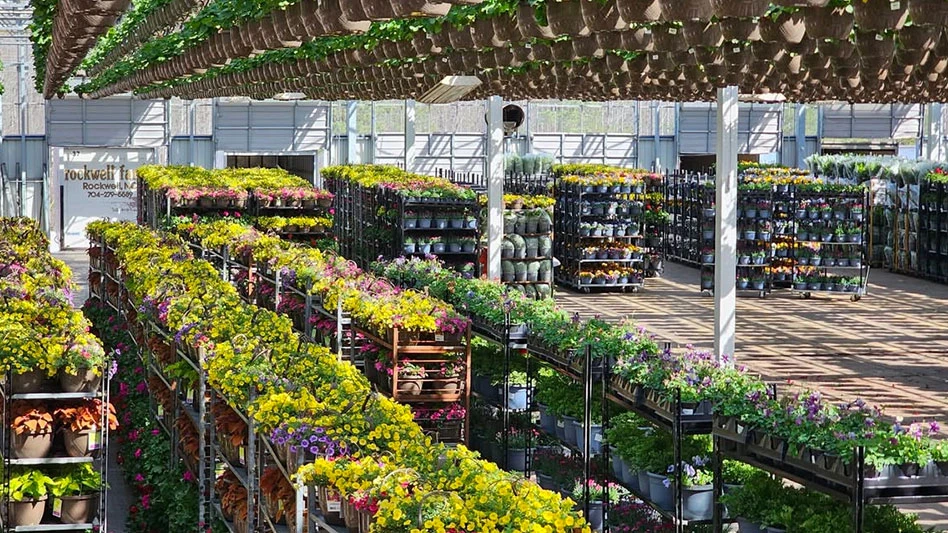
Photo courtesy of Rockwell Farms
Unpredictable weather is often cited as a grower’s top concern, and it's not an aspect of production that can be controlled.
Mima Stoeva, VP of horticulture for Rockwell Farms, was looking for a product to help protect her crop of 80,000 to 100,000 1.5-gallon calibrachoa hanging baskets that move outside around week 10. Heavy rain and freezing conditions are all possibilities that time of year in Rockwell, North Carolina, which is just northeast of Charlotte.
Stoeva first turned to Profile Products, whom she has worked with for the past 10 years, for solutions. Her first introduction to the North Carolina-based company was when she began using HydraFiber substrate, which has helped Rockwell Farms enhance root development, produce uniform growth and improve plant quality.
Stoeva had also used Florikan Nutricote controlled-release fertilizer for more than five years for Rockwell’s mum production, working with the team at Profile Products on trials to get the rate just right, and the results consistently met expectations. During 2025 spring production, Stoeva expanded the use of Nutricote, part of the Florikan line of controlled-release fertilizers, on a trial of 10,000 calibrachoa hanging baskets that finish outdoors. The goal was to ensure plants had consistent nutrient availability, no matter what Mother Nature had in store.
 Rockwell Farms first used Florikan Nutricote for its mum production. Photo courtesy of Rockwell Farms
“Almost every year, shortly after we transition plants outdoors, the temperature drops below freezing,” says Stoeva, who oversees 31 acres of outdoor production, in addition to 41 aces of controlled environment greenhouses. “To protect crops, we rely on an overhead sprinkler system to prevent frost damage. In some cases, when the cold period lingers for several days, the sprinklers may run continuously for two or even three days.”
Whether it’s raining or the sprinklers are running, excessive moisture can leach out precious nutrients, posing a challenge for young, developing plants. For the trial, the goal was to reduce the reliance on liquid fertilizer and ensure a consistent supply of nutrients during all weather conditions.
Partnering with Profile Products, Stoeva incorporated a trial of relatively low rate of Florikan Nutricote controlled-release fertilizer (CRF) to start, says Michael Moore, southeast regional sales manager for Profile Products.
“Let’s start with a useful rate of CRF that won’t eliminate the use of water-soluble but hopefully can reduce it by 25%, so we came in and proposed a CRF rate of 2 pounds per cubic yard, with the aim of reducing water-soluble by 25%,” Moore says.
He likens Nutricote to an insurance policy not only against inclement weather, but also if there’s a faulty injector or bad valve in a fertigation system.
They compared two blocks of 10,000 plants, one using Rockwell’s current regime — continuous liquid feed on average four times a week with liquid water-soluble fertilizer — and the other incorporating Florikan Nutricote 18-6-8 and only using water-soluble once a week.
“They monitor pH and EC every week and adjust liquid fertigation accordingly. They were able to skip water-soluble fertilizer for about three weeks in a row, because the ECs were getting a little high on the plants treated with Nutricote,” Moore says. “We were actually able to reduce water-soluble by 70% with just 2 pounds per cubic yard as the rate. It was just a phenomenal, perfect storm in favor of CRF and weather.”
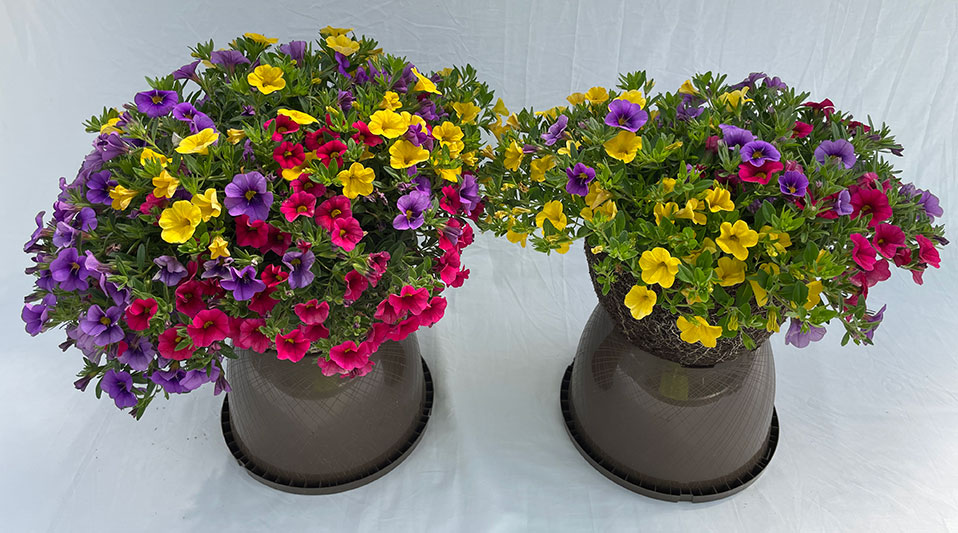 Comparison of calibrachoa hanging basket with Florikan Nutricote (left) and without (right.) Photo courtesy of Profile Products
For Stoeva, the results were clear: Plant growth and development improved, with no signs of nutrient deficiency throughout the trial.
“The plants treated with Nutricote were visibly stronger and more vigorous than the untreated group,” Stoeva says. “It’s been a completely positive experience.”
By using Nutricote, there were also labor savings by reducing the amount of fertilizer stock solution that needed to be mixed.
Though the plants were scheduled to ship in weeks 16 and 17, they were ready earlier than expected.
“Plants were more advanced, not only in size and development, but also in flowering,” Stoeva says. That might partially be thanks to better weather conditions this spring compared with in the past. “We saw the plants treated with Nutricote were at least a week or 10 days earlier ready to ship than with the liquid fertilizer. We can definitely reduce our crop production time in the future.”
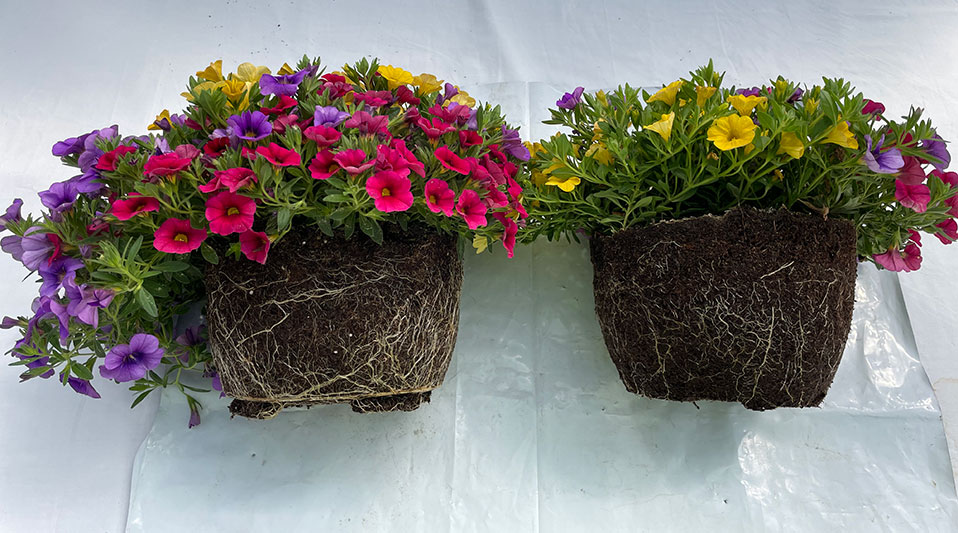 Root development in calibrachoa treated with Florikan Nutricote (left) was more advanced when compared to plants only receiving liquid fertilizer. Photo courtesy of Profile Products
Next year, Rockwell also plans to use Nutricote on all outdoor calibrachoa hanging basket production, conduct another trial with a higher rate of CRF, evaluate plant performance, and try to fine-tune the outdoor calibrachoa production to finish it without liquid fertilizer.
“At Rockwell Farms, we take a measured approach when introducing any new input,” Stoeva says. “We always start with small-scale trials and evaluate performance. It’s much easier to increase a rate or expand usage than to correct for over-application. We rely on proven results before scaling up.”
Given the scope of production —which includes 5.3 million spring annual unrooted cuttings, 1 million garden mums and 500,000 poinsettias annually — careful validation is essential to ensure quality, consistency and efficiency at every stage of the growing process.
For Stoeva, Profile Products consistently demonstrated reliability and a strong commitment to grower success.
Stoeva and the team at Rockwell have worked together for the past decade, when Rockwell initially began working with HydraFiber. The transition from traditional substrates to a wood fiber-based mix brought an initial learning curve, requiring adjustments in both growing techniques and nutrient management.
“Getting the lime rate dialed in was one of the biggest challenges early on,” Stoeva recalls. “It took time to understand how the substrate behaves and how to adapt our practices accordingly.”
Despite those early hurdles, the long-term benefits have been clear: HydraFiber has continued to improve root development and produce more uniform growth and enhanced plant quality.
“The substrate’s excellent air-to-water ratio supports strong root systems, while its consistent structure provides better control over irrigation and fertility struggles,” Stoeva says. “Now that we’ve fine-tuned our approach, growing in HydraFiber has become second nature, and it’s allowed us to produce higher-quality plants more efficiently and with greater consistency across crops.”
The established trust in both product efficacy and support has been a constant in Rockwell Farms' work with Profile Products.
“They’ve been an incredibly supportive partner — always willing to trial, adapt and find solutions that work,” she says. “Their team is knowledgeable, responsive and genuinely invested in helping us succeed. It’s been a pleasure working with such a professional team.”