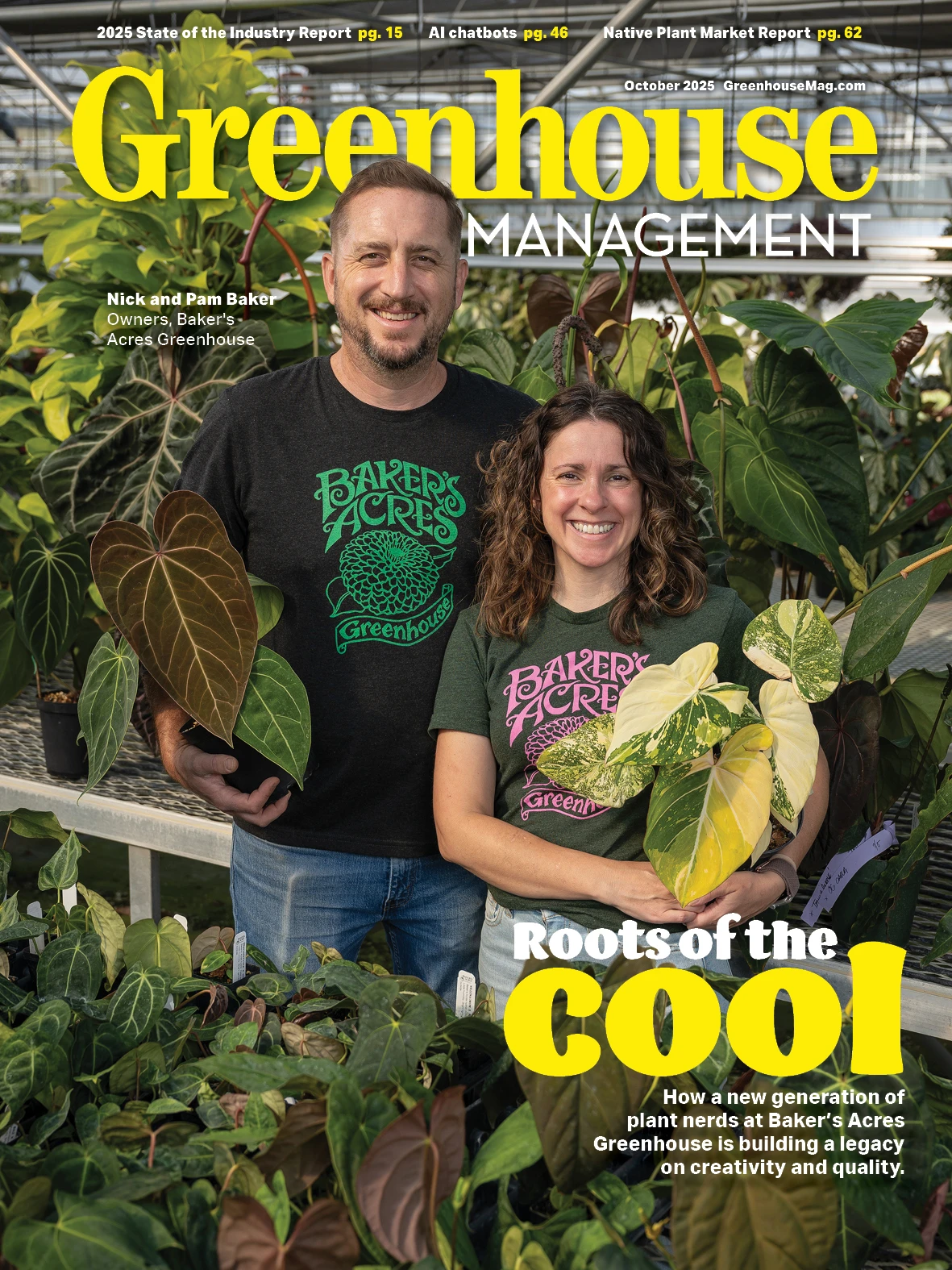
Editor's Note: This article originally appeared in the October 2025 print edition of Greenhouse Management under the headline “Roots of the cool.”

Chris Baker drove a cab. As a young man in the 1970s, it was not the occupation to which he aspired. He had majored in music. Driving was just the job that supported him as he worked toward a big break as a rock star.
But everything changed in a moment one day when he picked up a fare and suddenly found himself in grave danger. It was a holdup.
“I felt the gun in my ear,” Chris remembers, holding a pointer finger up to his head.
Being at the wrong end of a firearm while doing a job he took just to pay the bills was both harrowing and transformative. He made it safely through the experience, but it changed the trajectory of his and his future family’s lives. “I thought to myself, ‘Maybe I’ll go do something else,’” he recalls.
That “something else” was a job at Engel’s Greenhouse, a now-closed 7-acre wholesale plant grower in Columbus, Ohio. It was a much better fit than driving a cab. After all, Chris had grown up in a household oriented toward the garden.
So, in 1982, after gathering some experience, Chris and his wife, Nancy, decided to get into the garden business by finding some land and starting a greenhouse of their own. Then again, that story is the subject of some spousal dispute.
“She claims she got into the business by ‘marrying incorrectly,’” Chris jokes.
That kind of quip is emblematic of the lighthearted identity of the venture they founded, a sprawling retail growing operation in Alexandria, Ohio, right in the rural heart of the state, that they dubbed Baker’s Acres Greenhouse. In 2024, Chris and Nancy passed ownership of the business to their son, Nick, and his wife, Pam, who now oversee the operations of the 7-acre property featuring 15 greenhouses and 10,000 square feet of retail.
The company continues to thrive thanks to the business values the first Bakers instilled and the new Bakers continue to support while adding their own unique spice. The result is a growing operation and garden center steeped in a sense of playfulness, a deep love for the most unique and interesting flora, and a commitment to cultivating the highest-quality material garden consumers and plant enthusiasts could possibly want.

Growing up greenhouse
Nick Baker grew up with the greenhouse. There was no choice, really. The family lived in a lovely two-story home just feet from the operation. In fact, the business and house were so inextricably linked that employees would take breaks in the family kitchen, and sometimes-confused customers would be rung up in the living room.
Living on top of the business meant Nick saw his father working almost continuously. It was too easy to be called out of the house to deal with a boiler emergency or simply wander to the greenhouse to work with the plants.
And when Nick walked out the front door, he stepped into Baker’s Acres. When he was old enough to provide meaningful labor, he worked in the greenhouses until he graduated. But despite having been brought up in the daily hustle and bustle of Baker’s Acres, staying with the operation wasn’t necessarily on his radar.
“It was just something my parents did,” Nick says. “I always liked it, but it just never sparked too much interest.”
Instead, he moved to Columbus and enrolled in college. But within a couple of years studying “various things,” Nick discovered that higher education wasn’t his thing. So, he left and pivoted to bartending.
The upside to pouring pints and slinging drinks in the college town was meeting Pam. She was a regular at the Out-R-Inn, an unassuming dive bar just off The Ohio State University’s campus where Nick worked. After graduating with a degree in fashion merchandising, a soft job market found Pam working at the Out-R-Inn beside Nick. Love blossomed among the beer mats, and the two began dating.
Around 2007, Chris and Nancy Baker started thinking about retirement. At the same time, Nick was thinking about the future. It made sense to come back to the business, particularly because he could start out in a newly vacant maintenance position. Pam joined him, first starting as a seasonal transplanter and then taking on retail operations, where she discovered that she had a knack for horticulture, too.
“I worked in the store, and people just constantly asked me questions about a million things,” Pam says. “It just kind of got stuck in my brain pretty quickly after two springs. It was like, you’re a Rolodex of plant names already. And I just really liked it.”
Eventually, the pair got married, becoming the second set of coupled Bakers on the acres. And as the four worked together, it slowly became clear that the business would stay in the family and be in capable hands.


Roots of the cool
Walk among customers browsing Baker’s Acres, and you’ll hear the word “cool” a lot. That’s because the business is built on providing plants that are unique and diverse in an atmosphere that is wildly different.
“Our thing is: Diversify everything,” Pam Baker explains. “Don’t get stuck in doing anything, or you’ll die. So that’s why we’re just always changing what we do and finding customers however we can find them.”
That might mean curating a special collection of wildly unique begonias from which to propagate, or offering interesting succulents, or providing hard-to-find perennials. It also means selling direct to consumers through plant geek apps like Palmstreet, providing plants as prizes for pub bingo nights, or having events like the annual “Heavy Metal Houseplants” sale event, where customers can buy new green friends while listening to shredding guitars and blasting beats.
The distinct identity of the business was baked in (or, more accurately, Bakered in) by Chris and Nancy. From the beginning, they built a business that reflected their playful nature. The annual catalog, for instance, would be filled with jokes that Chris had been saving up all year, and Nancy’s eye for unique vintage elements in retail displays showcased her creativity and design.
“That was what Chris and Nancy were all about,” Pam says. “It was just very different here. It was not like a …” Here she pauses for a beat before finishing with a laugh: “… garden center.”
MORE: Read about Baker's bathrooms from Editor Patrick Alan Coleman
So when it was time for Nick and Pam to bring their own creativity to the table, they were thrilled to do so. For Pam, that creativity came in the form of building unique events and leveraging every bit of her degree and retail know-how to elevate the shopping experience. Consider the hand-lettered chalkboard signs in heavy metal fonts, or the Halloween-themed displays with bohemian skeletons relaxing among the greenery.
For Nick, ingenuity is shown through his wild new anthurium and his knack for marketing the business through social media. The company’s Instagram reels often feature the self-labeled plant geeks offering tips or simply obsessing over cool stuff beside a cast of staff and greenhouse cats that fill the feed with humor and generally delightful antics.

However, the coolness and creativity would just be window dressing if it weren’t for the Bakers’ commitment to providing high-quality plants. It’s been a core part of the business since the beginning. So, not only are the plants unique and cool, but they are well-rooted and healthy, making them more likely to thrive in customers’ gardens.
And the reputation for Baker’s Acres’ quality of plants has carried well past its local, relatively remote corner of the world, according to Pam.
“In spring, we get people from just everywhere,” Pam says, recounting what she’s heard from customers: Michigan, Indiana, West Virginia, Cleveland, Cincinnati and more. “They make that one trip here each year. They’re never buying plants anywhere else because the plants (we sell) always live and do well. And so it’s always nice to hear that because we do put a lot into them. We sell success.”
But the Bakers admit that staking a claim in quality can be tricky to navigate, particularly early in the season, when customer and sales pressures might make it tempting to put plants on the benches that look good on top but haven’t developed strong roots below.
“We don’t send anything out, whether it’s upfront or online, if it’s not a hundred percent how we think it should be,” Nick says. He points to what he perceives as a decrease in quality during the gardening boom years of the COVID-19 pandemic, as the industry rushed to get plants into people’s hands whether they were ready to be sold or not. “We’re traditionalists in that sense. We’ve held on to our way of doing it, and people have noticed,” he adds.
But the pair point out that once customers understand that quality takes more time, they accept that some plants may not be available right when they want them. And they also accept that the Bakers may even skip growing trendy and popular plants that won’t perform no matter how much coddling they’re given. Instead, the Bakers look beyond the popular, filling their 4,000 plant SKUs with varieties they know will thrive.
And because all those plants require different care and watering on the benches, it means everyone — from retail staff to growers — must know how to keep the plants thriving. There are very few specialists at Baker’s Acres.
“It kind of forces us and everybody who works here to know how to take care of everything and grow everything well. Not just a couple things, but everything,” Nick says.
That’s an important consideration, because every plant grown at Baker’s Acres is cared for by the staff of 25 people at peak season and eight to 10 people in the off season. And while the retail operations do shut down in the dead of winter, a 10,000-square-foot greenhouse operates year-round.
That greenhouse features a natural gas boiler, heated benches and some capacity for supplemental lighting. Both the supplemental lighting and heated benches allow the Bakers to ensure they can start annuals sooner in the season to help develop and nurture the ever-crucial root system. The heat also helps vegetable starts “pop” when other growers may not have tomatoes or peppers available.
For most of the company’s history, the thousands of varieties were watered by hand. While most were grouped in a way that helped make watering efficient, it would still take one employee 45 minutes to water a single bay. The elder Bakers had long considered automation, but it wasn’t until the height of the pandemic that the technology improvements were robust enough and the labor needs high enough to make the investment.
The Dramm automation system with a Weathermatic controller was installed in one bay of the greenhouse. The automated system has reduced watering time to just 12 minutes.
While the components of the greenhouse help Baker’s Acres’ plants build healthy roots, it’s also the center of the company’s breeding programs, led by Chris and Nick.
Clever coleus
Baker’s Acres grows about 80% of the plants it sells, with the exception of trees, shrubs and a few annuals. That’s a notable accomplishment, considering the operation carries 4,000 varieties. The business has always aimed to grow a broad selection far beyond that found at the average garden center. And where selection is limited, the Bakers have worked to collect, propagate and create their own unique options.
Creating new varieties through careful breeding began with Chris. In 2005, exotic plant propagator Ken Frieling — who operated the adored Glasshouse Works in Stewart, Ohio, until his death in 2024 — contacted the elder Baker at the end of the season, suggesting he come and collect some coleus stock plants before they were taken by the frost.
Not one to pass up on an opportunity, Chris retrieved the plants and brought them into a greenhouse, where he says they seeded down into the cracks of the concrete floor. When the seeds sprouted and grew, the plants were different from the parent plants that had naturally crossed with one another.
Chris was blown away by the changes, and he named about 12 of the new crosses, even though, he admits, “they weren’t that good.”
“I wanted to call it the Crack series,” he says with a mischievous grin. “They talked me out of it.”
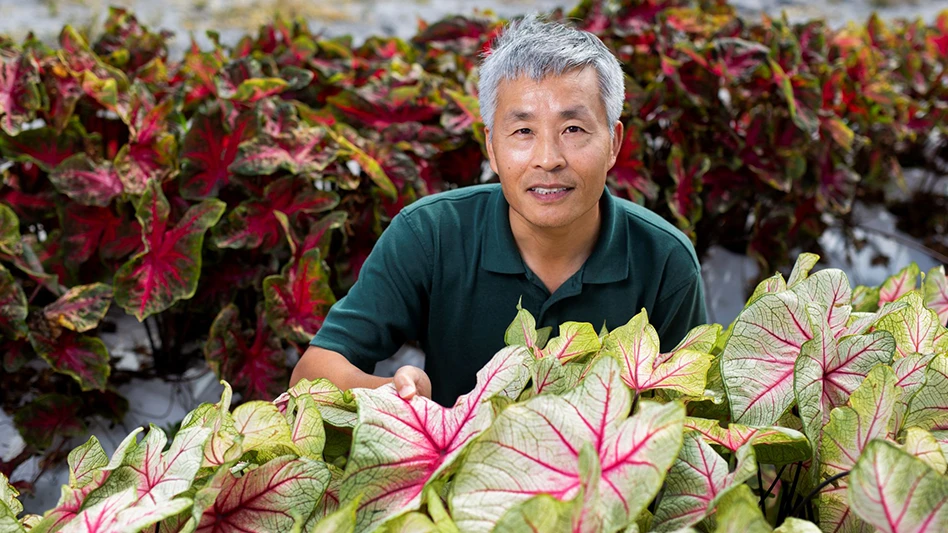
Those original crosses are long gone, but the passion for coleus remains. Over the past 20 years, Chris has become a legend in coleus breeding (he was even recently featured in The New York Times’ “In the Garden” section).
His creations are a riot of color, leaf forms and habits, and he takes a jokester’s joy in naming them. Consider the well-branching orange and yellow ‘Branch Manager’, or the splashy golden and chocolate brown ‘Duke of Swirl’, or the purplish pun-tastic ‘Grape Expectations’.
Walk through his hoophouse, and pot after pot is marked with flags from brands that want to try out his varieties. Currently, his coleus are sold by giants like Dümmen Orange.
Amazing anthurium
It’s no wonder then that the junior Baker would follow his father’s lead. An admitted “tropical head,” Nick had always been driven to sell houseplants, including pothos, monstera and anthurium. But around 2018, he and Pam noticed that demand from houseplant geeks was increasing. In 2020, as the pandemic hit, that demand exploded.
As they tried to meet the needs of their customers, they couldn’t get enough plants in from suppliers, and the plants they did receive lacked the quality that their business was built on. So, Nick began propagating and breeding, focusing on anthurium specifically.
“One of the reasons I started was that I was sick of having to buy them in,” he says. “But the main reason was I thought it was so cool I could create my own plants that weren’t like anything else.”
Anthurium have some unique qualities that make them specifically beneficial for a breeding program. For one, a single plant goes through both a female and male phase before creating small berries that contain seeds. The pollen is relatively easy to collect from the long central spadix during the male phase, which can be manually transferred to a plant with a flower in the female phase.
But more than that, anthurium, like coleus, has an incredible ability to produce a wide variety of colors, vein patterns and leaf forms. The leaves can be small and spade-shaped, produce finger-like forms or grow to torso-sized proportions. The veins can be pronounced or hidden. Aside from green, colors can range from nearly inky black to red or dark caramel.

Over the past five years, Nick has created a wide range of new anthurium varieties, earning a following from plant lovers across the country who routinely buy his new releases on the plant app Palmstreet. But he’s also developed the skills necessary to breed a tropical plant far away from its ideal conditions.
After all, Florida rain arrives like clockwork, and the humidity there is constant. Ohio, on the other hand, has a climate of extremes. The humidity and temperature can change quickly. It can be dry and hot one week and cool and wet the next week — or day.
Nick overcomes the extremes through heated benches, which allow him to grow even in the coldest months. He also has his own tropical substrate mix that helps keep plants hydrated regardless of rainfall or humidity levels. Still, he says, the adversity that he can’t manage for his plants hardens his “Ohio anthuriums,” making them easier for his customers to care for.
“Our anthuriums turn out so much hardier because they’re grown in central Ohio and not southern Florida, where conditions are perfect,” Nick says. “It makes them tough and better all-around plants.”
Anthurium continue to develop and show new traits as they age, which has led to a small problem. Every time a plant leaves the greenhouse, Nick says, he worries that the customer will later send him a picture of a plant that would have been perfect stock to breed from.
“One of my hardest challenges in selling anthurium is not letting them go,” Nick says. “I’ll go through all the seedlings, and I’ll find the best ones from the week. And then I’ll start taking pictures of them and I’m like, well, I can’t sell that. That one’s awesome. It’s easy to tell yourself it’s not hoarding when it’s a business.”

Parents, owners, managers
When Nick and Pam were gifted the business by Chris and Nancy, they were urged not to live on the property after the elder Bakers relocated to a nearby town to retire. They heeded that advice. As parents of two young kids, it’s important to the couple to keep strong boundaries between their family and their work life — at least as much as an owner can.
“You have to be able to let go,” Pam says. “I think that’s the hardest thing about being a parent and doing this particularly.”
So, as managers, they have worked hard to place trust in their staff and allow them to work independently. Pam explains that it’s part of the business’ commitment to creativity as much as it is a management practice. She and Nick allow the staff to fail and learn from their mistakes.
“We like to let people find their way a little bit and not micromanage, let them use some of their creative side,” Pam says.

Nick agrees. “We’ve found that really helps,” he says. “Our staff is really fantastic right now. We give them guidelines, but we want them to grow into it, and they have.”
That makes it easier as parents to delegate in order to have time to raise their kids. And they both point out that being growers has taught them patience that they can apply to cultivating staff, and that ultimately imbues their family life, too.
“I used to be very impulsive,” Nick says. “I wanted to see results instantly. So yeah, I had to develop it for sure. And being patient with staff, you learn how to be a little bit more patient with your kids, unless they’re hitting me in the face with the football or something like that,” he jokes.
The pair do note that being the second generation of Bakers and not living on the property has required some adjustments on the part of the business. There have been times when the necessary flexible schedule of a parent/owner/manager has not been well understood. Some sales reps may find it a little bit more difficult to get a hold of the duo, considering their busy lives. (They also own a local craft beer pub.) But Nick and Pam feel like any bumps in the transition have been smoothed.
And at the end of the day, the business and life partners have a kind of unofficial motto that you’ll pick up on in conversations with them: “It’s just plants.”
“We just never want people to forget what they’re doing,” Pam says. “You’re surrounded by beauty every day. And as we’ve worked through everything, it’s like there’s really a lot that can happen in a workplace that really makes you forget about all that stuff. We’re creating beautiful things for people. That’s really what we’re doing.”
Patrick Alan Coleman is editor of Greenhouse Management magazine. Contact him at pcoleman@gie.net.
Explore the October 2025 Issue
Check out more from this issue and find your next story to read.
Latest from Greenhouse Management
- Quality Horticulture to acquire Hydrofarm Canada distribution
- Blue Grass Farms acquires Brehob Nursery
- OHP expands sales team with new hire and internal promotion
- The inventive women of TPIE ’26
- Seed Your Future aims to double 2025 total for 'Round-Up at the Register' 2026 campaign
- [WATCH] Remix: Sakata Playlist Combos and New Variety Spotlight
- Beacon Impatiens partners with Roots for Youth in 2026
- Inner visions