Editor's Note: This article originally appeared in the March 2026 print edition of Greenhouse Management under the headline “Building Blocks to Better Plants.”
Entering 2026 without the power to predict future pest pressure, integrated pest management (IPM) planning becomes even more important for the season ahead. There is a simple way to build programs for a wide range of pests, and that begins with BASF Building Blocks to Better Plants. Using piercing and sucking insects as a model pest complex, let’s consider the coming spring, summer and fall and look at a range of crops, from transplants to gallons.
Building a Program with a New Approach
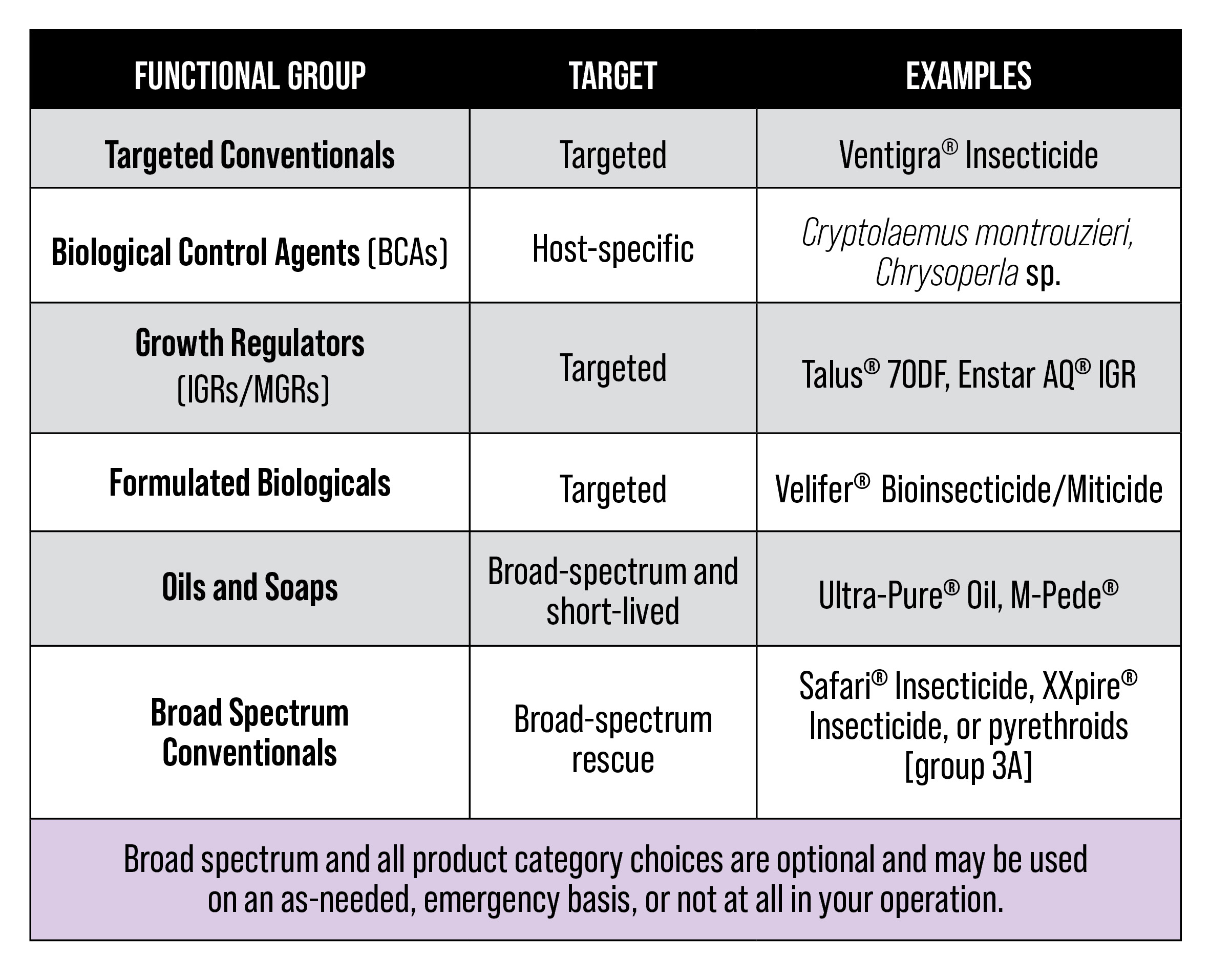
When designing robust IPM programs, multiple and unique mode of action (MOA) groups are needed. However, careful rotation and product stewardship are critical to protecting the efficacy of today’s active ingredients. Thoughtful planning for how each MOA group is rotated through the season matters. This approach simplifies product selection so rotations are intentionally distributed across the most functional MOA groups.
Each functional group serves as a building block within the overall program. By choosing two to five products within each block or functional group, each with a different MOA, IPM programs are simple to build and manage.
Not every operation will use all five functional groups. For example, some prefer to skip broad-spectrum conventional chemistry or biological control agents (BCAs).
Lower pest pressure and fewer applications per year typically require fewer blocks. IPM is dynamic by design, with some years calling for fewer blocks and applications than others.
A Smarter Way to Think About IPM Rotation
Using this model, consider our example pest complex, piercing and sucking insects, and build an example program. Piercing and sucking pests include aphids, whiteflies, mealybugs and scale insects.
In recent years, these pests have caused regionally variable pressure and damage. Severe winters tend to reduce their numbers in the growing seasons that follow, and dormant applications to overwintering stock can reduce the numbers of at least some species.
The program in the table below includes options to manage armored scale at a western greenhouse-nursery operation, though as we know, solid IPM programs address multiple pests. IPM programs need to resolve the problem of the moment while preparing for what may come next, including spider mites, red-headed flea beetles, thrips and more.
Anchor Your Program with Ventigra Insecticide
Ventigra insecticide is a foundational building block in IPM programs as a targeted conventional chemistry for piercing and sucking insect pests. Ventigra works by quickly paralyzing insects to stop feeding and virus transmission, followed by death of aphids, whiteflies, mealybugs and scale insects, as well as psyllids, lygus bugs and leafhoppers.
The next-generation active ingredient in Ventigra insecticide precisely targets piercing and sucking insects and belongs to MOA group [9D]. This makes Ventigra compatible with biological controls and pollinator-compatible with bees, butterflies and their caterpillars, and other non-targets.
Other targeted chemistries may have more or less narrow spectrums of activity, so reading product labels is always important. Sultan® miticide, for example, is a highly targeted miticide that is active only on spider mites and not on Eriophyid, broad or even predatory mites.
When Ventigra is part of a greenhouse IPM program, applications typically go out early in the season for aphids and at very low rates. Plan for whitefly applications a few weeks later, with mealybug and scale applications mid- to late season, depending on the species and region of the country.
For whiteflies, mealybugs and scale insects, the use of an adjuvant enhances control with Ventigra insecticide applications. The plant-safe adjuvant of choice, added to the insecticide to control these types of pests, helps to adhere to the insects that are already present and helps the spray materials adhere to leaf surfaces, particularly waxy tissues, such as on ivy, roses or Camellia sp.
For aphids, no adjuvant is required or needed, and there is no need to drench. Ventigra is foliar-applied with translaminar activity.
BASF Building Blocks to Better Plants
With a wide variety of crops to manage, the many products on the market and new pest problems to solve every season, this simple approach to planning can help streamline one part of the job. This is how we at BASF work with growers to quickly evaluate and fine-tune a program. The feedback is consistent: it works.
Ventigra insecticide serves as a key building block in successful IPM programs for piercing and sucking insects across nurseries, greenhouses, propagation and landscapes. Build IPM around this next-generation targeted chemistry for Better Plants with BASF.

Explore the March 2026 Issue
Check out more from this issue and find your next story to read.
Latest from Greenhouse Management
- New internship data empowers horticulture employers
- Sustainabloom releases new sustainability template for wholesale florists
- National Garden Bureau, All-America Selections recognize pepper breeder Terry Berke, Territorial Seed Company President Tom Johns
- University of Florida ornamental breeding program unveils 50th (and 51st) caladiums
- American Floral Endowment 2026 scholarship applications now open
- Resource Innovation Institute and The Ohio State University launch first national CEA training certificate for design and construction professionals
- Farm Bill passes out of House Committee on Agriculture
- [WATCH] The Biological Blueprint for Stronger Pest Management