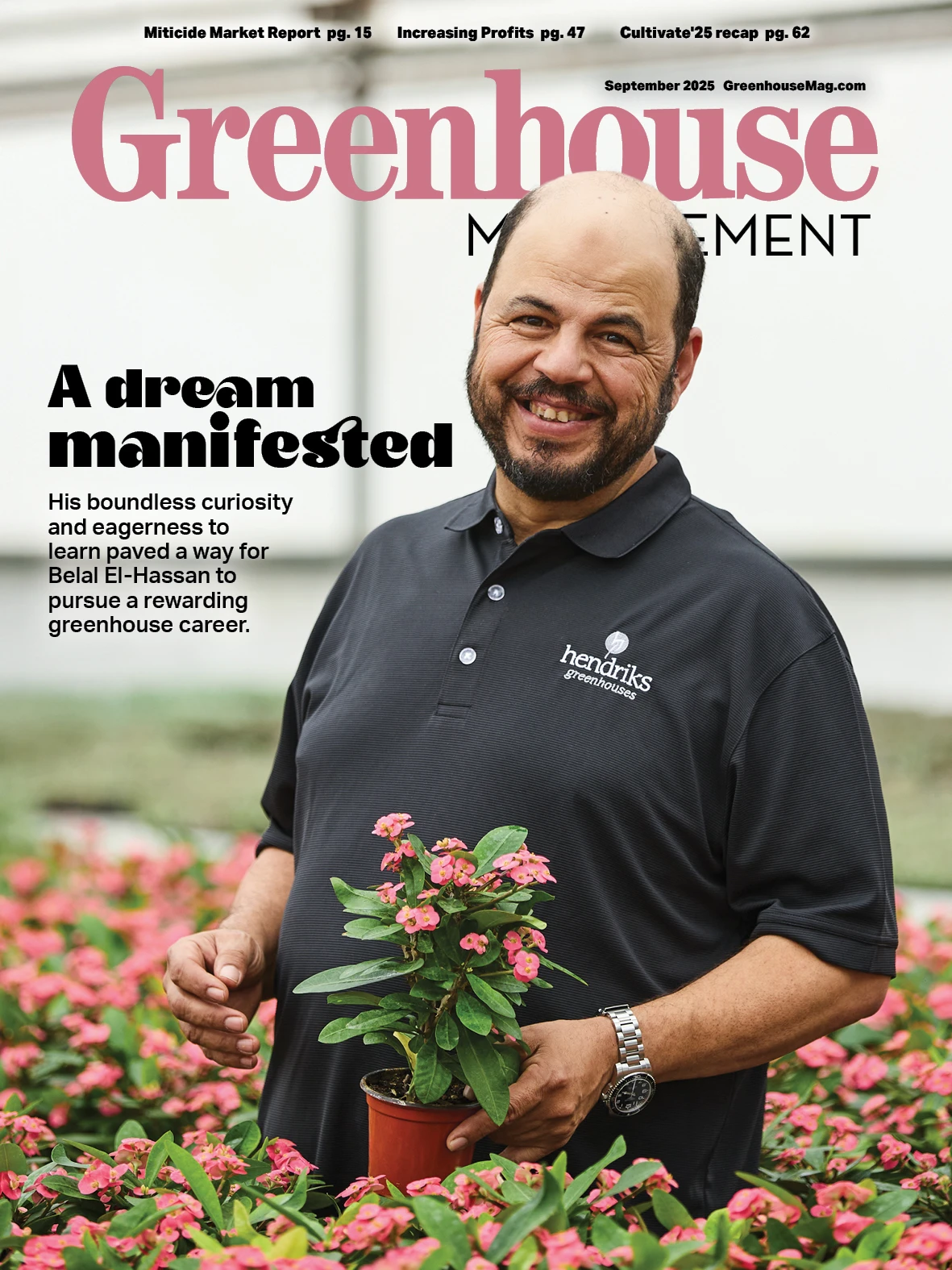
Editor's Note: This article originally appeared in the September 2025 print edition of Greenhouse Management under the headline “A dream manifested.”

Belal El-Hassan does not fear the unknown. Nor does he waste energy on feelings of defeat or resentment. Instead, he’s a man full of grace, gratitude and integrity.
These are qualities he learned early from his hard-working father, from others who gave him a chance along his winding path to floriculture and even from his children’s martial arts class.
As a child in Lebanon, El-Hassan's family lived in a refugee camp. It was a tough beginning, but they eventually settled in Kuwait, a life he describes as “beautiful.”
There, his father managed a poultry farm. And while El-Hassan grew up working in that industry, he wasn’t keen on making a career out of it.
Instead, he applied to study mechanical engineering in Germany.
Waiting on approvals was a slow process, and no doubt bothersome, but it turned out to be serendipitous.
While El-Hassan was waiting on his paperwork to clear, he was working with his uncle at a different poultry farm where a greenhouse was under construction for vegetable production.
David Harnois, the owner of the greenhouse construction firm, was managing the project.
“I was just a young guy trying to make some money while waiting to attend school,” El-Hassan recalls.
The project piqued his interest, and he started asking questions.
Harnois obliged and gave El-Hassan lessons in greenhouse construction and production.
It was the mid-80s, and greenhouse growing was new to Kuwait.
It was an up-and-coming technology, and the Kuwaiti government subsidized these types of greenhouse projects for food security purposes, El-Hassan explains.
“David got me excited about this type of growing, and he said to me, ‘We’re building this, but who’s going to run it?’ He planted the seed in my mind to study horticulture, and I was losing my patience waiting on my paperwork to study in Germany,” he says.

A new path
With encouragement from Harnois, El-Hassan considered two schools: the University of Guelph in Ontario, Canada, and DuPage Horticultural School in West Chicago, Illinois.
“I did the math, and it was going to take four or five years to finish at the University of Guelph. That was too late for me to go back to Kuwait and take over the greenhouse. So, I applied to DuPage, which was an 18-month course,” he says.
DuPage was set up for one month of classroom study and one month of on-the-job training. He worked in operations that grew bedding plants, cut flowers, tropicals and mums, as well as nursery and landscape crops.
He soon discovered that horticulture has a lot of similarities to raising chickens.
“I knew about providing vitamins for the chickens. And that’s like micronutrients for plants. I knew about protein and fat, which is like NPK for plants,” he explains. “Even mixing the feed for the chickens is a lot like custom mixing growing media or fertilizer. And controlling the conditions for the chickens is the same as controlling the conditions in the greenhouse.”
El-Hassan made another shrewd observation:
“The beauty of the greenhouse is that it doesn’t smell like a chicken farm.”
In all, it was a valuable education, El-Hassan says, but with every lesson, he asked his professors how to use that knowledge for tomatoes and cucumbers.
“They probably got tired of me asking,” he says with a chuckle.
When El-Hassan finished his studies in Illinois, he returned to that familiar site in Kuwait and grew greenhouse vegetables for about three years.
Later, an opportunity to work for a global horticulture company emerged, and he sold components such as fertilizers, chemicals, seeds, growing media and greenhouse technology to growers in Kuwait. It was filled with valuable lessons, expanding his horticultural knowledge.
Unfortunately, the Gulf War destroyed the greenhouse industry in Kuwait because there was no money left for the country to subsidize it. He was out of a job.

A new home
El-Hassan learned of a skilled worker program in Canada designed for people who had foreign work experience but wanted to become permanent residents. He applied and made it into the program.
With his parents’ blessing, he moved to Canada with just two suitcases full of his belongings.
And for a month, he went to the downtown Toronto library every day to search for jobs. During his research, he learned about the bustling greenhouse industry in the Niagara region and moved there.
He rented a room from a family he’d just met, went to work for a cut rose grower and took some time to familiarize himself with the Canadian culture.
When he felt comfortable enough to look for another job, he sent out some 100 resumes. He ended up with three interviews.
He eventually found his way to Hendriks Greenhouses in Beamsville, Ontario, a move that would allow him to establish roots in his new home and foster a rewarding career.
He started as an assistant grower where El-Hassan says the Hendriks family opened their hearts and their home.
“They treated me like family, and that’s why I’m still here after 26 years,” he says. “They mentored me and gave me an opportunity to become the grower I am now.”

A life lesson
During those 26 years, El-Hassan married, and the couple raised three boys — twin boys first, and another brother 18 months later.
When he’s not in the greenhouse, El-Hassan enjoys spending time with family.
“With three boys, you can imagine all the things we were involved in — individual sports, team sports, activities and vacations,” he says.
When the boys were in martial arts, El-Hassan learned about the eight virtues of Bushido, the code of conduct followed by samurai warriors. And it had a profound impact on him.
Those eight virtues are:
- Rectitude: The virtue of justice and moral integrity
- Courage: The ability to confront fear and adversity
- Benevolence: Compassion and kindness toward others
- Politeness: Respect and courtesy in interactions
- Honesty: Truthfulness and sincerity in actions
- Honor: Maintaining one’s reputation and dignity
- Loyalty: Faithfulness to one’s lord, family and friends
- Character and self-control: The ability to govern oneself and maintain composure.
El-Hassan calls them his “measuring sticks,” and it’s something he’s nurtured in his professional and personal life.
As head grower at Hendriks, El-Hassan helps manage more than 500,000 square feet of greenhouse space. The company specializes in indoor tropical plants.
He’s the antithesis of old-school management style. He trains his team to problem-solve, although he may call it by a different name.
“When someone comes into my office and says, ‘I have a problem,’ first I say ‘OK, let’s talk through it, and we’re going to call it a challenge and not a problem,’” El-Hassan explains.
He encourages his crew to be independent problem-solvers.
“Starting out, I always focus on the basics. In college, they’re learning to irrigate on the computer. But when they come here, I want them to first irrigate by hand. Learn what it feels like to water by hand,” he says.
“I enjoy teaching people how to sense what’s going on in the greenhouse. Walk around and observe, smell, listen. I rarely use a cart when I’m going from one place to the other. I walk the greenhouse and observe. If you’re driving, you can’t pay attention to the plants. Once the basics are covered, then we go on to the next level. Education is how I work.”
He also works on building relationships with other departments to help create an overall cohesive operation.

A good leader doesn’t suppress their team or try to keep them from moving on. El-Hassan is no exception. He says it’s reassuring when one of his employees moves on to another greenhouse but keeps in touch and sometimes asks him for advice, even after many years.
He also mentors horticulture students, and for more than 20 years has volunteered on the Niagara College greenhouse curriculum committee.
El-Hassan feels blessed to be part of the horticulture industry.
“In floriculture, we are producing plants that help people feel happy and enjoy their space, whether that’s indoor or outdoor,” he explains. “It also boosts their self esteem and makes them attached to nature, especially for those who work indoors where there are a lot of walls. ... More important is how this industry supports food security. If you think about the amount of vegetables and leafy plants that could feed people at a low cost, and if we reduce the carbon footprint, we could be the greenest industry in the world.”
These words were attributed to Japanese warrior Miyamoto Musashi more than 300 years ago, but they ring true of El-Hassan and his way of life:
“Think lightly of yourself and deeply of the world.”
Watch a video of Belal from the Horticultural Industries Leadership Awards at Cultivate'25 here.
Kelli Rodda is editorial director of the GIE Media Horticulture Group. Contact her at krodda@gie.net.
Explore the September 2025 Issue
Check out more from this issue and find your next story to read.
Latest from Greenhouse Management
- Blue Grass Farms acquires Brehob Nursery
- OHP expands sales team with new hire and internal promotion
- Seed Your Future aims to double 2025 total for 'Round-Up at the Register' 2026 campaign
- Beacon Impatiens partners with Roots for Youth in 2026
- Inner visions
- New internship data empowers horticulture employers
- American Horticultural Society announces winners of 2026 Great American Gardeners Awards
- Sustainabloom releases new sustainability template for wholesale florists