Editor's Note: This article originally appeared in the July 2025 print edition of Greenhouse Management under the headline “A crossroad conundrum.”

In a letter to French scientist Jean-Baptiste Le Roy in November 1789, Benjamin Franklin, referencing the newly ratified U.S. Constitution, wrote: “Our new Constitution is now established, and has an appearance that promises permanency: but in this world nothing can be said to be certain, except death and taxes.”
His truth isn’t lost on subsequent generations. Because here we are — standing at the mid-year point, where environmental factors, consumer contradictions and changes at every level of government feels like a crossroad conundrum.
Here’s the thing about Ben. By age 83, when he penned that letter, he had been a businessman, journalist, postmaster, inventor, statesman and ambassador. For all his acumen, he had to have known at that critical time in history what we in our industry know today: Leading a business through an uncertain time is not an easy task.
The only thing certain about certainty is uncertainty. And that right there is the heart of the matter for business leaders in our 21st century. Our culture of immediacy sighs over not knowing what’s around every corner, even as it peeks through shaky fingers covering its eyes.
This frustrated eagerness makes the unknowing doubly painful. But the unknowing can also make us hopeful. It can encourage us to stay true to who we are as business leaders and brand builders — and to become more resilient about adapting to change when it’s necessary.
Prepare to be resilient
The definition of a resilient business is one that can thrive in certain — and uncertain — times. Uncertainty is always difficult. People respond differently when faced with uncertain situations. But human response is an outcome of uncertainty. Preparing for uncertainty is different.
Preparation requires resiliency planning with adaptability that pivots on a company’s core marketplace values. Elections always come with loads of uncertainty. This naturally causes people to behave differently, and in general, act more cautiously.
When we do our forecasting at Loma Vista Nursery, elections inform how we plan for our fall sales. With that now behind us, we will see what changes and what legislative efforts we need to consider as we continue to strategically plan for day-to-day and long-term business operations.
It is important to stay up to date. Prepare by doing the homework on current events that concern our businesses and our industry. From weather inconsistencies to consumer contradictions and a changing political climate, don’t be the last one to the party in planning for resiliency when there are a wealth of good resources available that indicate what changes may or may not lie ahead.
Rely on forecasts by proven analysts at organizations such as AmericanHort. Lean on your business partners during uncertain times. Be sure you have cultivated relationships with your lenders, bankers, accountants, legal counsel, suppliers and customers.
I am thankful that my brother, Tyler Clear, joined Loma Vista Nursery last year. He has insight into the business and is a valuable resource to me. I don’t feel lonely in the driver’s seat knowing he has a stake in the business and is involved. Others I lean on are veteran employees, industry partners, mentors and service providers who help us grow our business and contribute to its efficiency and profitability.
Armed with information, business leaders can anticipate challenges, review plans and adapt resiliently if strategic changes need to be made. But honestly, I cannot imagine much that can't be tackled by leaning into the company’s core values as guiding principles for decision-making and flexibility.
Who’s on your bus?
Nothing much keeps me up at night anymore about running the business, because I believe Loma Vista Nursery is a resilient company that can and will adapt as necessary. We’ve done it many times before, so I know this to be true.
The company’s mission, vision and core values drive our culture, guide our decisions and inform our short- and long-term growth plans. Planning takes time and effort, but to be truly resilient, our plans are in place and communicated with buy-in from our team members so that, together, we can be adaptable.
Our stated core values have been in practice for several years now, and they are still very relevant, especially during our uncertain times. The values embody who we are. They guide what we will become because they shape our decision-making.
There might be some bumps along the way, and plenty to overcome, but the core values make up our lighthouse — shining in the dark, guiding boats back to safety. In line with our values, being truthful, credible, transparent and reliable will always matter in business operations.
Having great core values, a positive company culture and a viable vision are well and good — but having buy-in from employees is where the rubber meets the road. No matter what we do to attract and retain top talent to our companies, not everyone will be a good fit because not everyone will have buy-in about our company’s beliefs. That, especially during uncertain times, is stressful for everyone.
When you keep people on the bus who have not bought into your company’s vision, it is a detriment to the entire organization. It is painful to have unfilled positions in the heat of busy season. But, to me, it is more painful to have team members that don’t want to be there. I like the analogy from one of my favorite books, “Good to Great” by Jim Collins: get the right people on the bus in the right seats.
Sometimes, things come up that no amount of planning or strategizing will overcome. These can be all-consuming, which takes focus away from what is controllable. I’ve learned that focusing time, energy and effort on what is within my power as a business leader is a productive approach. Several years ago, we were having a lot of issues with safety incidents at the nursery. Our insurance partner worked with us to improve our safety programs, which led to an excellent safety record.
We’re currently nearing the three-year point of being accident-free. Last spring, we had a huge party with the Loma Vista Nursery team to celebrate the two-year mark, and we bonused out a significant amount of money to reward very deserving employees who bought into the safety program. We were able to do this because we are recognizing huge savings by having the lowest workers’ comp experience modification rate available for our industry.
Year of Reset
I read somewhere that 2025 was predicted to be the Year of Reset. We’ve faced down giant challenges in recent years: a worldwide pandemic, its implications and its after-effects. So, the Year of Reset is the time to get hyper-focused internally — not on simply keeping up to survive, but on centering to get ahead.
At Loma Vista Nursery, we’re honoring the Year of Reset with a mental adjustment and a physical examination. Through our internal “mental adjustment,” we’ll continue to train our management team and workforce on standard operating procedures that make sense while exploring additional efficiencies resulting from our benchmarking data.
Wage pressure has been one of our hurdles this year. Due to an increase in 2025 H-2A adverse effect wage rates (AEWRs) for Kansas, where our nursery is located, we have to get really efficient with our labor use. Our benchmarking data and analysis helps us do that, because it shows how many hours we spent on specific nursery tasks last year and the year prior.
After analyzing our data, we’ve already identified key focus areas for improving labor efficiencies. Because our management team is on board, they know what we are up against and understand the importance of managing the workforce in the most efficient manner possible.
I know we will find a way to be even more efficient this year because we are resilient. This alleviates enormous stress and confusion internally, not only because decisions are made as a management team, but because they are based on facts. Numbers don’t lie.
Certainty at the crossroad
Our internal “physical exam” is an inventory of our nursery’s health. At the start of the year, we made sure our equipment and facilities were up to date, our workspaces were organized and our tools were sharpened. To have the best, most productive growing season possible, we had everything we needed ready, so that when it was time to execute the plan for spring, it was much easier to do from a clean and organized operation.
Short- and long-term planning are part of being prepared. So is a well-trained staff that is cared for and valued. Having a well-developed vision and mission for your company and identifying and practicing its values are part of being prepared. Documented standard operating procedures that are flexible and resilient are as well. All of these are within our control.
Is there anything we can be certain of while standing at this crossroad conundrum? Absolutely. We can be certain that our industry provides documented benefits to the people-plant connection — that what we do collectively and how we do it as individual businesses is important and valuable to our culture and society.
Our industry is vital. All of us make it so. With the Year of Reset comes this revitalized effort: to tell the story of what we do and why it matters locally, within our states and at the federal level. As Ben Franklin also said, “What you seem to be, be really.”
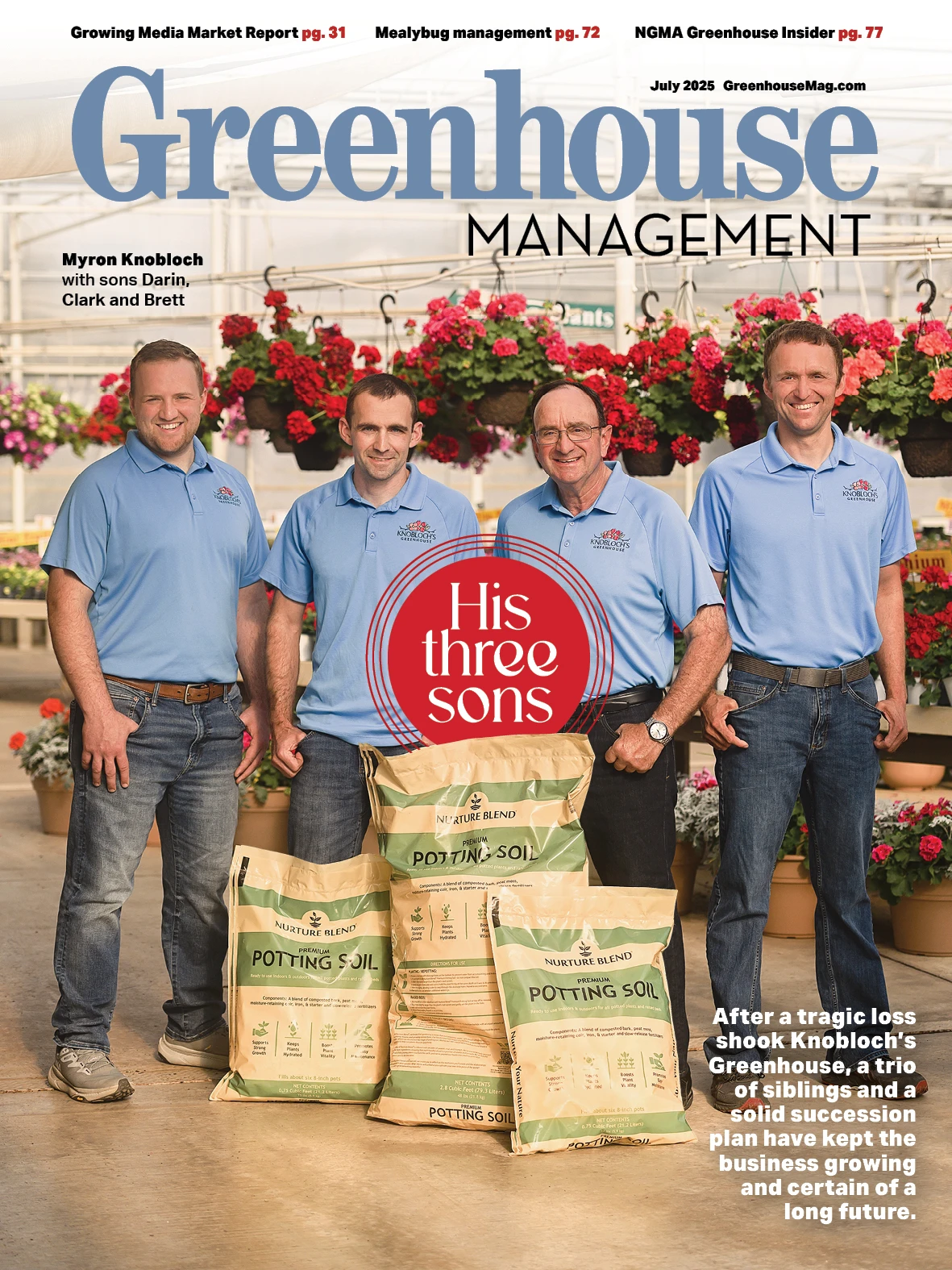
Explore the July 2025 Issue
Check out more from this issue and find your next story to read.
Latest from Greenhouse Management
- Blue Grass Farms acquires Brehob Nursery
- OHP expands sales team with new hire and internal promotion
- Seed Your Future aims to double 2025 total for 'Round-Up at the Register' 2026 campaign
- Beacon Impatiens partners with Roots for Youth in 2026
- Inner visions
- New internship data empowers horticulture employers
- American Horticultural Society announces winners of 2026 Great American Gardeners Awards
- Sustainabloom releases new sustainability template for wholesale florists