|
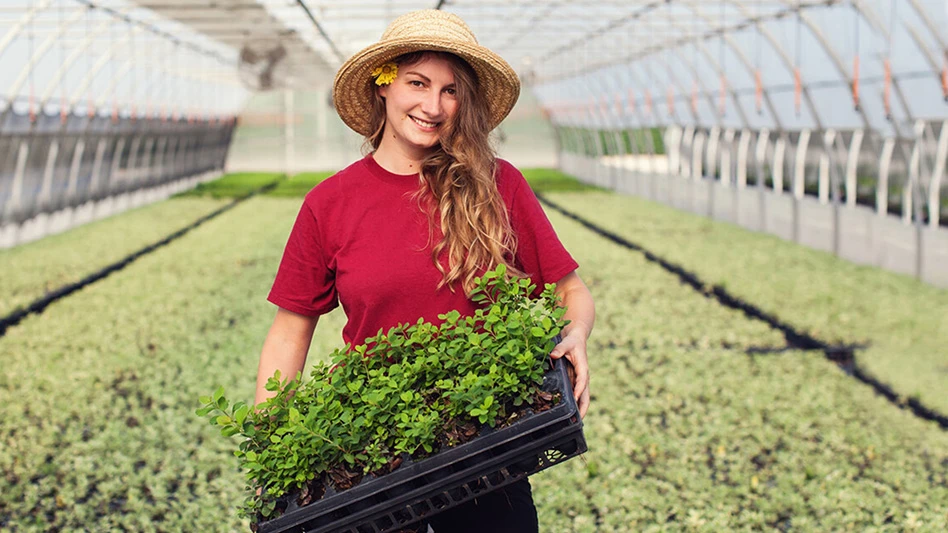
Transplanting and potting operations add considerable cost to the production of a crop. Developing a smooth flow of materials from the bale of growing mix to the production area can reduce these costs considerably. Determine initial costA simple of way of evaluating your whole operation is to total up the cost of employee time for the day and divide this by the number of pots or flats transplanted. For example, if you had four employees working the transplanting line and at the end of the day they had filled, transplanted and moved 1,200 flats to the growing area, then each employee, on average, produced 300 flats (1,200 ÷ 4 = 300). To figure the cost per flat, you need to total up the wages, including benefits, for the four workers and divide that by the 1,200 flats. If we assume the employees worked 8 hours and were paid $10/hr then the cost per flat is about 27¢/flat (4 employees x 8 hours x $10/hr ÷ 1,200 flats = 26.7¢). Gathering the output and costs over several days will give you an average. The output per worker can give you a benchmark to look at alternatives that may provide a lower cost per flat. In the above example, increasing the output to 1,400 flats per day by moving them on carts instead of hand carrying will lower the cost to 23¢/flat. The cost will vary with a number of factors, including: the number of plugs per flat or the size of the pot, the equipment used for filling and dibbling and the method and distance for moving the flats to the growing area.
Look for improvementsThe following are some techniques that successful growers are using to improve transplanting:
One way to offset the increasing cost of labor is to improve the efficiency of your present operations. An efficient work area and easy method for moving plants and materials are areas where the greatest gains can be made.
Bartok is a regular contributor to Greenhouse Management and an agricultural engineer and emeritus extension professor at the University of Connecticut. He is an author, consultant and a certified technical service provider doing greenhouse energy audits for USDA grant programs in New England. Have a question? You can write John at jbartok@rcn.com.
|



Explore the December 2014 Issue
Check out more from this issue and find your next story to read.
Latest from Greenhouse Management
- Millennium Pacific Greenhouses launches California Grown Cucumber Program
- Scientists develop vitamin A-enriched tomato to fight global deficiency
- Tennessee Green Industry Field Day scheduled for June 11
- UTIA and UT Knoxville research teams will develop automated compost monitoring system
- Ken and Deena Altman receive American Floral Endowment Ambassador Award
- [SNEAK PEEK] Leading Women of Horticulture: The women of Fairview Greenhouses & Garden Center
- [SNEAK PEEK] Leading Women of Horticulture: The inventive women of TPIE ’26
- Growing successful spring crops with Topflor