Editor's Note: This article originally appeared in the December 2025 print edition of Greenhouse Management under the headline “Add gratitude to your business toolbelt.”

If you’ve been in horticulture or agriculture longer than five minutes, you already know this isn’t an easy gig. We don’t get to hide behind a laptop when things get tough. We walk into tough times every day. The weather doesn’t care about your production schedule, labor shortages don’t pause for your peak season and the economy sure as hell isn’t checking in to see if your fuel surcharge can take one more hit. The reality is this is hard work: physically, mentally and emotionally.
Lately, it feels like everything outside our greenhouse walls is on fire, too. Political unrest. Cultural division. Social media outrage on tap 24/7. Even when you try to keep your head down and focus on the plants, the noise leaks in. It’s exhausting.
So, let’s be real. There are seasons in this business when it feels like gratitude is a luxury you can’t afford. You’re barely keeping the wheels on, and somebody on a podcast tells you to “just practice gratitude.” Great. Thanks for that, Becky.
But here’s the thing: Gratitude isn’t a fluffy self-help trick. It’s a business tool, one that changes how you think, how you lead and how your team feels in the middle of the chaos.
Gratitude as a weapon, not a weakness
We’ve all met that person who radiates calm in a storm. They don’t sugarcoat problems; they face them head-on, but they do it without letting the negativity take over. That’s not luck; that’s emotional discipline. And gratitude is often their secret weapon.
When you choose to focus on what’s working — even for 30 seconds — your brain starts shifting gears. You’re literally training it to move out of the fight-or-flight zone and into creative problem-solving mode. You start seeing options instead of obstacles. Lean into that! It is a sacred space that all creatives live for.
Gratitude doesn’t erase the hard stuff; it reframes it. It reminds you that while the market may be unpredictable and your transplant line might be one breakdown away from mutiny, you’ve got good people, living color and something worth fighting for.
What gratitude does to the brain
Let’s talk science for a second, because this isn’t just about “feeling better.” Studies show that when you intentionally practice gratitude, your brain releases dopamine and serotonin, the same chemicals that antidepressants target. Over time, those pathways strengthen, making it easier to find the good without having to fake it.
Gratitude also lowers cortisol, the stress hormone that floods your system during those long weeks of sleepless spring shipping. Lower cortisol means clearer thinking, lower blood pressure and fewer knee-jerk decisions. In short, gratitude doesn’t just make you nicer. It makes you smarter under pressure.
The leadership ripple effect
Here’s where it matters most: Your team feels your energy long before they hear your words. If you walk into a morning meeting tense and negative, that tone spreads faster than powdery mildew. But if you start by acknowledging small wins — the crew that crushed the transplant goal, the driver who went above and beyond or even just the fact that the sun finally showed up — you change the temperature in the room.
Gratitude creates buy-in. People want to work harder for leaders who notice the effort, not just the errors. And when they feel seen, they’ll follow you through the storm.
For me, gratitude isn’t a journal with perfectly written reflections (though if that’s your jam, go for it). It’s simpler. It’s standing in the greenhouse early in the morning, before the crew clocks in, and noticing the smell of soil and the sound of fans kicking on. It’s realizing that, despite the chaos, we still get to grow something beautiful and send a little joy out into the world.
Add it to the toolbelt
Sometimes, it’s writing down three good things before I turn in for the night — even if one of them is just, “We survived today.” Because, some days, that’s enough. And how rewarding is it to look back over a year to see so many things that were in my spaces that I could find gratitude for?
We talk about efficiency, systems, ROI and KPIs. Gratitude belongs right there next to them. It’s not soft; it’s strategic. Because when your head is right, your business decisions get sharper, your culture gets stronger and your resilience skyrockets.
So next time things go sideways — the truck breaks down, the crop underperforms or the world just feels heavy — pause for 10 seconds. Find one thing that’s still good. Anchor to it. That’s how you lead through hard seasons. Not by pretending they aren’t hard, but by remembering what’s still worth being thankful for.
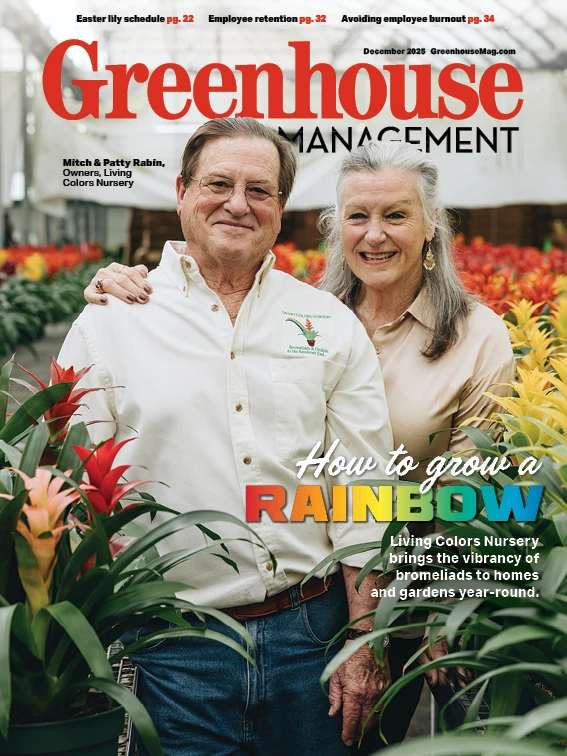
Explore the December 2025 Issue
Check out more from this issue and find your next story to read.
Latest from Greenhouse Management
- [SNEAK PEEK] Leading Women of Horticulture: The women of Fairview Greenhouses & Garden Center
- [SNEAK PEEK] Leading Women of Horticulture: The inventive women of TPIE ’26
- Get to know Brian Kemble
- Proven Winners partners with Pure Line Seeds to offer vegetable plants
- Award winners announced for 2026 PHS Philadelphia Flower Show
- [SNEAK PEEK] Leading Women of Horticulture: Delilah Onofrey and Krystal Snyder
- Top 10 things to know about Envu
- [SNEAK PEEK] Leading Women of Horticulture: Alexa Patti