Editor's Note: This article originally appeared in the May 2025 print edition of Greenhouse Management under the headline “Disaster!.”

Photography
I’m a huge fan of the disaster movie genre. Give me Paul Newman and Steve McQueen in “The Towering Inferno” or Bill Paxton and Helen Hunt in “Twister.” If there’s danger of cataclysm and epic mayhem, I will be in the theater, nervously demolishing a bag of popcorn and gripping the seat.
Yes, the genre allows special effects wizards to go all out, but that’s not why we watch. The real draw is the human drama. A disaster film asks: Who are we when everything goes wrong? And if Hollywood is to be believed, the worst of times could make a hero or a villain of any of us. That’s a great premise for a movie, but life is rarely like the silver screen — and thank goodness for that.
The reality of disasters is that more often than not, they inspire empathy and a desire to help. When things go very wrong, those connected to the event will often rally around one another. In my 20s, I experienced historic flooding in Oregon that hobbled my small town’s infrastructure. The community came together. Neighbors helped neighbors they’d never once spoken to, and differences seemed to dissolve in the common goal of support and recovery.
My one complaint about disaster movies is that they skip the recovery. What usually happens on the screen is the protagonist, caked in artistic streaks of soot and mud and dressed in stylishly tattered clothes, reunites with their family in the clearing smoke. The camera pans back to take in the full scope of the devastation. You can see glimpses of recovery in the background — busy firefighters and people in hard hats clearing away debris — but the actual recovery is left to the imagination.
That makes some sense. Recovery is not, generally, as nail-biting and action-packed as destruction. On the contrary, it can be a slow and agonizing process. But it is no less filled with human drama and emotion. It’s no less capable of pulling empathy from our hearts.
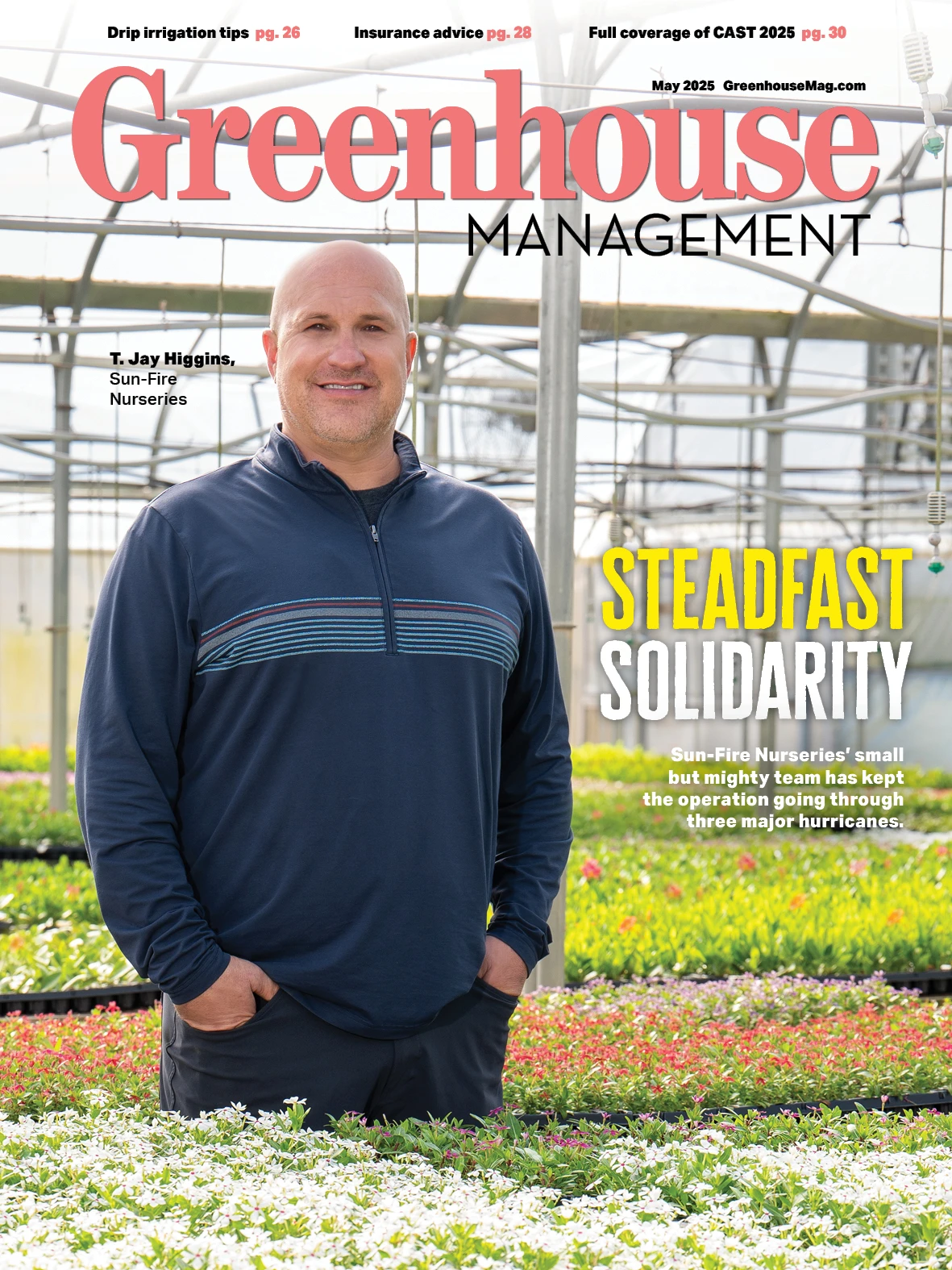
Disaster and recovery is at the core of this issue. On the cover is T. Jay Higgins, owner of Sun-Fire Nurseries in Sarasota, Florida. Over a short period, the business was hit by three hurricanes, the worst of which was Hurricane Ian in 2022. Higgins addresses lessons learned from disaster planning and cleanup and how Sun-Fire managed to keep business moving, thanks to a phenomenal team.
We also hear from two other businesses about how they recovered from their own brushes with disaster. Bedwell Gardens in Iowa lost all of its hoophouses in 2022 due to a storm that spawned several tornadoes and left plants at risk. The business managed to salvage some stock from a freeze predicted hours after the storm, thanks to the kindness of fellow businesses. Another business, Lynde Greenhouse & Nursery in Minnesota, experienced a fire that jeopardized its poinsettia crop. Fifth-generation owner Derek Lynde says that two-and-a-half years after the incident, the business is still recovering.
In the end, it’s the stories that happen after the credits roll on the disaster film that we can learn the truly important lessons from: those of resilience and heart. And those lessons are no less impactful than the ones Hollywood manufactures in the heat of the action. We present them here to help you prepare should you ever face your own feature film-worthy challenges.
Explore the May 2025 Issue
Check out more from this issue and find your next story to read.
Latest from Greenhouse Management
- Blue Grass Farms acquires Brehob Nursery
- OHP expands sales team with new hire and internal promotion
- Seed Your Future aims to double 2025 total for 'Round-Up at the Register' 2026 campaign
- Beacon Impatiens partners with Roots for Youth in 2026
- Inner visions
- New internship data empowers horticulture employers
- American Horticultural Society announces winners of 2026 Great American Gardeners Awards
- Sustainabloom releases new sustainability template for wholesale florists