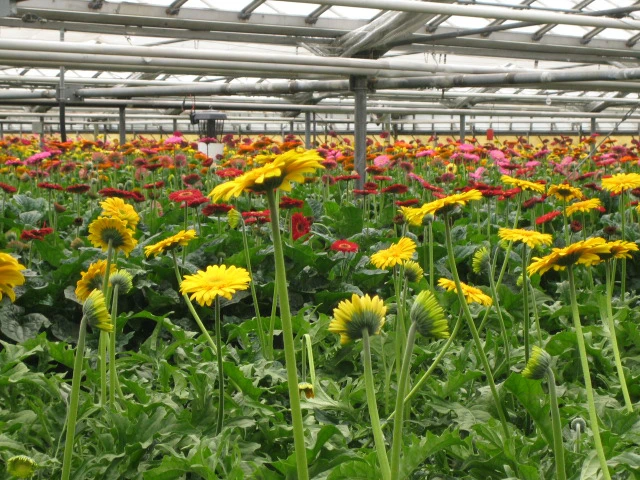
The project is conducted with financial support from the Production Board and commenced in 2011. Wageningen UR is responsible for building the model, as they have the largest amount of experience with building models for e.g. roses and tomatoes. The model is parameterised based on a massive amount of data derived from the sector, combined with experimental results from a day-length trial at Wageningen UR.
The sector asked for a growth model that could assist in strategic decision making on application of day length shortening, CO2 supply, assimilation light, energy screens, heating and ventilation. The model is currently ready for use in the cultivar Kimsey (see validation results in Fig.1) and is now in the test phase for the cultivars Suri, Bison, Rich and Candela. The tests are done at commercial greenhouses by simultaneously modelling and monitoring of flower production and quality.
In a tight cooperation with growers the model interface is being optimised in practicality and user-friendliness. Apart from an easy-to-use interface, it will be accommodated to connect a set of sensors for another location in the greenhouse. Thus, for a specific spot, growth, quality as well as botrytis risk can be simulated. An account at Letsgrow.com is required to access the model. The test phase ends in December this year and the model will then become available for gerbera growers.
Learn more here.
.JPG)
Photo courtesy of University of Vermont
Latest from Greenhouse Management
- The Growth Industry podcast Episode 10: State of the Horticulture Industry
- Millennium Pacific Greenhouses launches California Grown Cucumber Program
- Scientists develop vitamin A-enriched tomato to fight global deficiency
- Incubating invention
- Tennessee Green Industry Field Day scheduled for June 11
- UTIA and UT Knoxville research teams will develop automated compost monitoring system
- Ken and Deena Altman receive American Floral Endowment Ambassador Award
- [WATCH] Taking root: The green industry’s guide to successful internships