Editor's Note: This article originally appeared in the July 2025 print edition of Greenhouse Management under the headline “His three sons.”

Myron Knobloch of Knobloch’s Greenhouse is no less vigilant or watchful of potential disaster than any other grower. How could he not be? He has 2 acres under cover — about 33 greenhouses — producing 90% of the plants he sells out of his retail store. But Myron could never have foreseen, nor would he have dared to imagine, that the biggest threat to the business he built hand-in-hand with his wife, Beth, would be her sudden passing due to an aggressive and devastating glioblastoma in 2015.
“And it happened,” Myron recalls. “Suddenly she had a seizure and went down, and we found out she had a brain tumor.”
Beth had been the business manager. Where her husband knew plants and how to grow them, she knew numbers and how profits played into production schedules. But a week after the seizure, she came out of brain surgery unable to speak at all or communicate complex subjects. Five months later, she was gone.
Myron and his five children faced a world without a wife, a mother and a business manager. It was a tragic loss for the family and a huge blow to the business.
“I was trying to do what two people had previously done,” Myron says. “My personality is not to be in the office. It was just that Beth had taken care of it for close to 30 years, and it was Greek to me. It was just overwhelming.”
It was an uncertain time for the then-54-year-old grower-retailer. But among his five children, there were three sons who would become the future of Knobloch’s Greenhouse. The only question was how to get there.
From fruit to flowers
Beth and Myron Knobloch were still newlyweds when they started their cultivation career in 1987. Together they built a fruit operation, growing strawberries and apples amid the vast fields surrounding their Alvord, Iowa, home. The idea was to serve both the small local communities and the closest metro area, Sioux Falls, South Dakota, about 32 miles northwest.
Their first crop should have come in 1988, but 106 °F heat cooked their berries where they grew, and the couple lost their investment for the year. So, they diversified. In true entrepreneurial fashion, they decided to add a variety of vegetables into the mix, mostly grown outside on 15 acres, and leveraged Myron’s 7-foot by 16-foot hobby greenhouse to grow tomatoes, all of which they sold at Sioux Falls-area farmers markets. But they also used the space to grow a modest ornamental crop to sell to anyone who stopped by.
The farmers market business thrived for nearly 10 years, but the Knoblochs continued to improve upon their greenhouse and its offerings, adding more retail opportunities. The greenhouse became a full-time operation competing for bandwidth with fruit and vegetable production. So, farmers market operations ended in 1996 so they could focus on the ever-expanding greenhouse side, and the business was officially christened Knobloch’s Greenhouse. Soon enough, the operation was growing 90% of the ornamentals it sold, with the exception of specialized tropicals and houseplants.
But the couple had fostered deep connections in Sioux Falls, particularly among its medical community. Those customers followed the couple back to their retail operation in Alvord and took plants and pamphlets back to their homes and hospital break rooms, where the word about Knobloch’s grew.
The season became a full-on sprint. From April to the end of June — just about 12 weeks — Knobloch’s sells enough plant material to close retail operations for the remainder of the year.
The Knoblochs’ cancer journey was a very short one. On Jan. 29, 2015, Beth passed away after what the family calls a “tumultuous” five-month battle.

Growing up in the greenhouse
While the business grew, so did Beth and Myron’s family. First there was Laura, then Brett, Clark, Amy and the youngest Knobloch, Darin. They all grew up with the business about 300 feet from their front door.
“It’s the classic situation where you start the small greenhouse on the acreage, and pretty soon there’s a parking lot all the way up to the house,” Darin says.
The kids did everything from sweeping to labeling to direct seeding. It was pretty much their normal way of life from at least toddlerhood.
“One thing about the greenhouse business, it’s pretty kid-adaptable,” says Myron. “It’s not like a lot of farming things where there’s a lot of dangers. I mean, there’s still dangers, but there’s just a lot of things they can do at a pretty young age.”
Sitting side by side in their office, the eldest and youngest Knobloch joke about how the kids fared in the environment.
“Well, kids are kids, so you got to have some fun, right?” Myron asks Darin.
“From my perspective, we only worked,” his son replies.
Myron laughs and shoots back, “From my perspective, I sometimes wondered if you did work.”
Despite it being a family-owned and operated business, Myron says he and Beth never pushed it on their kids. “All through the years, our intention as parents was never really that the kids would be involved,” he explains. “We were doing this for our livelihood.”
That thinking changed when, after his senior year of high school, eldest son Brett, who’d always wanted to be an engineer, asked to be in the business. A couple of years later, Clark asked the same thing. That was the first time Myron really considered planning to pass the business on.
For his part, Darin wanted none of it. “I was leaving Dodge. I was going to get going,” he says. “I enjoyed it, but it wasn’t where I wanted to be.”
Then, when he was 16 — just a sophomore in high school — his mother’s seizure changed Darin’s trajectory.
‘Day one, it was over.’
The period of treatment and recovery, or decline, after a cancer diagnosis is often referred to as a journey, and the Knoblochs started theirs upon discovery of the glioblastoma in Beth’s brain. And like most people who are confronted with cancer, they were unprepared for what lay ahead.
“We knew glioblastoma was going to be a relatively short cancer journey. Short as in years, not decades,” says Myron. “So, we had thought we had a little time.”
The family waited and hoped that surgery would be beneficial. But the Beth that came out of the surgery was not the Beth from before the seizure. She’d lost cognition and her ability to effectively communicate. It would have been a terrible situation for any family to face. But for the Knoblochs, there was additional hardship. Beth was the driver of the family business, and all the business knowledge was now locked in her head, irretrievable. They hadn’t planned for anything like this.
“There was just no conversation about how to transition or how to do anything or even where things were,” Myron says. “I mean, there was nothing. It was just day one, it was over.”
And although he was young, Darin remembers the chaos of the situation. “There’s a family side to it, obviously. But from the business side, Mom knew the log-in to the bank, and she did payroll and the bookkeeping, everything,” he says. “I mean, it’s small business, and she just did it all. She had her own system. And they were trying to figure out year-end tax stuff, and there’s not really an accounting system in place. Also trying to figure out chemo treatments and relapses, and in out of hospitals and nursing homes and hospice and everything else.”
And there was also the consideration of what to do with Beth’s assets. Myron admits that the couple hadn’t done much work for end-of-life planning.
“We kind of scrambled in the end there,” Myron says. “Beth had 30% ownership in the business. I had 70%. One of the things that happened was that Brett and Clark got Beth’s share of the business. Each got 15%. And so that was kind of their beginning into the business.”
For many businesses, suddenly losing someone like Beth could have seriously imperiled the financial health of the operation. But as a business manager, Myron explains, she had been clever and fiscally conservative. So, while he was thrown into the management and accounting deep end and struggling desperately to swim, he was not particularly worried about paying the bills.
“Beth had us in a really, really good place financially,” Myron says. “She had done a lot of investment. We had built this business basically without any debt. She was a very shrewd operator.”
It also helped that Myron could take some time away from the growing operation to wrestle with managing the business, since sons Brett and Clark had been working full-time for five and four years, respectively.
The first season after Beth’s passing, Myron, daughter Laura, and Brett and Clark decided to copy what they’d previously done. They hadn’t been looking for growth. They just wanted to get through the season. But Beth had had other plans.
“Before Mom had gotten sick, she had put in the books for a 25% increase in hanging baskets,” Darin recalls. “So I mean, right away, first year back, it was big jumps.”

The prodigal business manager
Darin had watched as the family business found its footing in the stark new reality. He had also decided that being a part of that business was not for him. So, unlike his brothers, who were now part-owners, he distanced himself as best he could.
But he was also conflicted. His father was not where he needed to be to keep the business thriving, and Darin could see that Myron was, as Myron describes it himself, in “total overload.” So, the youngest of the Knobloch siblings had what one might think of as his “The Godfather” moment.
“I found the more I tried to steer myself away from the family business, the harder I was getting sucked in,” Darin says.
In May of his senior year in high school, with college on the horizon and a major already picked, Darin relented. He changed his major to business with the intent of coming back to take on the business manager role.
Darin took an abbreviated technical college business program. For two years, he studied and interned — one summer with a tree nursery/garden center, and one summer with a small business accounting and tax firm where he “learned more in those six months than every semester of college.” Eventually, he was back at the family business and taking on the role of business manager, to the relief of his very overwhelmed father.
“Brett and Clark, they’re six and seven years older than me. They had the growing thing on lockdown,” Darin says. “Business management suits my style a little more. I can hold a hoe. I can run a garden hose if I need to. But you’re probably not going to get Brett or Clark to sit down with QuickBooks. But it works out well because we all kind of have our sandboxes. We each have a department, which is good for any management structure.”
Myron offered Darin a share of his ownership as well, and at just 20 years old, Darin started managing the business in earnest in 2019. His plan was to ease into the job and maintain the status quo as he got his mind around the structure of the business and the scope of his role. He was set to just cruise for awhile, and in the fall of 2019, he ordered plugs, liners and hard goods for the following year.
Then, with only months on the job, the spring of 2020 rolled in, carrying with it a global pandemic.
“I mean, I was naive anyway,” Darin says. “Then March of 2020 hits, and we throw all the old scripts away and start writing our own. It almost made it easier because everyone was out of their normal. We needed e-commerce all of a sudden, which ended up being a big growth driver just by accident.”
By 2022, the worst of the pandemic seemed to have passed. Each of Myron’s three sons owned a share of the business. Each was taking responsibility for their portion, and the business was running well.

A succession in three-part harmony
But Myron had a nagging sensation, a realization gleaned from his wife’s passing. “It was very obvious that before too long, something needed to change,” he says. “I mean, we couldn’t continue the course we’re on.”
He had to get prepared somehow to pass the business on and keep it alive should something happen to him. But where to start? It all seemed like such a huge undertaking.
His first attempt to learn was through an Iowa Farm Bureau class on succession. But while the information was slightly helpful, it was more concerned with big outdoor agricultural growers with a lot of acreage. The rules didn’t particularly apply to an indoor growing and retail operation.
Then his sons went to Cultivate in Columbus, Ohio, to look for new greenhouse equipment. What they found was Chris Cimaglio and Ken Lane of PivotPoint Business Solutions and their talk on succession planning. Darin was impressed. By August of that year, they were working with PivotPoint to build a plan.
“Our process is to get to know the business,” explains Cimaglio, a certified exit planning adviser with PivotPoint. “We go through a period called discovery, and in discovery, we look at the personal, business and financial readiness. That’s through assessments. It’s through a lot of our questions.”
One thing stood out to Cimaglio as he looked over the challenges and strengths of Knobloch’s Greenhouse and the family that ran it. For one, they were civil with one another. There did not seem to be the potential for petty squabbles or jealousy.
“Having three sons in the business, you would think that there would be the potential for a lot of disagreement,” Cimaglio says. “But they kept their eye on the prize, and the prize was keeping this going, keeping Myron’s legacy going and continuing to want to grow the business in the future.”
Darin had heard horror stories of siblings making a mess out of succession by trying to extract value from the business at the expense of other hardworking family members. But he wasn’t terribly afraid it would happen to them.
“I mean, we get along pretty well,” he says. “We’re brothers at the end of the day, but generally we get along well.”
Myron chimes in, “I will say that they’re all very different personalities. They’re not like three in a pod. I mean, they’re very diverse personalities.”
Despite those different personalities, or perhaps because of them, as the business entered the second phase of the succession planning, the “prepare stage,” everything came together smoothly. Cimaglio notes that one of the major positive aspects of the Knobloch family was each brother had their niche and area of expertise, from growing to retail to business management. That didn’t mean there wasn’t any discussion. For instance, everyone had to be in agreement that Darin, the youngest, would be the business leader. But everyone seemed to be galvanized around the same purpose: working on the business and putting a plan together.
“The business is an asset or a holding of the family,” Cimaglio says. “You run the business; don’t let the business run you.”
The Knoblochs faced some serious challenges. To start, they had to lock down business continuity to keep the business stable — a necessary lesson learned from Beth’s passing. They also needed to do some risk mitigation and accounting for future taxes.
But succession isn’t just about making sure the right paperwork is in the right place. Cimaglio notes that a business should focus on growth to add value. After all, there were four families to provide for. Should Myron retire, he’d need to be taken care of without the remaining families feeling the pinch.
Cimaglio notes that PivotPoint looked at areas to increase profits and decrease inefficiencies. The Knoblochs allowed Cimaglio and his team to help them better understand their customers and the way they shopped. That resulted in an investment in larger carts that increased average ticket sizes. The family also made investments in IT, automation and modernization, including a new soil mixing line to replace an old mix tub. That mixing line helped them find a new line of revenue.
“So, on the growth side of things, we went ahead and we got a potting soil brand named and trademarked,” Darin says. “It’s Nurture Blend, and we worked with PivotPoint, who helped us do some brand packaging and getting a pot soil bag made. It goes really well with our garden center because the soil season is typically kind of in the fall, the winter, the early spring. So, developing Nurture Blend as a soil brand kind of balances our seasons.”
With increased growth, there is a solid succession plan in place. When Myron decides he wants to retire, the process begins. Through a system of gifting and installment payments from the business to Myron, the business can support everyone into the future.

Looking ahead through misty eyes
Despite everything that has happened in the past decade, and with some good planning for succession, the future of Knobloch’s Greenhouse looks bright. But looking forward doesn’t mean turning your back on the past. Even now, Beth’s memory shines through the mark she left on the business.
Cimaglio speaks of it with a kind of reverence. He notes that during discovery, they were looking at the signage, and while it needed the smallest tweaks for modernization, it was solid. “Myron told me that was all Beth. She did that,” Cimaglio says.
Tayton Knobloch, who is distantly related, had worked for the Knoblochs in the past and was excited to take on the grower tech position meant to capture a great deal of Myron’s specific expertise. It was one of the last hurdles and one of the biggest, according to Darin. At first, he was flummoxed as to how to find a full-time employee who could be a grower but also wanted to climb on a gutter to fix a roof, do all the maintenance and fix water lines. But he believes they found the right person.
She’s also present in the design of the store and in the amazingly adroit business sense that allowed her youngest child to take her seat four years after her passing and thrive.
“We’ve been on an awesome growth trajectory since Mom passed away in 2015,” Darin says. “I think by 2022, we had doubled our revenue. Sometimes it feels like you’re not moving forward, but when you look back and you’re like, OK, we’ve been able to maintain that growth without Mom being here, I guess that’s pretty encouraging. And it is not even about the revenue dollars. It’s just moving past that on a personal level and just a business management level.”
There is one tiny hiccup in the plan. All the Knobloch men have their place in the business, including Myron. So, who fills the patriarch’s shoes when he decides to retire? How about a 19-year-old high school graduate without any real experience?
“He has an eagerness to learn,” Darin says. “He was sick of learning in a classroom. No college for him. So we’re sending him to the College of Myron. He just doesn’t know that’s a college yet, but not a classroom as much: hands-on. He’s a sharp kid.”
With the new hire, Myron says he sees the “light at the end of the tunnel.” But to look at him, it seems he’s a long way off from retirement. When he gets there, he’ll be ready, though.
When asked how confident he is that his sons will be good stewards of the brand he and Beth built, the emotions well up, and he pauses to collect himself.
“I got a very high level of confidence,” he says, his voice wavering. “Sorry, a little emotional here. But what I’ve seen the last 10 years, what they put in it, there’s no question in my mind that their heart is in it. Yeah.”
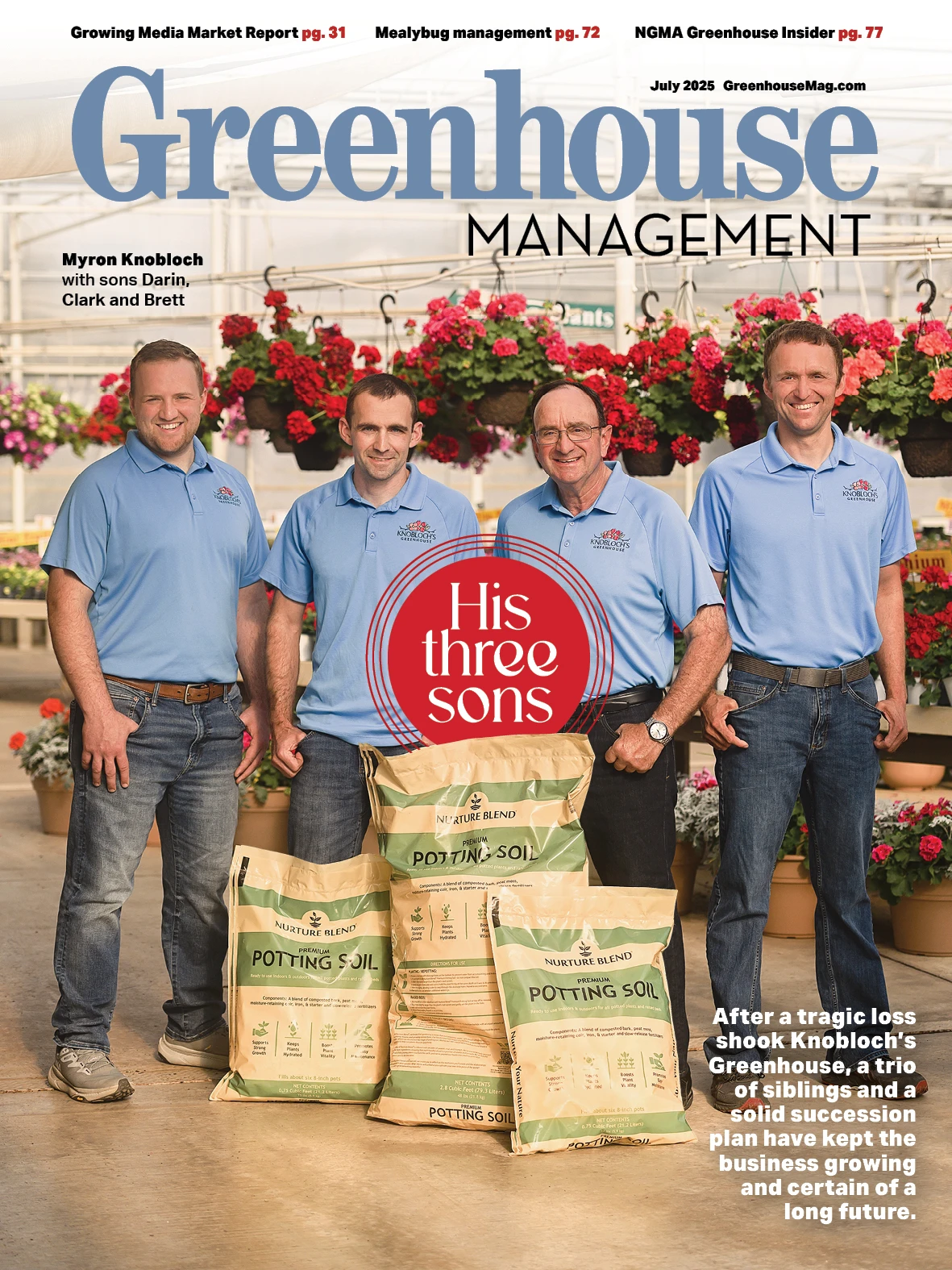
Explore the July 2025 Issue
Check out more from this issue and find your next story to read.
Latest from Greenhouse Management
- Blue Grass Farms acquires Brehob Nursery
- OHP expands sales team with new hire and internal promotion
- Seed Your Future aims to double 2025 total for 'Round-Up at the Register' 2026 campaign
- Beacon Impatiens partners with Roots for Youth in 2026
- Inner visions
- New internship data empowers horticulture employers
- American Horticultural Society announces winners of 2026 Great American Gardeners Awards
- Sustainabloom releases new sustainability template for wholesale florists