Editor's Note: This article originally appeared in the March 2026 print edition of Greenhouse Management under the headline “A nose for horticulture.”

Alexa Patti’s nose knows.
As the head grower and nursery manager at Little Prince of Oregon Nursery, located just south of Portland, Patti possesses the uncanny ability to sniff out problem areas — literally. Her sensory intuition for plant pathology borders on the supernatural.
“I have a very sensitive nose, and I don’t know what it is about plant diseases, but they have the most recognizable smells,” she explains. “They’re not great by any means. Some of them have, like, a sickly sweet smell. I am a bloodhound. That’s the best way to describe it.”
While modest about her extrasensory abilities, Patti maintains that experienced growers often develop a sixth sense for shifting greenhouse atmospheres. She can sense the unmistakable tension in the air when crops are distressed, such as from a dual infection of Phytophthora and Rhizoctonia.
Little Prince Production Manager Mike Hicks has watched Patti identify specific diseases the moment she enters a greenhouse. Combined with her keen eye for detail, Hicks says Patti pinpoints microscopic irregularities well before they escalate into systemic problems.
“I don’t want Alexa noticing things anymore,” Hicks says in jest. “So, I’m challenging my maintenance guys that I want things done before she ever sees them. And they need to be out scouting and looking around for problems well before Alexa or her growing team ever sees them.”
But Patti’s unique olfactory precision isn’t the only trait that makes her a standout. Colleagues describe her as bringing a modern, empathetic approach to nursery management, a fresh departure from traditional industry norms.
Long before overseeing greenhouse operations, Patti established a successful decade-long career in the aesthetic arts. A classically trained makeup artist and licensed esthetician, Patti began her journey in 2006 by relocating from her native Fargo, North Dakota, to Toronto. Choosing the Canadian metropolis to remain closer to her Midwestern roots, Patti pursued one of the few elite programs offering the specialized training required for a union card in film and television special effects. This technical foundation led to a lucrative tenure in the beauty industry, where she transitioned from artistry into retail management for major cosmetic brands.
Despite these professional achievements, the loss of her father served as a profound catalyst for change. In a moment of clarity, Patti decided to stop prioritizing a career she was merely good at in favor of one that brought her genuine joy.

“I decided to go back to school for horticulture because I was spending all my extra time in my garden or researching plants when I would have an especially trying day with customers or clients,” she says. “I just really love gardening and plants, and (horticulture) was a way for me to actually enjoy what I did day-to-day.”
In December 2019, Patti traded in the fast-paced world of beauty and enrolled in horticulture school at Clackamas Community College in Oregon City, Oregon. While engaged in classwork, Patti started at Smith Gardens in nearby Aurora in early 2022 as a spray technician, where she quickly distinguished herself and earned a promotion to integrated pest management (IPM) supervisor.
“My time at Smith was absolutely incredible,” she says. “I couldn’t have asked for better people to teach me about growing.”
During this formative period at Smith Gardens, Patti’s talents and natural affinity for horticulture quickly became apparent to those around her.
“From the start, Alexa’s curiosity made her stand out,” says Lauren Brown, Smith Gardens’ assistant head grower and Patti’s mentor. “She’s like a sponge. She wanted all the information we could possibly give her. She wanted to know it all. And not just about what to do, but why we did it — the full understanding of it all. She really thrived on that technical curiosity, and she picked it all up really quickly.”
Patti’s long-term aspirations were rooted in her passion for perennials and houseplants, which eventually drew her to Little Prince of Oregon Nursery’s distinctive company culture in August 2023.
“I’ve never known someone as young as Alexa and with as short of a horticultural career who absolutely knows her stuff,” says Mark Leichty, director of business development for Little Prince of Oregon Nursery. “From the very first day I met her, I kind of recognized Alexa as a savant of sorts who brings to the table an extraordinary amount of knowledge on how to grow plants.”

Patti’s transition to Little Prince was catalyzed by a connection through a former college instructor, leading to an interview with the nursery’s leadership. Although a specific opening did not exist at the time, the management team was so impressed by her potential that they created the role of assistant head grower specifically for her.
Patti’s impact was immediate. Within 18 months, Little Prince’s leadership tapped her to succeed Hicks as head grower, a role he’d been performing in addition to nursery manager and production manager.
“Alexa became one of those people where, after we hired her, I didn’t know what I was going to do with her, and then I quickly realized that I didn’t know how I got along without her,” Hicks says. “She was able to take a large burden off my plate and was able to really accelerate the growing system in a way that I just never had time to do.”
By early 2024, Patti was further promoted to nursery manager, a move Hicks championed to provide a visible example of female leadership for a production team where 90% of members are women.
“Mike said, ‘Alexa, this is really important. I think it would mean a lot, especially to the team, if they saw a woman in charge. You’re doing the work, you have the title and you take care of them. It would mean a lot if a woman were actually the nursery manager,’” Patti recalls.
“That was the reason I took the position, because it did mean a lot to the team to have a woman promoted to nursery manager,” she adds.
The move has paid off for Little Prince. In fact, Leichty attributes the nursery’s recent peak performance to Patti’s rapid professional growth and her deep understanding of the wholesale nursery industry’s competitive landscape.
“Alexa really recognizes what it takes for a wholesale nursery like us to be competitive in the marketplace by producing the very best products that we can possibly produce,” Leichty says. “She empowers her team to do what they need to do to make that happen.
“I feel like we have never been as efficient as we are today,” he adds. “We’re a well-oiled machine, and Alexa has had a lot to do with that.”
Patti defines her leadership and management philosophies through a sense of duty toward her staff and the unique talents required to manage people effectively. Her “team-first” approach balances her acute instincts for plant health with a protective, advocacy-based philosophy to managing a crew of 45 people.
“I like to lead by example, and I think that being a leader is one of the most important things in a team,” she says. “If you’re going to do it, you’ve got to put all ego aside and realize that you are here to build up your team and support your team. So, I like to look at the management structure of the manager being at the bottom, literally supporting the team going up, rather than the other way around.”
Patti’s approach to team management is rooted in individualized support and professional development. By prioritizing the person over the position, she fosters a culture where team members feel valued as individuals, not just names on a spreadsheet.
“My whole job is to make sure that people have the information, tools and knowledge to do their jobs successfully,” she says. “And I do a lot of self-reflection. If somebody is missing the mark or they’re struggling, I always look at whether I have given them the tools, knowledge, information and training to be successful.”
A workplace built on mutual respect and personal investment creates a self-sustaining community where employees take natural pride in their collective success. “When you take care of people, people will take care of you regardless,” Patti says. “And if you take care of people as actual individuals, then they will make sure the company does well.”
To balance the demands of a horticulture workplace, Patti implemented the concept of “enrichment time.” Under this framework, she identifies specific tasks — for example, propagation or seedling care — that provide her team with genuine creative satisfaction. By streamlining mandatory duties, she carves out dedicated time for her team to focus on high-interest projects.
“It’s finding out what they enjoy doing within their day and getting them the support so they can have that time,” she explains.
Patti includes herself in that enrichment time, too. “I go out and play in the Helleborus because I breed the Winter Jewels hellebores. You need those little things that spark joy. It really is important in every job in the nursery.”
Reflecting on her career path, Patti acknowledges that the cosmetics and horticulture industries are philosophically intertwined. Ultimately, she is driven by a desire to create beauty.
“Gardening is truly self-expressive. Your garden is your canvas,” she says. “You are putting your blood, sweat and tears into expressing beauty within your own space. And I love the feeling of knowing that when I go to garden centers, and I see people buying our plants and how excited they are to put that into their own beautiful space to express themselves … That’s a really special feeling.”
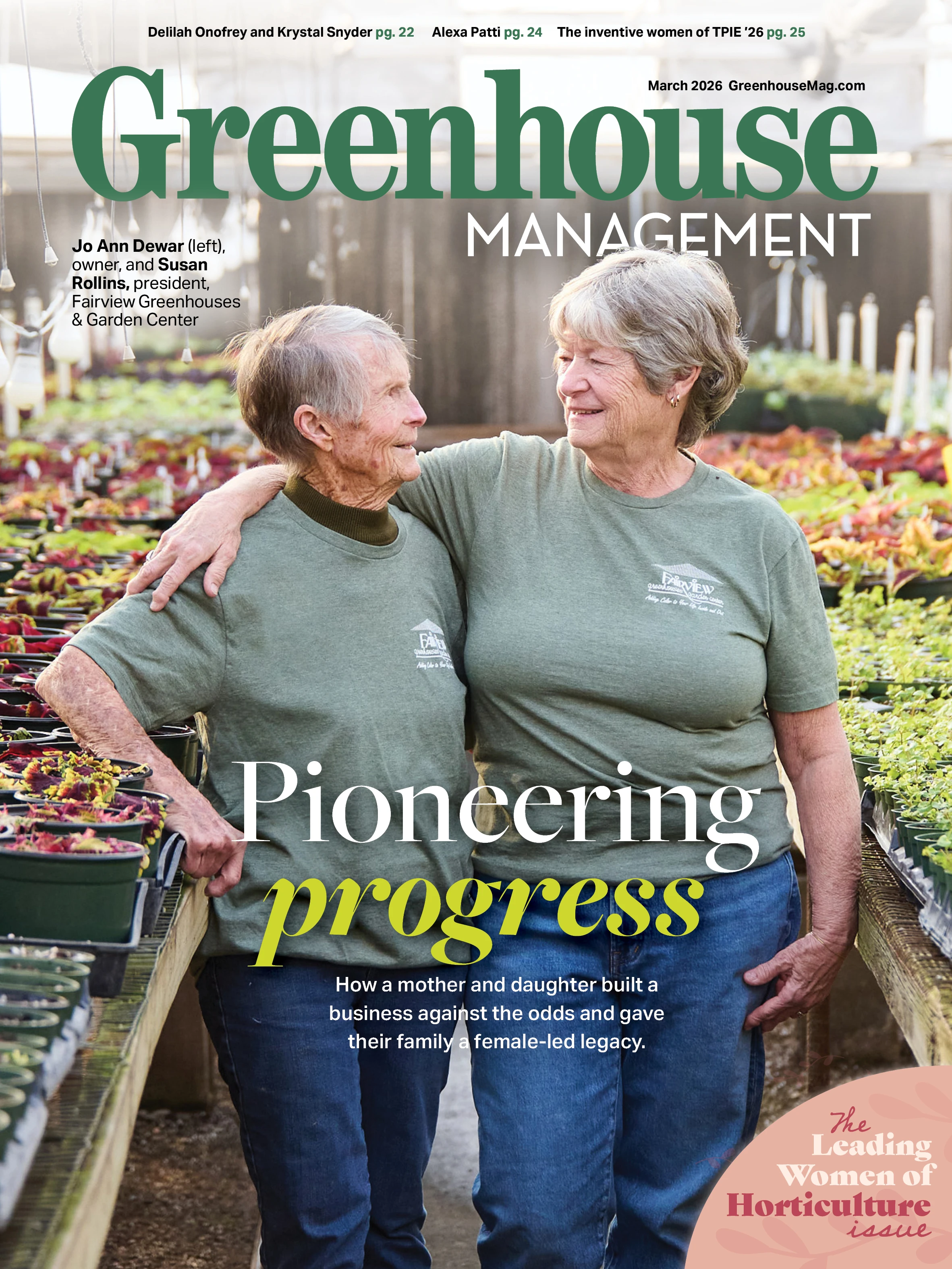
Explore the March 2026 Issue
Check out more from this issue and find your next story to read.