Editor's Note: This article originally appeared in the March 2026 print edition of Greenhouse Management under the headline “Pioneering progress.”

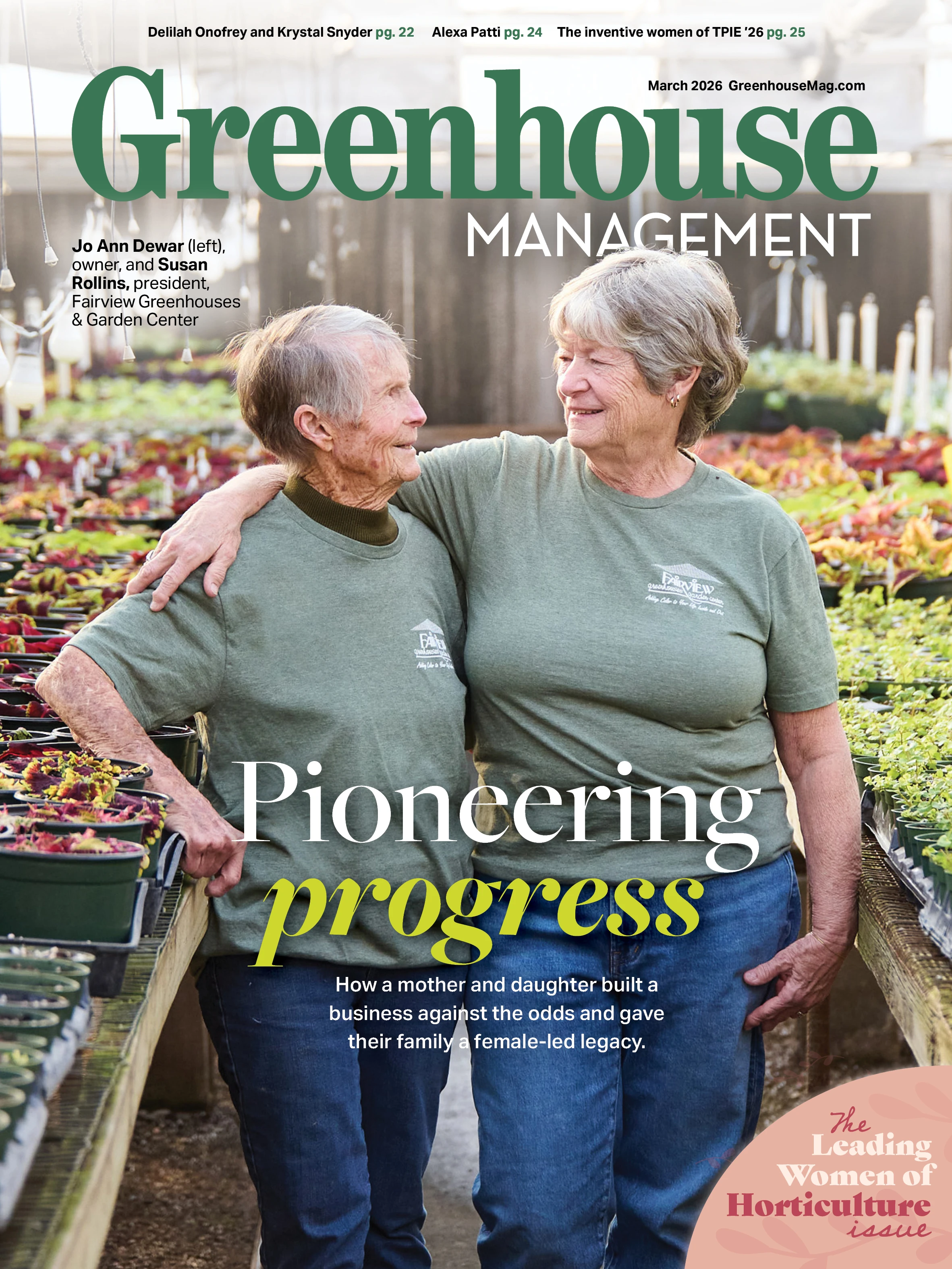
Jo Ann Dewar is a rarity in an industry where multi-generational businesses are most often traced back to fathers, grandfathers and great-grandfathers. As the 94-year-old owner of Raleigh, North Carolina’s Fairview Greenhouses & Garden Center, she’s a founding great-grandmother.
With more than 50 years in business, Fairview is thriving, with garden center retail and plant production situated on 12 acres. What started as a modest growing operation surrounded by tobacco fields is now a bustling enterprise surrounded by Raleigh suburbs, as if the city wanted to bring eager customers right to the company’s doorstep.
To serve those customers, Fairview grows a wide variety of annuals, herbs, vegetables and seasonal plants like poinsettias under plastic in 2 acres of gutter-connected greenhouses. They sell plants, as well as decor, pots, statuary and plant care items, out of an airy, barn-style, 24,000-square-foot building, plus just over 5 acres of retail greenhouses and tidy grounds showcasing trees, shrubs and perennials.
Jo Ann is the heart and soul of the business. She still comes to work every day to “play.”
Growing plants has always been play, just as it was when she was little and would bring “roots” home from her aunt’s house to try and make them thrive. She grew up on a tobacco farm in a home that didn’t have electricity until she was 15.
After graduating from high school in 1951, she had a career as an FBI fingerprint expert before she left Washington to care for her ailing mother back in North Carolina. She eventually married her high school sweetheart and moved to the country.

Creating a business that would bring in over $3 million in annual retail sales was not something she planned.
“I’ve always enjoyed playing and growing plants. And we started a hobby greenhouse,” Jo Ann recalls. It was a modest undertaking — a 50-foot by 15-foot Quonset hut-type structure built by Jo Ann’s husband out of electrical conduit and plastic. “I knew absolutely nothing and had no formal education in this field at all. I actually went across the road and did some geranium cuttings from my friend. I didn’t know you could buy plants or seedlings or soil. We got a small cement mixer, and we actually went to the country and brought sand home and used dirt from the farm in order to mix some soil to start our first plants with.”
She might not have had training in cultivation, but she did have her daughter, Susan. Jo Ann had passed down her love of growing, and Susan was inspired to join the Future Farmers of America program in high school, taking an interest in agriculture. With her daughter’s help and some good old trial and error, Jo Ann began to develop the skills of a grower.
“I learned a lot about plants,” Jo Ann says. “And we found out that I could sell a plant if it was a good quality plant.”
Eventually, those good quality plants became a legacy powered by women.

Mother and daughter build a business
Susan (now Rollins) is Fairview’s current president. She says that for the first couple of years working as a teen on her mother’s hobby project, she was most interested in the spending money she earned. But there was a shift when she enrolled at North Carolina State University and started studying agriculture.
“I just felt like I had more knowledge and understood more of why we did what we did. I think it definitely helped in that aspect,” Susan says. But she notes that her mother remained her primary mentor. “Mom always knew best anyway. She learned from the school of hard knocks, but she learned a lot. We’ve had a lot of students from the university come here and work, and some of them say they wish they’d have just come here and worked instead of going to school.”
For her part, Jo Ann extended a great deal of respect to her daughter and what she was bringing home from her university classes every day. She can’t remember a time when her self-taught techniques and knowledge created conflict with Susan’s formal training.
“I tried to learn from her leadership as well as what she was learning from me. We have always worked together,” Jo Ann says. “She’s always pretty open to my ideas, and I try to listen to her.”
Susan’s connection to the university did allow Jo Ann to connect with resources like the NC State Extension that ultimately helped her grow her business. But Jo Ann admits there were difficulties. After all, she was in uncharted territory when it came to being a woman in North Carolina with a horticultural business.
“There was no such thing as a woman in business back in those days. I had no business plan, had no idea what I was doing so far as the business was concerned,” she says. “And we did struggle for years because we didn’t know really what we were doing. I had no education about how to make a business plan or anything. I made a lot of mistakes along the way, but thanks to the good Lord, I tried not to make the same mistakes twice.”
Fairview’s founder does not shy away from talking about the hardships. She acknowledges them. In a promotional video posted to the Fairview website, Jo Ann recalls, “There were many days where I wondered if we were going to get through it.”
In a separate video, Susan notes, “I asked Mom what would happen if we did fail and we lost this property, and she said, ‘Well, it’s a chance that I’m willing to take.’”
All those chances paid off. Fairview became a successful wholesale growing business, despite hobbyist origins that created unique quirks, like greenhouses constructed the wrong direction to catch optimal light.
Then, in the early ’80s, the tobacco farms started being replaced by neighborhoods. Raleigh rolled right up to their doorstep. So did folks who saw greenhouses and plants and asked, “Can we just buy from you?”
So, Fairview started to offer the suburbanites some plant selections and hanging baskets and put a cigar box out to collect money. Then, as demand grew, they built a 40-foot by 50-foot metal structure to house the retail operation.
Around 2004, Jo Ann and Susan decided that the garden center should be reflective of the neighborhoods that surrounded them. A makeover was in order. The result is the stately garden center that exists today.
Fifty years of female leadership at Fairview
The original hobby greenhouse is long gone, crushed under snow many decades ago. But Fairview is thriving.
Keeping production and sales on track is a 12-member leadership team, nine of whom are women. Working with Jo Ann and Susan are Susan’s son Brad Rollins, vice president; daughter-in-law Heather Rollins, marketing director; and sister-in-law Phyllis Rollins, assistant general manager, personnel manager and floral designer. Women also hold leadership positions as department managers for perennials, nursery and hard goods. In the greenhouses, Carmen Hernandez is the production manager.
Like Jo Ann, Carmen has no formal education in horticulture. She relocated from Seattle, Washington, to the Raleigh area with her husband and children to start a restaurant before the COVID pandemic destroyed those hopes. That was when her husband suggested answering the help wanted sign at Fairview, her favorite garden center.
She was hired and started from the bottom by watering plants.
“Everything I have learned was from Ms. Jo Ann and Susan and other staff members,” Carmen says. “It’s all just been hands-on experience and learning here.”
The ethos of being curious and sharing information has been woven into the business since the beginning. There’s also a sense of trust that anyone can learn what they need to learn. It worked for Jo Ann. It can work for others, too.
And just as Jo Ann shared in her daughter’s education, Susan says she’s sharing in Carmen’s after recently returning to the production side.
“She’s just getting into horticulture, and she’s taught me so much that I had forgotten,” she explains. “There’s been so much change in the industry from 40 years ago with PGRs, fertilizers and insecticides. Back then, I was doing most of it myself, but now I’m learning a different way.”
But even as she studies modern methods of propagation, often independently, Carmen says Jo Ann’s experience remains invaluable. “She’s very willing to share all of her knowledge. She’s still constantly teaching me, and she’s really willing to teach anybody and everybody who comes back and visits her while she’s propagating.”
Personnel Manager Phyllis Rollins explains that new employees understand from the start that Jo Ann is the heart and soul of the business.
“I’ve always told every person that applies for a job here that Jo Ann is our founder and how in awe of her we all are,” she says. “And being a woman, to see her starting this business, teaching herself and never questioning our growth path, that’s how we are where we are today, because she’s been willing to veer left or right whenever it’s needed. And I’m just so impressed by her.”
A family business, regardless of relation
Carmen says that while she isn’t family, she feels as if she has been adopted by Jo Ann and Susan. “They’re so welcoming to me. I don’t have any family around here, and I honestly feel like they are my family.”
“She’s our adopted family,” Susan interjects. “We have a lot of adopted family.”
“They’re my adopted mamas,” Carmen agrees.
That orientation toward family and treating employees as family members likely originates in the fact that so many kids were raised in the greenhouses. The first, of course, was Susan, whose adolescence was spent in cultivation.
She was well into her career as a grower at Fairview when she had her son Brad. When he was an infant, Susan would keep him in a cardboard box beside her. She remembers that people assumed there was a puppy in the box and were taken aback when they learned it was a baby boy.
When he was older, she attached a bouncer seat to the greenhouse purlins. “He’d stand in that thing and jump,” Susan recalls with a smile. “And I’d put flowers in front of him, and he jumped toward them and jumped toward them. And he finally got a hold of a few of them. So, we had to slip his boundary back a little bit.”
The tradition of raising babies on Fairview’s grounds continued with Heather’s second daughter.
“I think my maternity leave turned into just bringing her in here and setting her up in my office with the monitor. We could go back and forth and check on her,” she says.
During the COVID-19 pandemic, the garden center was a godsend for her distance-learning children. Heather remembers her kids would go into the greenhouse and collect lizards. They’d then try to profit on the captured critters.
“There’s two little blond-headed girls with lizards hanging off their ears and everywhere else trying to sell them,” she says, laughing.
That kind of experience as mothers has made Fairview an ideal place for women like Carmen to work.
“They’re very considerate of a family and needing to spend time with your children or your loved ones,” she says. “And that’s their No. 1 priority: making sure that everybody is happy, healthy and being with their families.”
Phyllis notes that the orientation toward family is explicit from the beginning of an employee’s tenure.
“I get that chance to share the love of Fairview with these people,” she says. “And I tell them, ‘whether you’re blood-related or not, if you work here, you are family.’”

Pioneering and perseverance
Being a mother while trying to run a business could be a difficult task, according to Jo Ann. She admits that as she worked to learn how to be a business leader, her focus would sometimes be divided.
“Women back in those days weren’t working. They were back home raising their families; they weren’t owning their own businesses or starting businesses,” she says in the website promotional video. “Taking care of the business here and looking after it was so demanding that I almost put my business before my children at that stage. I have felt very guilty about that. It was a difficult time.”
It’s an interesting thought experiment to wonder if Jo Ann would feel as guilty had she started her business as a young woman five years ago rather then 50. After all, in the age of “girlboss culture,” where women entrepreneurs are often celebrated, it may not feel as heavy to sometimes have to put business before children.
But there’s no way of changing the past, even though some stories don’t put it in a particularly good light. As a woman business owner, there would have been no way for Jo Ann to secure a business loan if she’d been single.
“When Mom first started the business and we were going to start building some additions, she couldn’t even borrow money on her own,” Susan remembers. “I had to have my dad co-sign for everything that we borrowed.”
Susan was a pioneer in her own right. As an agriculture student at NC State, she was one of very few women entering the industry. And, as an integral part of the wholesale business in the ’70s, she remembers that there were few times she wasn’t taken seriously.

She recalls going to buy a new truck for the business with her brother. As she walked the lot, the salesman wouldn’t address her.
“He was talking to my brother the whole time, and he finally said, ‘Hey dude, she’s the one who’s got the check in her pocket. You need to address her,’” she says.
Even Heather, who has been in the business since the early 2000s, has had to rebuff some incorrect assumptions.
“Even still to this day, when people find out you’ve got a garden center, they say ‘Oh, was it your dad that started the business? Your dad works with you?’ That type of thing,” she says. “And Brad’s always been like, ‘Oh, my dad’s not even here. He works for the state.’”
The Fairview leadership has definitely seen a change in the number of women entering the industry, particularly in roles dedicated to plants. They do note, however, that areas like greenhouse construction and equipment still tend to be dominated by men. Yet, progress has been made.

For the women to follow
The women of Fairview feel there is plenty of opportunity for young women interested in the horticulture industry. And they are happy to offer the wisdom of their experience.
“Don’t just jump in like I did, not knowing what we’re doing and that type of thing,” Jo Ann says. She encourages those entering the field to do some research. “Find out if the service that you’re going to provide is needed in this area, have a good business plan, have a backup, do some planning ahead.”
Susan, who spent most of her early career in the greenhouse propagating and growing plants, points out that the work can be physically taxing. She recommends a stress test of sorts for newcomers.
“Get a job to start with and see if you can work in that environment,” she suggests. “Some people don’t like 105-degree days in the summertime. Some people don’t like to be dirty and sweaty. They think they do until they actually do it. So, before you put all your eggs in one basket, see if that’s something that you could do and enjoy it — even if it’s just watering.”
Heather’s perspective from the marketing side is a bit different. She says that while she did go to school for horticulture, it was being on the ground and gaining experience in a wide variety of disciplines that gave her the most valuable insight.

“I’ve definitely learned a lot more working in the industry than I ever learned in a classroom. So, internships are important,” she says. “Experience is everything. The great part of this industry is that so many people work together. It’s not a cutthroat industry. I mean, how can you be sad when you’re looking at all the beauty?”
As another of Fairview’s self-taught growers, Carmen sees endless opportunity in horticulture for those with a curious mind.
“You do not have to go to school to be a grower. You just have to have a passion for it and get out there, find people that are willing to teach you what you want to learn in the horticulture business,” she says. “The sky’s the limit. There’s so much fantastic research out there. Take advantage of what the industry has to offer.”

Looking to Fairview’s future
There’s another generation who know Fairview as a playground and a second home. And if the attempted lizard sales of Heather’s girls are any indication, they are already inclined toward entrepreneurship.
“I love that they see their great-grandmother and their grandmother and their mama and their daddy working every day together,” Heather says. “And we come home dirty and sweaty, but I hope it shows them that hard work pays off, and it’s just as important. But yeah, they’re not going to get in here and start just working at the cash register one day. If they ever work here, they’re going to have to get their hands dirty.”
Even if the girls don’t join the family business, Jo Ann and Susan will always be at the center of what Fairview means.

“That’s what sets us apart. We all work together, and we all have a passion for it,” Heather says. “And that’s all from what we see Jo Ann and Susan doing every day, taking care of everybody and every plant and doing it all with a smile on their face.”
For Jo Ann’s part, the founding great-grandmother will be a fixture until she’s unable. After all, she’s retired a half-dozen times. But after a month or so away, she always shows up again to work. They’ve stopped throwing retirement parties for her. Incidentally, Susan notes that retirement isn’t in the cards for her, either.
“How can I retire when my 94-year-old mother is still working?” she says with a laugh.
So, Jo Ann will keep playing. And as she surveys her business from a golf cart or mobility scooter, she might catch a glimpse of that fourth generation playing among the plants. And while no one knows if they’ll run Fairview someday, Jo Ann can rest assured (if she ever chooses to take a rest) that she has built them, and her family of talented women, a horticultural legacy.
Explore the March 2026 Issue
Check out more from this issue and find your next story to read.
Latest from Greenhouse Management
- Sustainabloom releases new sustainability template for wholesale florists
- National Garden Bureau, All-America Selections recognize pepper breeder Terry Berke, Territorial Seed Company President Tom Johns
- University of Florida ornamental breeding program unveils 50th (and 51st) caladiums
- American Floral Endowment 2026 scholarship applications now open
- Resource Innovation Institute and The Ohio State University launch first national CEA training certificate for design and construction professionals
- Farm Bill passes out of House Committee on Agriculture
- [WATCH] The Biological Blueprint for Stronger Pest Management
- Looking back and moving forward