Editor's Note: This article originally appeared in the March 2026 print edition of Greenhouse Management under the headline “Paths to partnerships.”
Patrick Alan Coleman: You both know each other because Delilah has placed Suntory Flowers in the Penn State trial garden that you manage, Krystal. But you’ve never talked about how you got into the industry. Delilah, how did you get your start?
Delilah Onofrey: I came from the publishing world. I started entry-level at Greenhouse Grower magazine. My first career was there for 18 years, and now I’ve been with Suntory for 14 years. I grew up in a suburb of Cleveland, so it’s not like I was in a rural area or anything, but I do have fond memories as a child. My mother always had nice flower gardens. When I landed at the industry magazine, it was like, “Oh, wow.” I ended up in a good market, something I really enjoy.
Krystal Snyder: Yeah, that’s actually funny. I didn’t grow up in a rural area, either. I went to a small university in Pennsylvania. I was a math education major, and I had a hort minor. But the department chair asked if I wanted to just become a hort major. I did and worked on commercial fruit and vegetable production.
I was at a fertilizer company for eight years, but I was looking for something different. I really wanted to help everybody and not just customers of our company. I worked with the Penn State Flower Trials really closely. I called then-director Sinclair (Adam Jr.) because I saw a position open. I asked, “Do you think I should apply?” And he’s like, “Immediately.” So, I did. I started at Penn State in 2019.
Sinclair and I used to have this really great little video series. Tragically, he passed away (in 2023). My boss was like, “You need to clear your calendar. You are running flower trials.” And that was three years ago. I always joke that I’m an accidental flower trial director.
DO: And I remember those videos. I was like, “Wow, these are so good.” How do you do it?
KS: Literally, we would drive around on the golf cart, and he would ask, “What do you see? What should we highlight?” We always had a theme like sun versus shade or what’s looking great right now. I’d make a list, we’d get out the tripod and we would one-take it. The first year after he was gone, I was like, “Man, I got to do this, but who am I going to do it with?” I could not figure that out. So maybe someday, we’ll bring those back. I don’t know.
DO: Those were really good. I remember I would clip them and use them in our weekly eblasts, and I really love the whole platform you’ve built at Penn State with the data and the pictures. It’s very useful to me as one of the participating companies.
PAC: Krystal, you started with vegetables and fruit. Delilah, you started with words. What brought you to flowers specifically? And what makes you stay?
DO: The people and friendships in the industry. A lot of other industries aren’t as open and sharing. I hear that all the time from people in other industries. They’re like, “Wow, we would never let our competitors visit.” And even though we’re competitors, it’s friendly. I mean, we’re always sharing meals with each other. Even now, people I’ve known for 25 years, there are fresh opportunities to work together on some things that just come I guess organically.
KS: I do a little bit of work still in vegetables, mostly in controlled environment vegetables. Hydroponic lettuce is actually the biggest thing that I work in still. And to be honest, a greenhouse full of hydroponic lettuce is nice, but a greenhouse full of new introductions is way better. There is nothing like standing in the middle of my greenhouse in the middle of May and seeing benches and benches and benches of everybody’s new stuff.
PAC: In your time in horticulture, how has the industry changed for women?
DO: A lot of the growers and retailers are mom and pops, so you see mom, too. It’s not just pops. At industry events, you’ll see couples more than just the guys. And I think, more and more, the next generation, you do see more daughters stepping up.
KS: I remember when I very first started in the industry, I would show up to a meeting and not only be the youngest, but I would be one of the few women there. But I think in the greenhouse floriculture part of horticulture, it’s definitely more equitable, I would say.
PAC: Delilah, you just welcomed your first grandbaby, right?
DO: I have two grandchildren now, and I have three sons. My eldest is 31. He lives in Indonesia. My middle one, Tristan, went to the Cleveland Institute of Art to get his BFA in illustration. So, I actually use him for a lot for things I do for Suntory. My youngest is finishing up in chemistry at Baldwin Wallace (in Cleveland).
KS: My stepdaughter is 23, and she just finished at Penn State in the spring of ’25 with a psychology major. She’s my husband’s daughter, and then we have one together, Lucy, who’s 12. We’ve got a grown-up out of the house and a teenager. I joke around that my job is really just to Uber her places. She’s been around plants all of her life. During COVID, I would take her to visit greenhouses with me because I’ve known the growers around here for many, many years. Now, they’re like, “Well, where’s your assistant? Where’s Lucy?” I grew 2,000 heads of lettuce for my master’s research, and she just tagged along. She was there doing work with me, too.
PAC: Do you think she’ll remember this and go into the horticulture field?
KS: I always used to joke that I would have to just grow my own clone to take my place for the industry. And honestly, she’s been around it for a long time; she does know quite a bit. But I don’t know, I think they see me working all the time, and I don’t think that they want that in their life. But Lucy does want to grow things.
PAC: What would you say to young women who are looking at a career in horticulture?
DO: I would say it’s a great industry in general, whether you get your hands dirty or not. So many things wrap around the industry. Yeah, there’s the actual plants and products, but then there’s the marketing; there’s the shows. Whether you’re an actual grower or not, there are ways you can be part of the industry and advance it.
KS: I always say, and I think Seed Your Future used to say this all the time, too: Plant people are the best people — because they really are the best people.
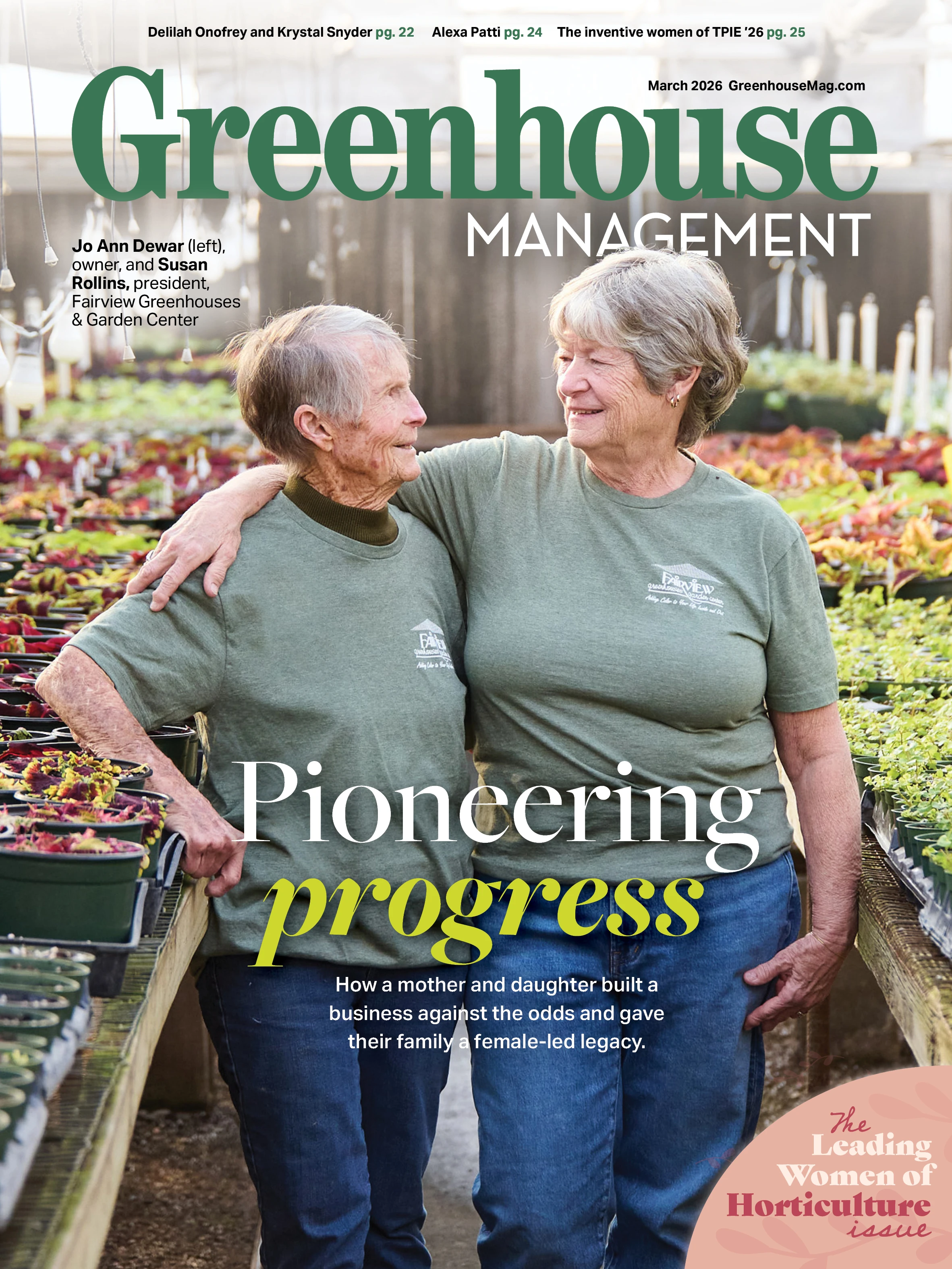
Explore the March 2026 Issue
Check out more from this issue and find your next story to read.