Editor's Note: This article originally appeared in the June 2025 print edition of Greenhouse Management under the headline “Part 3: From dark to light.”

A good start is essential to producing high-yielding and high-quality plants. We know that sub-optimal growing conditions during propagation can have lasting effects through transplant, finishing and ultimately at harvest.
The light environment during propagation is a key factor in producing quality seedlings. However, there are many strategies to provide light. Do you sow seeds and place the flats straight into the lighted production environment, or do you provide a dark germination period? How long is the dark germination period? Does this influence plant growth and quality?
At the University of Tennessee, Knoxville, our team is testing ways to save energy and reduce the costs of growing leafy greens and culinary herbs. In the study outlined here, our goal was to determine if seedlings should be germinated in the dark, and if so, for how long? If seedlings can be germinated in the dark for as long as possible without reducing crop yield or quality, energy usage can be reduced.
However, some plants — including lettuce — are very sensitive to darkness during germination, and it can cause them to grow poorly. Why is that? It’s complicated, but it all comes down to a tiny protein called HY5. Germinating seedlings usually need light, because light allows HY5 to do what it’s supposed to do: when light is provided, HY5 is free to hop around, grabbing onto bits of DNA and switching certain genes on or off. So, during the day, HY5 causes the seedling to develop a nice green color and to stretch at a normal pace.
But in the darkness, HY5 has an enemy: COP1. COP1 is another protein, but its role is to "tag" HY5 (and some other molecules) to be degraded by the cell.
So, when darkness falls, and COP1 becomes active, it means doom for HY5. This is why, when seedlings are germinated in darkness, they are yellowed and stretched.
However, we think maybe a little bit of stretching isn’t a bad thing. Our team believes we can find a balance: allowing for some darkness, some stretching, but not too much. So, we designed an experiment to test our theory.
The experiment
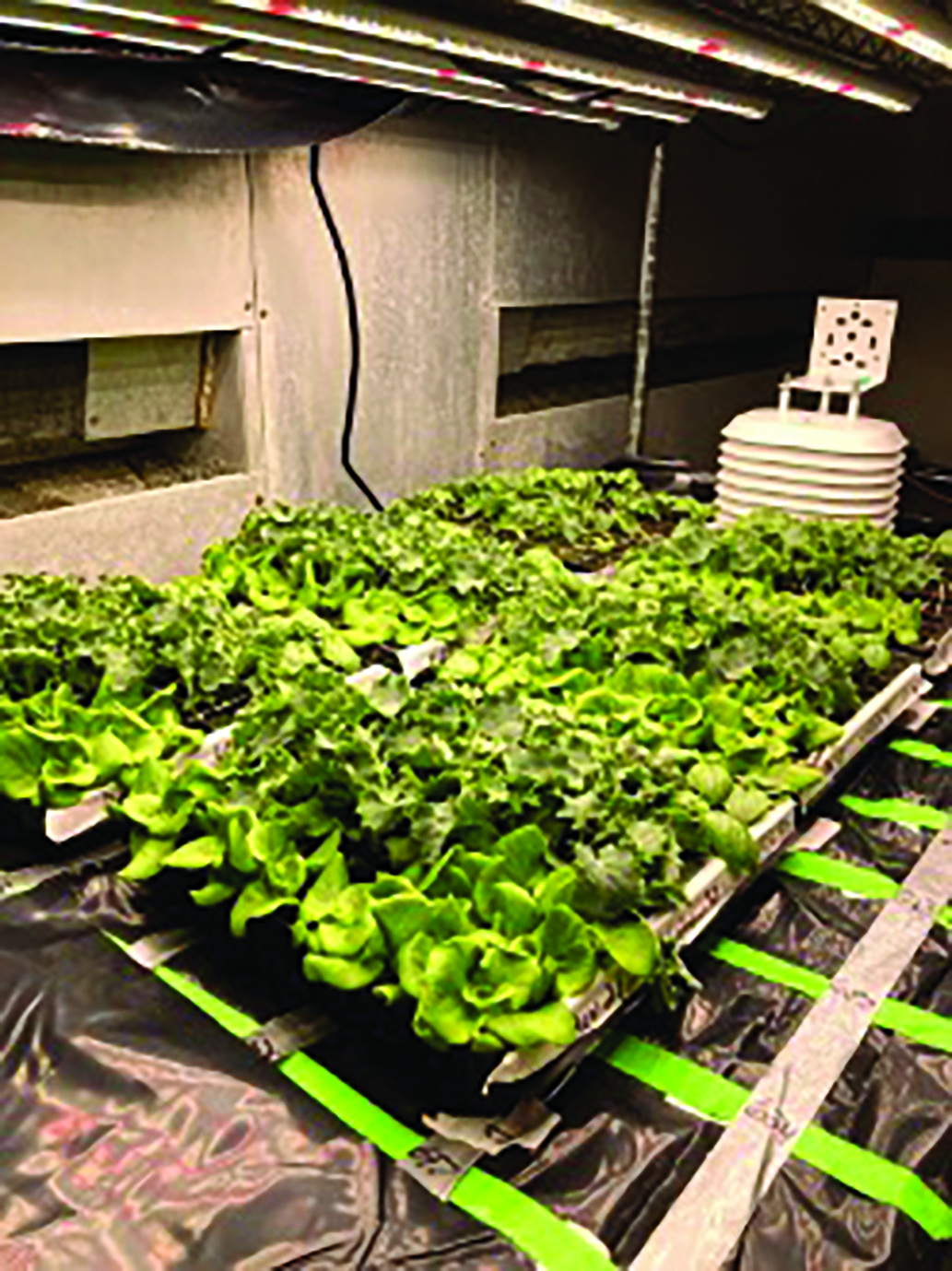
We germinated ‘Italian Large Leaf’ basil, ‘Winterbor’ kale and ‘Rex’ lettuce inside a growth chamber. We treated the seedlings with different doses of darkness: some germinating seedlings received light immediately (0 days of darkness), and the rest received either 1, 2, 3, 4 or 5 days of darkness before they were exposed to light.
We were also curious if the light intensity during propagation would alter the results of dark germination. We know that, in general, providing more light results in increased photosynthesis, carbon fixation and ultimately greater yields. So, in addition to those dark germination treatments, we also tested two different light intensity treatments: one group of seedlings received a high light intensity of 800 µmol.m−2.s−1, and the other received a lower light intensity of 200 µmol.m−2.s−1 for 16 hours (Figure 1).
Then, 14 days after sowing, all seedlings were transplanted into a common greenhouse environment (Figure 2). They continued to grow in the greenhouse for an additional 21 days, floating on rafts in deep water culture hydroponic systems (Figure 3).
Both at transplant and at harvest, we measured plant hypocotyl elongation, height, growth index, fresh and dry mass, stomatal conductance to water vapor and chlorophyll fluorescence — clues to how the plant is responding to its environment.

Results
When basil, kale and lettuce were propagated under the high light intensity of 800 µmol.m−2.s−1, germinating in the dark for longer than two days resulted in a lower fresh mass at transplant (Figure 4). Interestingly, some of these reductions in fresh mass (yield) persisted after a three-week period in a common greenhouse environment. This highlights how important the initial production environment is on final yield.
However, kale and lettuce grown under the lower light intensity of 200 µmol.m−2.s−1 only exhibited reductions in yield after three days, and basil had similar mass at transplant if they were immediately placed in the light after sowing or if they were in the dark for five days. Not surprisingly, there was also no difference in basil fresh mass at harvest.

Beyond yield, you may be interested in plant morphology. When propagated in the dark for more than two days, the hypocotyl, or stem between the root and cotyledons, became elongated (Figure 5). This was true for all three species, regardless of the light intensity provided. The longer the seedlings were covered, the longer the hypocotyl became, and the leggier the seedlings were.
We found it was difficult to separate the elongated seedlings, and they often flopped over once they were placed in the raft hydroponic systems. While we found that covering seedlings for five days under the lower light intensity did not affect their fresh mass compared to placing them immediately under light, the stretch caused would likely increase hand transplanting time or inhibit the use of robotic transplanting.
Our light intensity predictions were accurate: providing a high light intensity did substantially improve the plants’ growth and morphology. The seedlings under high-light intensity had thicker stems, increased biomass and were less stretched.

However, this came at a cost, because energy efficiency was reduced. Yet, the improvement in growth and morphology was significant, and the higher energy cost per area during propagation can be spread across more plants than during finishing, when plants take up more space.
Our recommendations
To maintain high yield and reduce legginess, we recommend that for basil, lettuce and kale, you should not germinate seedlings in the dark for more than two days. You can also improve yield and plant quality even further by increasing the light intensity above 200 µmol.m−2.s−1 after dark germination. If you’re growing basil under a light intensity of 200 µmol.m−2.s−1, you can have very long periods of darkness (as many as five days), but the seedlings will become very elongated.
Explore the June 2025 Issue
Check out more from this issue and find your next story to read.
Latest from Greenhouse Management
- Blue Grass Farms acquires Brehob Nursery
- OHP expands sales team with new hire and internal promotion
- Seed Your Future aims to double 2025 total for 'Round-Up at the Register' 2026 campaign
- Beacon Impatiens partners with Roots for Youth in 2026
- Inner visions
- New internship data empowers horticulture employers
- American Horticultural Society announces winners of 2026 Great American Gardeners Awards
- Sustainabloom releases new sustainability template for wholesale florists