Editor's Note: This article originally appeared in the February 2026 print edition of Greenhouse Management under the headline “Teaching the next generation.”

Producing ornamental flowers in a greenhouse presents plenty of challenges, even for experienced growers. But growing flowers that can be safely eaten, not just admired, poses a whole new set of problems that researchers like Makenzie Lee are trying to solve.
Lee, a third-year Ph.D. student in the Department of Horticulture and Landscape Architecture at Colorado State University, is exploring the perception of edible flowers while comparing flower yields and flavors produced in different growing environments. Through her doctoral project and other research, Lee hopes to inspire the next generation of horticulturists by showing them that plants can do much more than just look pretty.
Born to grow
Growing up in the Central Valley of California among acres of peach, almond and walnut farms, Lee was surrounded by agriculture from a young age and naturally developed a passion for plants early on. As soon as she turned 16, she got a job working at her local nursery.
Even then, she says, “I never thought horticulture was something I could do as a career.”
Lee enrolled at the University of California, Davis, as a biology major, and she discovered the potential of the green industry through a horticulture minor.
“That’s what really got me learning about horticulture and the jobs that were available,” she says.
While taking a course in greenhouse production, Lee conducted research related to hydroponics and agrivoltaics, which sparked her passion for controlled environment agriculture.
After earning her Bachelor of Science in plant biology, Lee moved to Colorado in the midst of the COVID-19 pandemic. She pursued a Master of Science in horticulture online from Texas Tech University while working at a couple of local hemp companies, including Charlotte’s Web, where she was part of the breeding research team.
Initially, Lee started her Ph.D. at CSU with a focus on hemp research, but — realizing how much she missed greenhouse growing — she shifted her focus to ornamental horticulture. While working on a grant application, she noticed a lack of edible flower research and decided to focus on filling that gap.
Taste-testing edible ornamentals
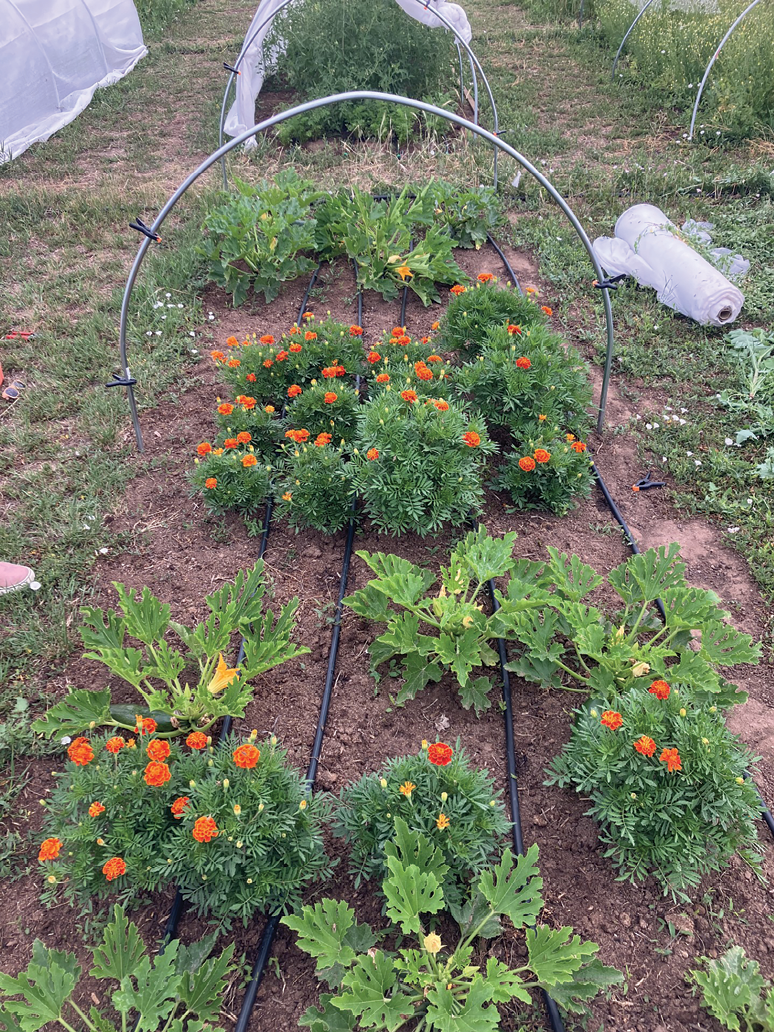
For her doctoral research project, Lee is comparing edible ornamental flower production in greenhouse and outdoor environments, while also comparing hydroponic systems against flowers grown in standard potting mix.
“We’re looking at how that affects flower yields and phytochemical content, including antioxidants and polyphenols,” she says.
So far, Lee is “very optimistic about the hydroponic production,” she says, noting the lack of published research on hydroponic dahlias due to the risk of tubers rotting in water-based growing systems — which prompted her to grow them from seed instead.
“We’ve seen higher yields of dahlias in the deep water culture and nutrient film technique. Some weeks, we’re getting 60 dahlia flowers per plant,” she explains.
As part of her research, Lee has held tasting events to introduce people to edible flowers. Of the four flowers she’s growing for her doctoral project, she notes that dahlia tastes like water chestnut, dianthus tastes very sweet, zinnia a little bitter and buzz buttons “make your mouth tingle and go numb for a few minutes,” she says — hence its nickname as the toothache plant.
However, growing edible flowers in the greenhouse comes with one big challenge.
“Right now, there’s not any federally regulated pesticide application for greenhouse-grown edible flowers,” she says, which kept her from taste-testing specimens grown under cover — forcing her to only eat flowers grown outdoors without pesticides. “That’s definitely a big area of focus in the future.”

Expanding public knowledge
In addition to her research, Lee also serves as a graduate teaching assistant for a plant propagation class at CSU and teaches a plant health care class focused on integrated pest management at nearby Front Range Community College. As much as she enjoys growing plants, she loves the educational aspect of horticulture even more, with plans to pursue a career as a horticulture professor.
Having completed two internships with CSU’s Office of Engagement and Extension, Lee hopes to work for a land-grant university where she can work through an extension office to share research and educational resources with the next generation of horticulturists, growers and farmers.
“People don’t realize the wide breadth of jobs and different things you can do in the horticulture industry,” she says. “People outside of the industry think it’s just growing plants, when there’s so much science and technique. There’s so much you can learn.”
Increasing the public knowledge of plants — and particularly edible flowers — is key to fueling the demand for multi-purpose plants like buzz buttons and butterfly pea flowers, Lee says. She conducted a survey of farmers market managers who agreed that the biggest challenge they face in selling edible flowers is the lack of knowledge about them.
“You can’t increase that industry without building the public knowledge,” she says, “because farmers won’t put in the effort if there’s not a demand.”
Explore the February 2026 Issue
Check out more from this issue and find your next story to read.
Latest from Greenhouse Management
- Proven Winners retail survey finds plant quality and selection are top shopping considerations
- The Growth Industry Episode 9: IPPS International Tour preview with Brie Arthur and Liz Erickson
- Weather report
- ‘Horticulture is just the vehicle that I ride’
- Gordie Bailey Jr., third-generation family leader of Bailey Nurseries, passes at 90
- Keep it moving
- New American Floral Endowment scholarship supports global floriculture research
- Seventh edition of Tulip Trade Event planned for March 2026 in Netherlands