Editor's Note: This article originally appeared in the January 2026 print edition of Greenhouse Management under the headline “Sanitation sanity.”
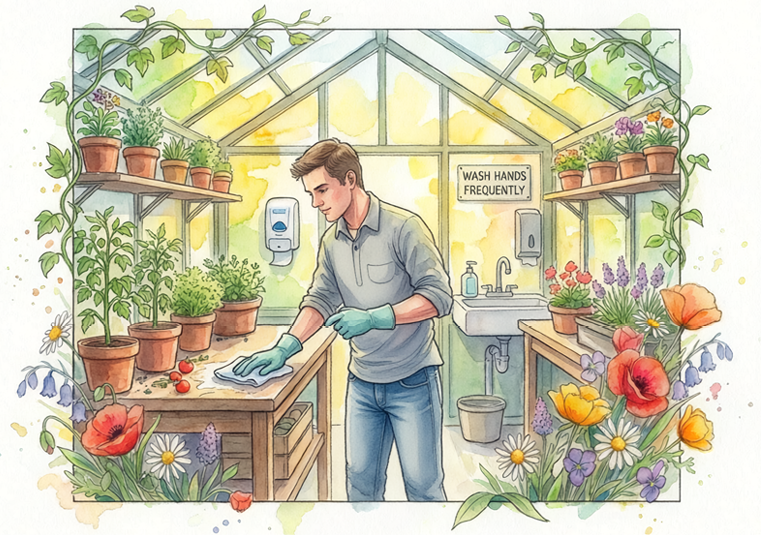
Growers devote a lot of time, money, resources and stress to keeping their plants disease-free. When inevitable plant health issues occur, the increase in effort, materials, cost and worry can become a nightmare. However, a good sanitation program can reduce the need for reactive chemical and biocontrols and improve the effectiveness of other disease management practices.
Nicole Gauthier, a professor in The University of Kentucky’s Department of Plant Pathology and plant pathology extension specialist, says a proper sanitation program — from the smallest steps to large-scale changes — can reduce pathogen numbers and eliminate infective propagules that cause disease, like fungal spores, bacterial cells or virus particles.
“Sanitation can be me washing my hands, or sanitation can be me rouging diseased plants,” she says. “When we talk about sanitation and break out the options, it just gets bigger and bigger.”
Here are a few sanitation tips that can form the foundation of a strong disease management program and help you prepare before spring arrives.
Keep it simple
What are the best methods for sanitation and disease prevention?
“The easy ones,” Gauthier says. “I think that’s a really important thing. So, let’s start with the easy things we can implement without second thoughts. These might include designated tools or supplies per greenhouse zone so we don’t have to move things back and forth; pruning or cleaning plants onto a designated cart or tarp so things get out of the area; or not leaving materials behind. We can’t always disinfect, but washing with soap to remove particles is effective. The easiest things first.”
She also recommends foot baths as a simple preventive step when going between zones of the greenhouse, as well as fallowing for long enough to disinfest and sanitize properly between crops.
Sanitation best practices
Gauthier has authored several fact sheets on effective ways to sanitize within the greenhouse. Here are a few processes to put in place now:
- Remove diseased plant tissues from infected plants and discard plants that are heavily infected.
- Disinfect tools. Cutting blades should be dipped in a commercial sanitizer, 10% Lysol disinfectant, 10% bleach or rubbing alcohol between each cut. If using bleach, rinse and oil tools after completing work to prevent corrosion.
- If infected plants are to be treated with fungicide, remove diseased plant tissue before treatment. This eliminates sources for spore production or propagule multiplication. Fungicide effectiveness may be reduced when disease pressure is heavy.
- Remove weeds and volunteer plants from your greenhouse or nursery to prevent establishment of a “green bridge” between plants. A green bridge allows pathogens to infect alternate hosts until a more suitable one becomes available.
Do not reuse soil from container-grown plants. Pathogens can survive in growing media.
Teach everyone
Keeping an operation healthy means keeping personnel up-to-date on these best practices, Gauthier says. Regular check-ins and continued training are great ways to bond with the team while preventing mishaps.
“Your sanitation program is only as good as your weakest link,” she says. “So, educate everyone. A lot of times at our events, we see the owner or the supervisor or the manager or the person with the license, but we rarely see all the other people in a production system. And that’s where we lose track of our sanitation fundamentals.”
What about the pests?
The benefits of proper sanitation extend beyond viral infections, according to Raymond Cloyd, professor and extension specialist in horticultural entomology/plant protection in the Department of Entomology at Kansas State University.
Growers should be removing weeds, reducing algae and removing plant debris from both inside and outside the greenhouse facility as a part of their practice. This reduces pests that might infest and infect plants.
“Weeds, they harbor insects and mites,” Cloyd says. “They harbor the viruses that some of these will transmit. Algae is a breeding ground for fungus gnats and shore flies. Then there’s just cleaning up debris — growing medium and plant debris — because they’re areas where insects and even diseases can reside. So, when you look at things holistically, (sanitation) is one very important component of pest management.”
Cloyd recommends the following:
- Use pre-emergent herbicides prior to weed emergence. Post-emergent herbicides can be applied after weeds emerge.
- Avoid over-watering and over-fertilizing and use well-draining growing media to avoid algae.
- Always place debris into refuse containers with tight-sealing lids.
It is important to remember that sanitation is the first line of defense in any plant protection program. It can reduce potential problems with insect and mite pests and diseases.
“It’s year-round,” Cloyd says. “It’s very easy to do.”
Explore the January 2026 Issue
Check out more from this issue and find your next story to read.
Latest from Greenhouse Management
- Jackson & Perkins expands into Canadian market
- Green & Growin’ 26 brings together North Carolina’s green industry for education, connection and growth
- Marion Ag Service announces return of Doug Grott as chief operating officer
- Cincinnati Zoo & Botanical Garden debuting new perennial section at 2026 Breeder Showcase
- The Garden Conservancy hosting Open Days 2026
- Registration open for 2026 Perennial Plant Association National Symposium
- Resource Innovation Institute and North Dakota State University explore co-location of data center and greenhouses
- Fred C. Gloeckner Foundation Research Fund calls for 2026 research proposals