Photos © Barbara Banks and Sun-Fire Nurseries
Editor's Note: This article originally appeared in the May 2025 print edition of Greenhouse Management under the headline “Steadfast solidarity.”
The city of Sarasota, Florida, has experienced years-long reprieves from hurricanes. And the locals used to enjoy retelling a piece of folklore based on “Legend of Sara de Soto,” a story by George Chapline written in the early 1900s. The story describes a forbidden romance between Sara, the daughter of an early Spanish settler, and a Seminole prince, Chichi-Okobee. When the warrior becomes gravely ill, Sara nurses him back to health, but she eventually falls ill herself and dies. Okobee buries her in the bay, and her spirit guards the area against hurricanes. It’s a quixotic legend, but it doesn’t inspire the same sentiment anymore. Not since hurricanes Ian, Helene and Milton.
Before those three hurricanes assailed Sarasota, there were also armchair meteorologists who’d come up with interesting explanations as to why the area was spared so often — and which were about as veracious as the Sara de Soto legend.
T. Jay Higgins, owner of Sarasota-based Sun-Fire Nurseries, knew it was balderdash. It’s Florida, after all, and there’s no escaping a hurricane at some point, he says.
“We missed a lot of storms over the years, but we still had a plan for when we’d take a direct hit,” he explains.
He bought the nursery in 2005 and dodged some big storms for almost 25 years until Sept. 28, 2022. Hurricane Ian, a Category 4 storm, hit Sarasota from the south, stalled and turned by the nursery, he recalls.
“Ian dumped tons of rain. We got hurricane winds from north to south, and because it stalled, we got those hurricane winds for about 12 hours,” he says. “We had one whole bay of houses where there was one pipe that wasn’t bent. All the anchors were straight, but those winds and the saturated ground made the whole house lean like 3 feet.”
Almost 40,000 square feet of greenhouse space was beyond repair.
“Because of the wind direction, our north curtains held up. They were just being pushed against the wall. So, we had barely any plant damage with that storm, which helped,” Higgins explains. “But it ripped out all of our computer controls systems. All of our old polycarbonate end walls were blown out. We had to rebuild every curtain, every end wall and every roof. Since the wind blew for so long, it literally moved everything to the south end of the greenhouse.”
Besides the hit to the eight greenhouses, the large warehouse doors were blown out, and the soil room, which housed all the nursery’s equipment, was leveled. One of the toughest repairs was to the tissue culture greenhouse with concrete floors.
“We had to go through and cut up the concrete, pull out the anchors, reset the anchors, pour the concrete and rebuild the greenhouse. It was a lot of extra work,” he says.
Since Ian was the first major hurricane to hit Sun-Fire, Higgins says it was difficult to imagine an end to all the cleanup.
“It’s hard to see how or if you’ll get everything back to the way it was. Then at some point, you just realize it’s never going to be back exactly the way it was, and you just accept it. I don’t own any perfectly straight greenhouses anymore.”
Because of its age, the Damatex control system was damaged beyond repair, so Higgins got a new and upgraded system. But that meant being without greenhouse controls for even longer than if they had just done basic repairs.
Sun-Fire is a young plant nursery that supplies liners ranging from roses to Catharanthus, specializing in mandevilla varieties, and ships several million plants each year.
“Since we only do propagation, that meant hand-misting everything every 15 minutes. It’s quite the work. For growers who only do finished material, if they have a generator, they can water just once a day. But when your liners expect to be misted often, that means one person has to switch on each zone every 15 minutes. Then they have to manually run the fogging system every 30 minutes. It’s just that when you have everything else going on, hand-watering is just one more thing you have to take care of,” Higgins explains.
Ian also caused severe flooding, and many of Sun-Fire’s employees — especially ones from Arcadia — were unable to travel, due to river flooding trapping residents. Traveling back and forth between work and home proved difficult, and many residents didn’t have power or water. Higgins’ wife and nursery co-owner, Daphne, rented motor homes and parked them at the nursery for employees.
“Even if they had generators at home, it was tough to find gas. With the motor homes, they had power, they had showers, and Daphne kept them all fed,” Higgins says.
Despite the widespread damage, the Sun-Fire team was shipping plants within three days of the storm.
“We were getting plants out pretty quickly at that time with a short crew. We were trying to get anything out that we could. It was one last thing we had to take care of,” he recalls. “We were able to fill all orders. It was probably a week and a half to two weeks before we were back to a full crew. And then another eight months until we had the same amount of square footage as we started with.”
With repairs and rebuilds, Higgins and his crew added more bracing and more metal on the houses — plainly speaking, they built them a lot stronger, he says.
Disaster plans
Despite dodging hurricanes for years, Higgins had a disaster plan for protecting the 250,000 square feet of greenhouses.
“We’ve gone through tropical storms, and there’s a debate about cutting greenhouse roofs off or not cutting them off. I’ve always kept roofs on, lowered all my curtains, closed all my doors and turned on my exhaust fans to create pressure on the inside. But we only keep the fans on until we lose power. We don’t run them on the generator. We turn off the generator when a storm is approaching. You definitely don’t want to send power out when things are blowing away,” he says.
Other parts of his pre-storm plan include putting anything up “that would fly away.” He also brings in pallets of bottled water each year prior to hurricane season.
“We let employees take cases of water home, and we hand out generators,” Higgins adds. “We also have a phone chain, where people are assigned to check on other people and find out if everybody’s OK. I also tell everybody, ‘Listen, don’t hurry back. You come back when you’re safe, when your family is safe and when your home is safe.’ We don’t push anybody. We let everyone know that whenever they get back, they’ll have a job and not worry about it.”

Back-to-back hurricanes
After Ian, Sarasota stayed relatively quiet during the 2023 hurricane season. The following year was a different story: the area experienced two hurricanes 13 days apart. Helene, a Category 4 storm, hit the area on Sept. 26, followed by Milton, a Category 3 storm, on Oct. 9.
Milton’s eye went directly over Sun-Fire, so the wind hit the nursery from every direction. But oddly, there wasn’t much rain, unlike Ian.
“We had no rain on the backside of the storm. But the winds did a lot of damage. Most of the curtains were torn, and all the roofs were gone again,” Higgins says.
With Milton, the nursery experienced extensive plant damage.
“Those winds tossed everything everywhere,” he adds.
Stock plants were damaged, which affected future cuttings, but there was more damage to liners. Day to day, it was a guessing game of what would survive.

“The frustrating part was we’d go out one day and think it doesn’t look too bad. And two days later, it looked much worse. That was probably over a two- or three-week period where stuff that we thought was going to be OK ended up not being OK,” Higgins says. “And customers don’t always understand that. Some asked, ‘How can you not give me an answer?’ And I would tell them we’re doing our best. I didn’t want to tell anyone, ‘Yeah, it’s going to be fine,’ when I didn’t know if it was going to be fine. Some customers were totally understanding and said to just keep them informed. But some demanded answers.”
The crew was pulling as many orders as they could, and all of Sun-Fire’s customers eventually got plants, but there were a lot of substitutions.
“Things would change day to day. It was a stressful situation because we’re all worried about our customers’ sales and our own sales,” Higgins says.
While the plant situation was taxing, rebuilding the greenhouses wasn’t as difficult because of the team’s experiences with Hurricane Ian.
“The guys and I knew exactly what we had to do. We had all the roofs recovered in probably 30 days. And we did it with fewer people,” Higgins recalls.
His stress level was exponentially lower after Milton.
“After Hurricane Ian, I would work from 5 in the morning until 6 at night, every single day. I wasn’t sleeping. But after Milton, we worked normal days. We had the guys take the weekends off. After Ian, we learned there is an end, and you just have to work consistently. The longer days don’t necessarily get you anywhere faster. It just gives you more stress,” he recalls.
After rebuilding greenhouses twice in two years, Higgins says he’s changing his plan and will now cut the roofs prior to a hurricane, which in theory helps save the greenhouse. “I used to not cut the roofs because I thought it would save the plants. But I’m tired of rebuilding greenhouses,” he says.

A trusted team
Higgins says the best disaster plan starts with a rock-solid team, something he’s fortunate to have at Sun-Fire.
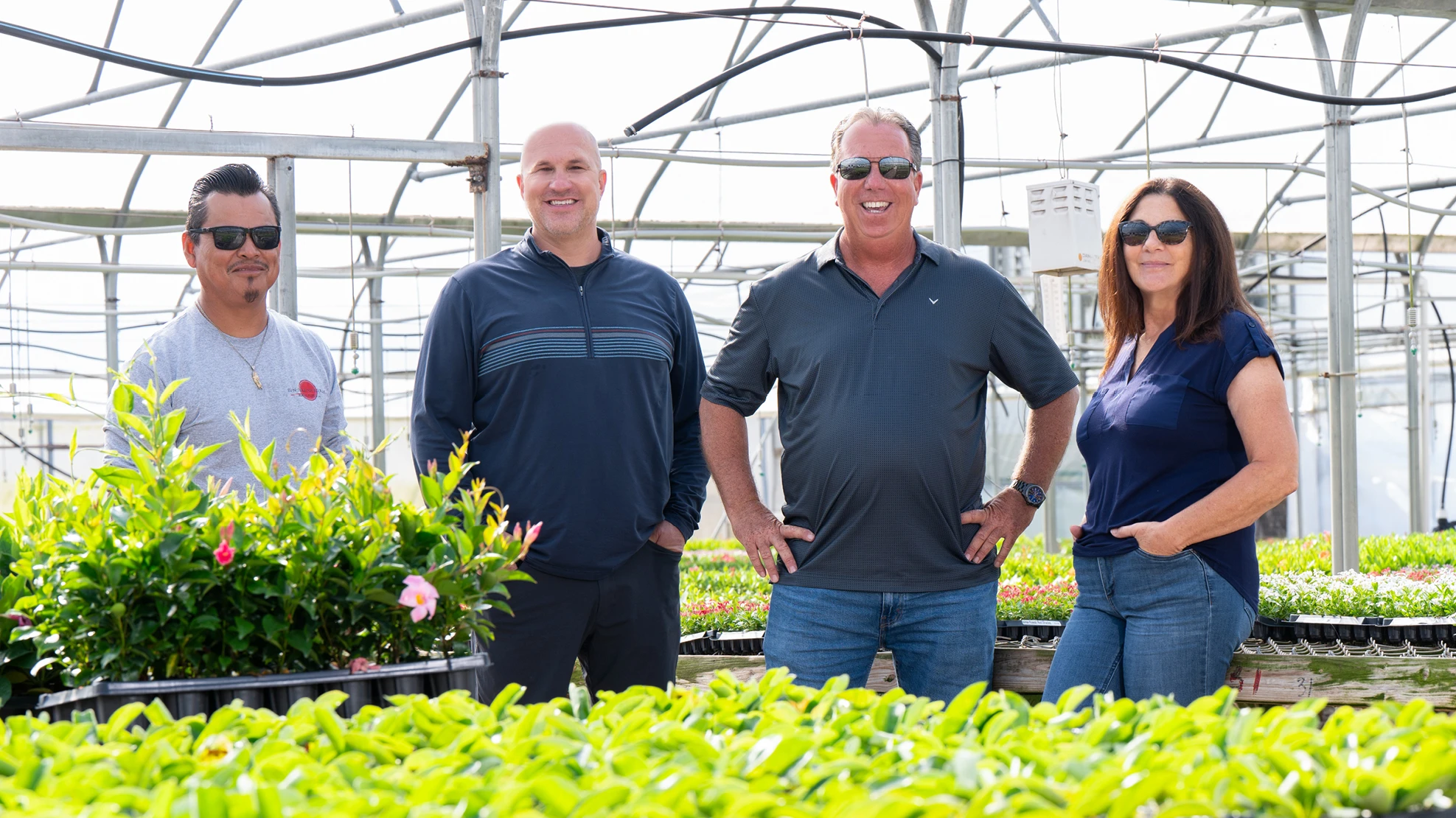
“I have an incredible team. They’re like family,” he says.His core team includes general manager Terri Kelley, shipping manager Teresa Salgado, property manager Scott Gilham, head grower Paul Cummiskey and team lead Victor Salgado. Daniel Martinez is not an official Sun-Fire employee, but he has been an integral part of the post-hurricane cleanup and construction.
“He put his own business off to the side and helped us get back up and running after both hurricanes,” Higgins explains.
In the end, it’s all about your team, he says. “Your team is what’s going to make the difference. They’re the most important thing. You can prep and have all kinds of plans, but if you don’t have the team to carry it out, you’re going nowhere.”

The takeaways
Higgins’ advice for post-hurricane cleanup is simple yet effective: “Be patient and fix things section by section. It can be overwhelming, so accomplish one thing at a time — and celebrate the small victories.”
One important piece of advice for growers: shut down the power and slowly turn the breakers on one at a time.

Higgins said, besides cutting the roofs, there’s nothing he’d do differently when the next hurricane comes through.
“We had a lot of damage, but overall, our plan really went well. I mean, we made it through two hurricanes with everybody being safe and all our employees making it back to work. I would say that’s successful.”
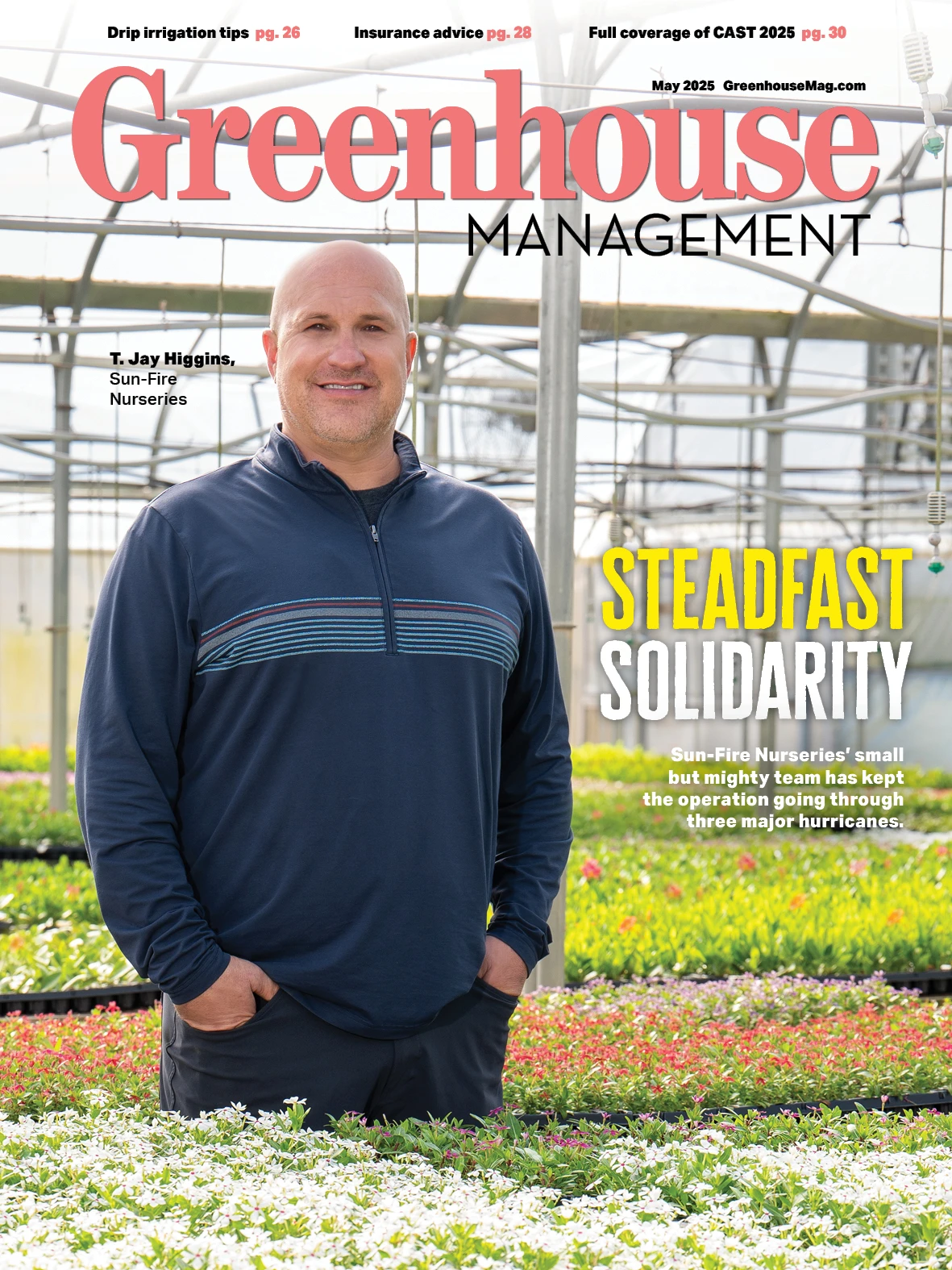
Explore the May 2025 Issue
Check out more from this issue and find your next story to read.
Latest from Greenhouse Management
- Quality Horticulture to acquire Hydrofarm Canada distribution
- Portrait of progress
- Blue Grass Farms acquires Brehob Nursery
- OHP expands sales team with new hire and internal promotion
- The inventive women of TPIE ’26
- Seed Your Future aims to double 2025 total for 'Round-Up at the Register' 2026 campaign
- [WATCH] Remix: Sakata Playlist Combos and New Variety Spotlight
- Beacon Impatiens partners with Roots for Youth in 2026