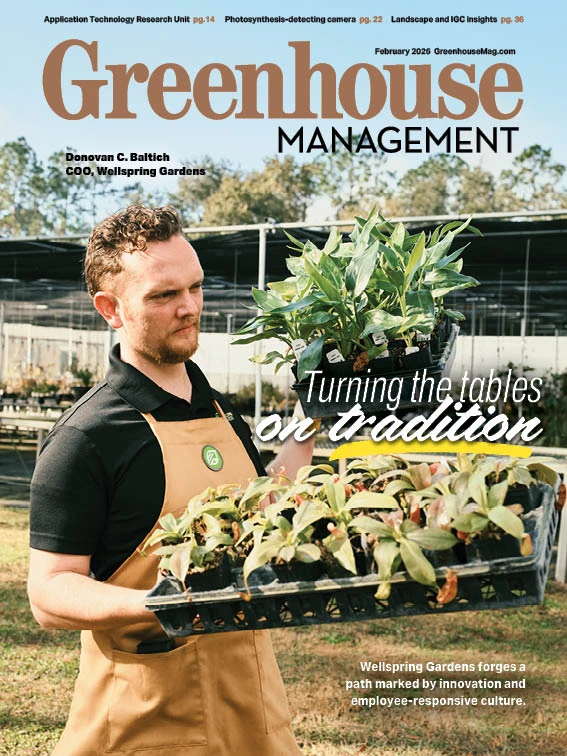
Editor's Note: This article originally appeared in the February 2026 print edition of Greenhouse Management under the headline “Turning the tables on tradition.”

Innovative companies constantly seek ways to attract new employees and retain the best ones. Yet most business offerings revolve around traditional benefit packages.
Wellspring Gardens, the top-ranking company in Greenhouse Management’s 2025 Best Places to Work in Horticulture survey, is an exception to the norm. The company stands out both for its high employee satisfaction and its unconventional approach to achieving that goal.
As an online-only grower-retailer, Wellspring Gardens’ uniqueness springs from its earliest roots. Today, the Lakeland, Florida, business is managed by siblings Donovan C. Baltich, chief operating officer, and Kirsten Maghraoui, production manager, who both spent years in other careers before rejoining the family business.
Wellspring Gardens was founded in 2004 by their father and mother, Donovan K. and Dana Baltich, who remain its owners.
Donovan and Kirsten recall that their father dreamed of a brick-and-mortar plant business. But up-front costs were too high, and it never came to pass. However, it was the early days of online sales platforms — and Kirsten was busy selling “clutter” on eBay.
The family saw an opportunity, and a new dream took form. They combined their desire to grow and sell plants with online eBay sales, and Wellspring Gardens was born.
Twenty-two years later, the company is still entirely online and closed to foot traffic. In 2025, it shipped 85,000 orders — roughly 150,000 plants. It all happens with the help of 15 highly engaged employees who, according to the survey results, are happy to contribute to the company’s success and growth.
Finding the right fit through thoughtful hiring
The Wellspring Gardens website includes an open invitation to apply for work, whether the business is hiring or not. A nearby university is a favorite pool for new associates, many of whom use their time at Wellspring Gardens as their internship.
Plant knowledge is not a requirement to work at Wellspring Gardens. But being teachable is.
“As long as someone’s teachable and willing to work within our systems, they’re able to learn a lot of things,” Kirsten explains. “So, they’re not expected to come with knowledge of our product, but they leave with it.”
Donovan adds that they’re able to keep good people because they’re careful about who they hire. An employment test, completed before the person ever comes on site, is one way the business screens applicants. But Donovan says how a person scores on the test is less important than their willingness to take the test at all.
“I tell people it takes 45 minutes. It only takes 15 to 20. But if they’re willing to take a 45-minute test, that’s a really good sign that they’re going to add a lot to the business,” he explains.
When an applicant clears that first hurdle, an on-site working interview comes next. It’s no face-to-face across a desk. Instead, it’s a hands-on experience of what the job entails, so the applicant is confident it’s something they want to do.
“We have them run through our entire system, and they get to experience it, because it’s just as much us learning about them as it is them learning about us,” Donovan says.
The company only hires in spring, when business peaks. And, though Floridians and Californians order year-round, employees who move on to new opportunities aren’t replaced until the following spring. That ensures everyone has hours during slower times in fall and winter. The company has never had seasonal layoffs.

Prioritizing employee preferences and well-being
Donovan and Kirsten explain their “small but mighty” business does things a bit differently when it comes to benefits and compensation as well. It does not offer health or dental insurance or retirement plans.
But it does offer flexible schedules, on-the-clock breaks to refresh during hot summer months, free hydrating beverages, a vending machine where every price button reads “free,” a weekly company lunch and similar employee-friendly perks.
“We’ve had retirement plans in the past, but we didn’t really have that much participation,” Donovan says, noting that 401(k)s and company matching are things many companies boast about. “That’s only great so long as people are participating in it. We found that our people are much more excited about cash.”
As a result, the company switched to a monthly cash payout. When it became clear that a more frequent payout schedule would help employees, the company switched to a bi-monthly model.
Other non-traditional benefits also respond to employees’ preference for cash. On their work anniversary, employees get a $100 bonus multiplied by their number of years worked. Employees also receive a $100 bonus on their birthday.
“It really encourages staying power,” Kirsten says, adding that appreciation is integral to their management styles.
While the company has turnover, it’s generally not due to job dissatisfaction. It’s simply time for someone to move on. Their longest employee, also the first non-family manager, joined them 4.5 years ago.
With compensation, the company works to “keep a nice buffer” well above Florida’s minimum wage, which is currently $14 per hour. Every time the minimum wage rises, associate compensation goes up, too. That’s in addition to raises given due to length of service or promotions.


Supporting associates through hands-on training and mentorship
The Wellspring Gardens team is split between two departments: fulfillment and production. While people are hired for specific departments, as with most smaller teams, there’s also some crossover and cross-training. And some responsibilities — like watering an overly dry plant — fall to everyone.
“We found it very valuable to have people know how to do all things. Not only does it help us if someone’s out or something, but it helps them to understand this is what happens in the next step,” Kirsten says.
The onboarding process is pretty basic, covering company policies, benefits and expectations.
“We do a little presentation and get them to understand the overall structure of everything so that when they’re out there, it makes a little more sense,“ Kirsten says. “But we believe that actually getting in there and doing the task is what really helps them.”

After the presentation, new employees dive in. Newcomers train with a manager or a longer-term employee who can support them as they work and learn.
Every workstation has simple and easy instructions posted, so there’s never any doubt about what needs to be done and how to do it.
“We’ve made it very hard to make mistakes and very easy to do the right thing,” Donovan explains. “When I’ve worked in other jobs and I’ve been given resources like that, my confidence soared, and that’s what we want. . . . They don’t ever have to feel like they’re floundering.”
Everyone starts as a temporary employee, subject to 30-, 60- and 90-day reviews.
“Once it becomes clear someone has what it takes, they pretty quickly move up to being a permanent employee,” Donovan says, noting that everyone who is now filling more managerial roles started as temporary employees.
“As they show natural aptitude, they get promoted and rise in the ranks,” he adds.

Encouraging healthy competition and team achievement
Tracking employee performance is a priority at Wellspring Gardens. Every workstation and every task is tracked. As an example, the packing line has a physical counter that employees push every time they complete an order. There’s also a timer, so everyone’s packages per hour rate is known.
While Donovan and his fulfillment manager have access to a data dashboard, everyone can see everything that’s being tracked live that day. Yes, that includes the performance of other employees.
Kirsten explains that employees understand the data are needed not just to track individual performance but also to track team performance and staffing needs.
Rather than making people feel pressured, the transparency has fostered what Donovan and Kirsten see as healthy competition. People want to break someone else’s record but also work together as a team to meet specific goals. There’s pressure to improve, but it’s a healthy, balanced pressure.
Challenges to improve are typically tied to incentives, such as raises dependent on meeting a specific goal.
“I don’t think I’ve ever really had to be a stick kind of guy. I’ve always been a carrot. We motivate with the carrot,” Donovan says. “(Our employees) are very invested in being efficient. They’re very invested in doing great work. They care about doing a great job.”
Many of the company’s most innovative, beneficial ideas have come from employee suggestions. Donovan and Kirsten point again to their hiring practices: Teachable, humble people who listen and learn naturally come up with very helpful ideas as they learn the process and understand the business as a whole.
Team activities have evolved as the business has grown from family-only to minority-family. New traditions for company activities and celebrations come from the ground up.
“As our employees suggest they want to do these things, we start doing them,” Donovan says.
A suggestion box was recently added — in response to a suggestion.


Illustrating a ‘Best Places to Work’ culture through real-life examples
Asked for the primary reason they believe their employees show up every day, Donovan and Kirsten keep the spotlight on their employees.
“I think the No. 1 reason why our associates like coming to work is because they like the people they work with. This says more about them than it does about us in management,” Donovan says. “Our primary role is to hire A-players that our current associates want to work with.”
He offers four examples to illustrate the type of people who help Wellspring Gardens run:
- When Donovan was still fulfillment manager, he made a YouTube playlist of unboxing videos their customers had posted. “I sent it to my team because I thought they might find it interesting. About a week later, a team member told me she’d watched every single video because she wanted to find ways to improve. That playlist contained three to four hours of footage. That associate is now our fulfillment manager,” he shares.
- In the past, the team purchased postage on orders after they were packed. This required hours at the end of the day — scanning packing slips, buying postage, printing labels and applying them. It’s also where most mistakes occurred. “You could have performed every function of the fulfillment process flawlessly, but if you put the wrong label on an order, it’s all for naught,” Donovan says. An employee suggested purchasing the postage labels in advance and printing them with the packing slips. “We had to create a system that could accurately estimate the weight of each package, and once we did, it became an efficiency and accuracy game-changer. This is just one improvement of dozens he’s brought me over the years,” Donovan adds.
- A former associate proved himself highly responsible and trustworthy at a time when the company needed an assistant manager. But he was only 17 years old. There was some concern that older employees wouldn’t respect his authority, but he was promoted anyway. “It turned out to be an overwhelmingly positive thing. He carried himself in such a professional manner — well beyond his years — and he was so well-trained that both his peers and his seniors followed him without hesitation,” Donovan says.
- Another former associate initially didn’t feel confident about her ability to pack orders fast enough. “After her first day, she took a few boxes home with her. She returned to work the next day and smashed all our previous packing records. She had taken the boxes home to figure out the fastest way to fold them,” Donovan explains.
As the company has grown from its eBay origins, the “family” at Wellspring Gardens has also grown, adapted and learned to create new ways of doing business that remain uniquely its own.
“In many ways, the way that we run the business and our interactions with our employees are mostly based on how we ran things as family members,” Donovan says. “As a small team, I think we grow closer together, maybe a little bit closer than you would at a bigger company.”
From the results of the 2025 Best Places to Work survey, it seems the Wellspring Gardens approach is working.
Explore the February 2026 Issue
Check out more from this issue and find your next story to read.
Latest from Greenhouse Management
- Proven Winners retail survey finds plant quality and selection are top shopping considerations
- The Growth Industry Episode 9: IPPS International Tour preview with Brie Arthur and Liz Erickson
- Weather report
- ‘Horticulture is just the vehicle that I ride’
- Gordie Bailey Jr., third-generation family leader of Bailey Nurseries, passes at 90
- Keep it moving
- New American Floral Endowment scholarship supports global floriculture research
- Seventh edition of Tulip Trade Event planned for March 2026 in Netherlands