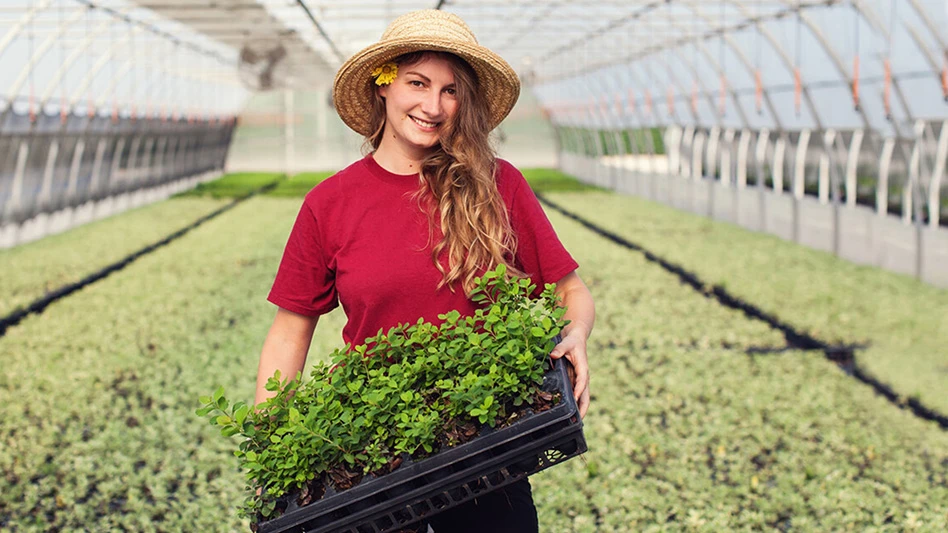
There is a significant shift in today’s greenhouses from those of just a few years back. Plants were typically placed on boards resting on concrete blocks or pallets. Floors were dirt. Ceilings were low. It was humid, the temperature often extreme. A greenhouse was like an industrial space.
Since the majority of today’s garden center shoppers are women, the typical greenhouse of the past could hardly be considered consumer friendly. All that has changed today.
Whether you’re building on, retrofitting or simply making do with your existing greenhouse structures, here are 10 factors to consider.
1. Orient the building carefully
In the past, retailers tended to place greenhouses to the side or in the back of the property, and they had as much aesthetic appeal as a lawnmower repair shop. Now greenhouse manufacturers and designers recommend you put your greenhouse in front of the store and capitalize on its curb appeal.
“Point the south end toward the road, so you have a lot of plant material and color showing,” said Matt Stuppy, president of Stuppy Greenhouse Manufacturing Inc. in
2. Boost curb appeal
Greenhouses no longer have to be generic lookalikes. They can be custom designed.
Jeff Warschauer, vice president/sales at Nexus Greenhouses in
Neil Devaney, vice president of Jaderloon Co. in
3. Connect buildings
Aesthetic connections can be made between the greenhouse and the store through a wooden gazebo, a porch with rockers or various lean-tos, said Chuck Sierke, sales representative at Cravo Equipment in
Sometimes a store door can lead directly into the greenhouse so the customer has no exposure to inclement weather.
But, as Sierke said, many times there is no connection -- at least no visible connection -- between the store and the greenhouse, and there are often many more higher-margin items, such as shrubs and trees, on the outside, exposed to the elements. In rainy weather, this disinclines people to shop.
“A rainy weekend at the end of spring can drop sales up to 80 percent,” Sierke said. “If you can cover more area with canopies and awnings, that is the biggest potential for up-sales even in inclement weather.”
Sierke told about a garden center chain in
4. Install retail-friendly doors
Pay attention to entry and exit doors, Warschauer said, and make sure they are wide and easy to manipulate. He said it’s much better to put in automated doors, which are expensive, but make it easy for customers pushing carts.
5. Think about floors and ceiling
Instead of dirt floors, which are difficult to walk on for women with heels or to push a cart over, have a concrete or other solid floor surface, Devaney said.
Another retail-friendly move is to raise the ceiling. “In the past a greenhouse would give you a boxed -in feeling. You felt as if you could jump up and almost touch the ceiling,” Sierke said. “Now the trend is, instead of having the roof just above your head, you have the high under-gutter heights, with the ceiling up to 14 feet, to get a more open feel to the structure.”
6. Reduce the number of columns
Another way to create an open feel, Warschauer said, is to remove columns -- replaced with beams. “With columns or posts you tend to go 20 to 30 or maybe 26 feet, but with beams you can go straight across 50 to 60 feet, which allows for better retail bench layouts,” he said.
7. New materials are more durable
Polycarbonate is recognized as a better material than polyethylene, Devaney said. It will last 20-plus years rather than four or five. “Polycarbonate will be a greater initial investment, but will take far less maintenance, and this is especially important for a garden center without a maintenance staff. And it looks much better aesthetically.”
8. New air-flow techniques cool customers
The trend is toward more natural ventilation as opposed to fans, Devaney said. This incorporates open-roof design, along with long sliding doors or roll-up curtain walls.
Much more attention is being paid to the comfort of the customer, avoiding extremes of temperature.
“Salespeople now tend to make sure that people are comfortable, for if they are too hot or too cold they won’t want to stay long in the greenhouse,” Stuppy said.
9. Rethink irrigation
Instead of overhead watering, Warschauer suggested a subirrigation system with automated pump and tank. This process flushes out salt buildup, allows better water absorption, results in losing water only due to evaporation in warmer climates, saves labor and makes for a less-damp environment for shoppers.
10. Lower hanging baskets
With more open spaces, Stuppy suggested placing hanging baskets at eye level. “You can also display more material per square foot,” he said. “You want to have your popular plants where people can get to them easier than others they would have to walk for. And you want to set up an easy method so you can replace plants as they’re sold, so if people walk from one end of the greenhouse to the other, they don’t see vacant spots.”
For more: Chuck Sierke, Cravo (888) 738-7228; www.cravo.com. Jeff Warschauer, Nexus Corp., (800) 228-9639; www.nexuscorp.com. Matt Stuppy, Stuppy Greenhouse Manufacturing, (800) 733-5025; www.stuppy.com.
{sidebar id=3}
- Thomas G. Dolan
Thomas G. Dolan is a freelance writer in Anacortes, Wash.
August 2008
Latest from Greenhouse Management
- The Growth Industry Episode 10: State of the Horticulture Industry
- Millennium Pacific Greenhouses launches California Grown Cucumber Program
- Scientists develop vitamin A-enriched tomato to fight global deficiency
- Tennessee Green Industry Field Day scheduled for June 11
- UTIA and UT Knoxville research teams will develop automated compost monitoring system
- Ken and Deena Altman receive American Floral Endowment Ambassador Award
- [SNEAK PEEK] Leading Women of Horticulture: The women of Fairview Greenhouses & Garden Center
- [SNEAK PEEK] Leading Women of Horticulture: The inventive women of TPIE ’26