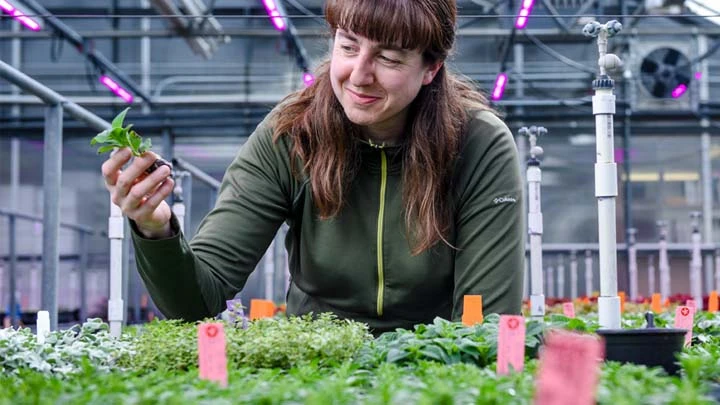
As more and more growers begin incorporating LEDs into their production facilities, they’ll learn LEDs involve more than just installing new lights. In early 2017, Iwasaki Bros., Inc. in Hillsboro, Oregon, installed Philips LED toplighting over three growing areas. Below, Kathleen Baughman, Iwasaki’s operations manager, share four tips that will help growers make the transition to LED lighting.
1. Use amber-tinted safety glasses.
Working under the red/blue LED lights can make it difficult to see, especially when it is darker outside and the lights become nearly sole-source. Scouting for insects or diseases can be especially challenging under these conditions. You can invest in spectrum-correcting eyewear, but they are cost prohibitive (up to $60 per pair). Amber-tinted safety glasses are an economical alternative (only $2-3 per pair) and counteract the red/blue spectrum almost completely.
2. Install an outdoor PAR sensor.
There are daily light integral (DLI) maps you can reference on the internet, but there really is no substitute for knowing what happens at your facility. You can use the PAR data to determine what time of year and how long you need to run your lights. Having an outdoor PAR sensor also helps you determine how much light you are losing from greenhouse glazing, shade, or hanging baskets. Just stand inside your greenhouse with a handheld sensor and compare to the outdoor PAR in real time.
3. Increase operational flexibility with switches.
Being able to control row of five to 10 lights at time will allow you to turn off portions of the greenhouse as the crop expands and contracts, further increasing energy savings. Having banks of lights on individual switches will also allow you to customize light needs by crop.
4. Conduct your own trials.
Installing LED lights will impact your nutrition program and crop timing. Is your operation flexible enough to respond to new transplant schedules? Can you adjust your cutting or liner orders down as a result of fewer losses? Running a trial will help answer those questions, but make sure the trial is large enough to be meaningful.
Photo courtesy of Philips Lighting
Latest from Greenhouse Management
- The Growth Industry Episode 10: State of the Horticulture Industry
- Millennium Pacific Greenhouses launches California Grown Cucumber Program
- Scientists develop vitamin A-enriched tomato to fight global deficiency
- Tennessee Green Industry Field Day scheduled for June 11
- UTIA and UT Knoxville research teams will develop automated compost monitoring system
- Ken and Deena Altman receive American Floral Endowment Ambassador Award
- [SNEAK PEEK] Leading Women of Horticulture: The women of Fairview Greenhouses & Garden Center
- [SNEAK PEEK] Leading Women of Horticulture: The inventive women of TPIE ’26