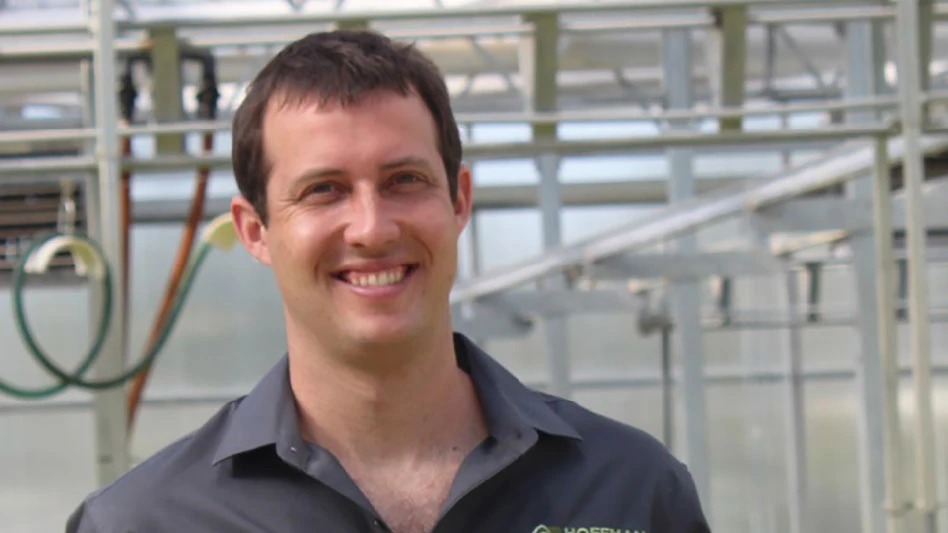

As time marches on and the current industry leaders get older, eyes are turning to the younger generations rising through the ranks at growing operations across the country. As the new chief operating officer at Hoffman Nursery since January, 32-year-old David Hoffman brings specific goals to the company’s leadership team, which includes his parents John and Jill, who founded the nursery in 1986. Like other young people, both in the industry and outside of it, Hoffman is concerned with sustainability. While Hoffman says that a commitment to sustainability has always been part of the nursery, it’s taken a new form since he’s become a leader at the business, saying that sustainability is “definitely becoming more and more of an opportunity.”
Sustainability efforts
Hoffman is focusing on their inputs, including plastic, perlite and water. Not only are they trying to reduce them, but they’re also trying to switch to more sustainable options where they can.
Hoffman credits the innovations made across the industry over the past five years, which have provided the industry with more sustainability options.
Plastic accounts for a large chunk of horticulture’s current sustainability issues, so being able to implement alternative materials would be a great step forward in sustainability, he explains. “There are alternatives to plastics that I think in another five years would probably be more reasonable,” Hoffman says, mentioning the possibility of making trays out of mushrooms instead of plastic in the future, or making pots out of fiber or cardboard. But until then, the nursery is still doing what they can. “As far as plastic alternatives,” Hoffman explains, “we are leaning towards an inhouse tray for the future and refining our shipping process with potentially different materials or packing methods.” They’ve also recently started collecting their plastic trays to be recycled. “One of our customers had been compiling our plastic waste with theirs to send to East Jordan’s plastic recycling program,” Hoffman says. “I think as we collect more and find the space to do so, we will be able to fill a full truck ourselves.”
Hoffman says they’re slowly trying to phase out using perlite. “Perlite is something that is quite energy intensive to make, from the mining process to the popping of it for the final product,” he explains. They have switched about half of their growing media blends to include HydraFiber instead of perlite. Being made from wood and bark, Hoffman considers HydraFiber to be a more sustainable alternative to perlite.
For water, Hoffman says, “that’s probably one of the most important inputs that we need to take care of and be considerate of when we’re making decisions here.” After all, it takes a great deal of water to irrigate plants and make plastics, and it takes a lot of energy to preserve that water and keep it clean. “I think that’s probably one of the most important parts of this.”
Hoffman explains how they’re trying to conserve water, which can be tricky when running such a large operation that’s continuing to grow. Already encompassing a total of 129 acres, Hoffman says the nursery just bought another farm, where they’ll be using 10 more acres to grow mother plants, so they need to conserve water to offset the extra production space. “We try to collect as much of the water as possible that lands on or flows through our property,” Hoffman says. “We have wells that we try not to use unless in drought situations. We recirculate runoff water that has collected in our bioretention ponds back into to our irrigation ponds to reuse.”
“The water that we use is a resource for our livelihoods and it is in our best interest to protect and maintain that,” he says. Especially with global climate change and droughts in the western U.S., using water in a smart and sustainable fashion is becoming more important for everyone, including the North Carolina-based Hoffman Nursery.
But at what cost?
Current technological capabilities aren’t the only limiting factor when it comes to sustainability initiatives. As a business, Hoffman Nursery also has to be concerned with the expense of certain efforts. “It comes back to trying to figure out what makes the most sense for us,” Hoffman explains. “And at this point, what’s most cost effective to make may win, to some extent, because we’re still a company that needs to make a profit … so we just have to find ways to make it better or figure out easier solutions to some of it, because in some cases, it [the most sustainable solution] is cost prohibitive.” Path blocked by pandemicThe COVID-19 pandemic and all its related problems have somewhat hindered Hoffman’s sustainability efforts. “I think it’s hard enough to try to implement different sustainability things, not to mention adding on supply chain problems in a pandemic on top of that, and labor shortages. You know, it comes at you fast,” he says. “It’s presented challenges and we’ve worked as a team to be able to overcome them. Our goals are still in place, but I think they’ve probably been delayed some, too, whether that’s for some of those reasons or that it’s just cost prohibitive at this point, or that it’s not mainstream enough to be at the level that we need it to.”
Young leadership
The leadership scene in the green industry continues to change.
“[Baby boomers] are largely the ones that are running the operations now, so either they’re going to transition their businesses, or those businesses are going to be bought up and consolidated,” he says. “But I think whether it’s consolidating or transitioning, I think there’s a lot of opportunity. Whether it’s for a young entrepreneur to take over a business or even people like myself to be able to take and lead some of these businesses up into the future, I’m excited about it. I think there’s a lot of opportunity out there for people that are just getting into the industry.”
And each generation has something to teach each other.
“I think that there’s an opportunity there for current leaders to be able to learn from younger leaders,” he adds. “And taking a risk on some of these young people isn’t always a bad thing. I think that they all have good ideas. So, I think that’s all important and all part of how we’re going to grow not just as a business, but as an industry, too.”
Beyond more young people taking leadership of individual businesses, the younger generations will soon be getting onto boards and becoming industry leaders. And having those different viewpoints at the highest levels of the industry will help the horticulture world move forward, especially when it comes to sustainability initiatives like the ones Hoffman is implementing.
Latest from Greenhouse Management
- The Growth Industry Episode 10: State of the Horticulture Industry
- Millennium Pacific Greenhouses launches California Grown Cucumber Program
- Scientists develop vitamin A-enriched tomato to fight global deficiency
- Tennessee Green Industry Field Day scheduled for June 11
- UTIA and UT Knoxville research teams will develop automated compost monitoring system
- Ken and Deena Altman receive American Floral Endowment Ambassador Award
- [SNEAK PEEK] Leading Women of Horticulture: The women of Fairview Greenhouses & Garden Center
- [SNEAK PEEK] Leading Women of Horticulture: The inventive women of TPIE ’26