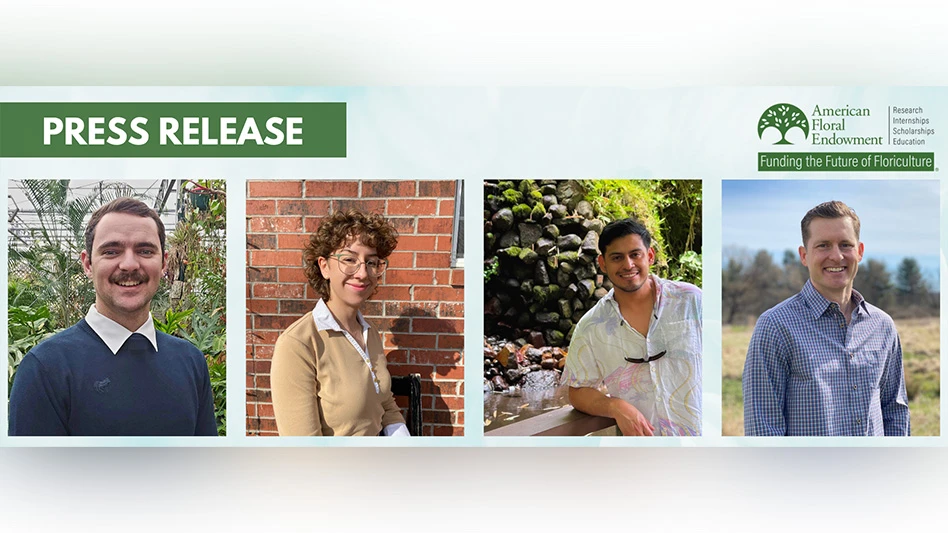
Photos courtesy of American Floral Endowment
Four graduate students have received scholarships through two programs administered through the American Floral Endowment.
Andre Truter, a master’s student at North Carolina State University, is the recipient of the 2025 Paul Ecke Jr. Scholarship. Truter will receive a total of $10,000 ($5,000 each for two consecutive years).
Three students each received a $5,000 2025 Altman Family Scholarship: Rose Elbert, a master’s student at Michigan State University; Henry Gonzalez, a doctoral student at Michigan State University; and Bret Timmons, a doctoral student at North Carolina State University.
“These exceptional young professionals are working through their studies to bring a fresh perspective and innovative momentum to the industry,” said AFE Executive Director Debi Chedester. “We are excited to support them on their career path that will continue to advance the areas of horticulture and floriculture.”
The Paul Ecke Jr. Scholarship honors the late Paul Ecke Jr., a horticulturist from California credited with moving the industry forward with his innovation and educational program development in the field. The scholarship awards $5,000 for two consecutive years ($10,000 total). The recipient must be pursuing a master’s or doctorate degree at a U.S. land-grant university. For more information about this scholarship, click here.
Created in 2015 by Ken and Deena Altman, the Altman Family Scholarship seeks to support improvement in horticulture education and research by investing in young industry professionals. This scholarship provides an annual scholarship ($5,000) to horticulture graduate students. For more information about this scholarship, click click here.
To learn more about the Paul Ecke Jr. and Altman Family Scholarships and to apply, click here. Applications are due by Feb. 1 each year.
Read more about each of the scholarship recipients below, courtesy of AFE.
Andre Truter, North Carolina State University
As an undergraduate student at Stellenbosch University in South Africa, Truter set out with a career goal to do what he was familiar with while growing up. His parents and grandparents were farmers. It was the life he had always known. So, he began college studying conservation ecology.
But by his junior year at the university, he developed a strong interest in plant cycles and growth and how they relate to natural systems. It was a moment of realization that his interests had expanded to both conservation and sustainability and how those are applicable to the production system. By the time he had graduated with his bachelor’s degree in conservation ecology, he was invested in horticulture. He went to work for a company that specialized in producing organic substrates and found a passion for research in the field.
“It honestly found me before I found it,” he says. “But I am glad it did. I was introduced to the idea of sustainable substrates and the production of organic substrates. And from then on, it’s just been so fascinating.”
It was a by-chance meeting in South Africa that led Truter to the United States to continue his studies and research in substrates. Brian Jackson, professor and director of the Horticultural Substrates Lab at NC State, was on a visit to the vermiculite mines in South Africa and a guest speaker at the Seedling Growers Association of South Africa annual conference. It was there that Jackson met Truter and recruited him to NC State to pursue a master’s degree.
A year and a half later, Truter says he is more passionate about the field than ever.
“I think it’s sort of diving into the unknown that is so appealing to me. It is these things that we do not know about, and it’s about slowly discovering each of these little puzzle pieces and trying to piece them together,” he says. “That is what keeps me going. It’s like a continuous cliffhanger that you’re waiting for all these exciting things and results to come in. It’s a passion that pulls me out of bed at night. I think it’s quite fulfilling.”
Truter says he envisions a career that allows him to equally balance a hands-on approach, working alongside growers and being part of the practical side of horticulture, with plenty of time to continue research in the field.
“My dream job is to be able to work with multiple growers as well as substrate manufacturers on a global scale,” he says. “I have two possible paths to follow. The first is to work with multiple substrate companies globally to improve resource utilization and management. The second path is to work for a substrate company on the technical and research side but also be able to interact with clients and businesses.”
For now, Truter is focused on completing his master’s degree in horticultural sciences, with an anticipated graduation date in December 2025. He plans to continue his education at NC State to obtain his Ph.D. in horticulture. He said earning the Paul Ecke Jr. Scholarship has been an honor in more ways than one.
“I think that the money is obviously a fantastic bonus, but it’s definitely an encouragement to have the recognition for a lot of the hard work and sleepless nights that I’ve had with the research that I’ve been doing,” he says. “That is such a massive positive aspect of the scholarship for me.”
Rose Elbert, Michigan State University
When Elbert was young, little did she know that when her parents took her to the Family Tree Nursery garden center near her home in Kansas for horticulture camp that it would be a prelude to her future.
Now, Elbert is months away from earning her master’s degree in horticulture. Upon her graduation in December 2025, she plans to continue her education to earn a Ph.D. in the field before setting out to apply her research and studies to advance the industry.
“When I was a senior in high school, I was trying to figure out what I wanted to do for a major in college,” she says. “That’s when I realized you can have a satisfying career in horticulture. I was trying to find the intersection of my hobbies and a full-time profession, and it just happened to be horticulture. I love it. The more I learn about how things grow and how the industry operates, the happier I am to be part of it.”
In addition to her studies and research, Elbert had the opportunity to be immersed in the industry through two internships. In the summer of 2022, she interned at Winterthur Museum, Garden and Library. While there, she gained insight into working with a variety of annual plant materials intermixed with the native species of Delaware. She was trained to identify invasive species, proper planting techniques and operation of landscape equipment.
In 2023, Elbert interned at Willow Lake Student Farm in Manhattan, Kansas, where she learned more about small-scale vegetable production techniques, running a community-supported agriculture program, organic pest management and outdoor cut flower production. She also wrote weekly newsletters.
Elbert said one of the things that attracts her to the industry is interaction with other horticulturists. It is the people, she noted, blended with industry research, that have helped her create a goal of becoming a professor.
“It’s a unique position where you can connect good talent to the industry and also connect the industry to solutions,” she says. “I think that’s what really draws me to the idea of becoming a floriculture professor.”
Earning the 2025 Altman Family Scholarship is an incredible honor, Elbert says, noting her thanks to her adviser, Roberto Lopez, who encouraged her to apply. She is grateful to the Altman family for believing in young professionals and helping them reach their goals.
“Especially in these uncertain times, the ability to reduce the financial burden is significant,” she says. “But also, this recognition is really flattering and an honor. To be recognized by the American Floral Endowment while working toward becoming a floriculture professor is huge. I know it is more motivation to continue what I am doing and to do it as well as I possibly can.”
Henry Gonzalez, Michigan State University
One could say that Gonzalez was born into horticulture. The Michigan State University graduate student is a native of Nahuizalco, a town in El Salvador that is part of what is known as “The Flower Route.” An area highlighted by charming blooms and natural wonders, it is a fitting environment for someone who would one day move the needle on horticulture and environmental research.
“I would say I learned from my grandmother,” Gonzalez says. “Since I was a child, she shared some traditional knowledge with me on plant propagation, irrigation and the importance of bees. My previous academic journey has led me to the horticulture field to research alternatives to make it more sustainable and resource efficient.”
Before entering the doctoral program at Michigan State, Gonzalez earned a bachelor’s degree in environment from Zamorano University in Honduras and a master’s degree in mechanized systems management with water planning from the University of Nebraska-Lincoln.
In addition to his dedication to his studies and research, Gonzalez has a deep commitment to mentorship and community service. He said the passion to remain active in those areas stems from several people who have mentored and supported him. His biggest supporters are his family members, he notes.
“I would like to thank my family for trusting in me, investing in my dreams and supporting me during difficult times,” he says. “It just hits differently when they share that they have a son pursuing a Ph.D. in horticulture and a Ph.D. in environmental science and policy, even when they don’t understand many of the things I do.”
Gonzalez says he also draws inspiration from an opportunity to learn English as a result of mentorship from his high school teachers.
“Since then, I have decided to get involved in community service and mentoring high schoolers,” he says. “I really like sharing my story and recognizing my background (first-generation student since high school and from an underrepresented community). I wouldn’t be where I am if it weren’t for all the people who provided me with their mentorship and support. I just feel like it sends a strong message about working hard for your dreams. In Zamorano, we have this phrase that I always use: labor omnia vincit, which means 'work conquers all.'”
Gonzalez says he plans to carry mentorship into his future career as a professor in the field of horticulture. As he looks ahead, he says the one thing he hopes his students will take with them into their own careers is a strong understanding of what the industry is and what it isn’t.
“I hope my students understand that horticulture is not merely about plant cultivation, but fundamentally about stewardship,” he says. “It involves nurturing ecosystems, conserving resources and contributing positively to the communities we serve. Whether they work in research, production, policy or education, I hope they always approach their work with curiosity, humility and a commitment to stewarding natural resources for the benefit of both current and future generations.”
Earning the Altman Family Scholarship is an incredible honor, he says. He says that while the financial support is deeply appreciated, being recognized is a meaningful affirmation of dedication to an academic and research journey.
“It is a recognition of the long hours, challenges overcome and unwavering commitment I’ve brought to my studies in horticulture and environmental science,” he says. “It validates my efforts and the values of curiosity, perseverance and integrity that have guided my path. Receiving this scholarship motivates me to continue striving for excellence and to use my work to contribute positively to my field and community.”
Bret Timmons, North Carolina State University
Timmons proudly served his country, earning a Certificate of Commendation for performance of duties while serving in Operation Iraqi Freedom from 2007 to 2008. Afterward, he decided to enroll in college using the GI Bill to study political science.
“After a couple of semesters, it felt like a dead end — not necessarily in terms of value, but in fit,” he says.
It was a vacation trip to Idaho that would open his eyes to his future. When he found himself surrounded by farms and ranches, he realized those were the things that mattered.
“Plant production began to check all the boxes — being outdoors, working with people, solving real problems and producing something that improves daily life for others,” he says. “That was my aha moment. I came home and changed my major. I haven’t looked back.”
Since then, Timmons has earned a bachelor’s degree from California State Polytechnic University Pomona and a master’s degree from Cornell University. He's now a doctoral student at North Carolina State University, working with alternatives to peat-based substrates for floriculture producers.
Timmons says upon his anticipated graduation in May 2026, his ultimate goal is to become a professor, where he will have an opportunity to shape the next generation of horticulture industry members and solve the problems within the industry.
“I love the idea of tackling real-world challenges in horticulture and being part of the solution,” he says. “But even more than that, the chance to mentor students (and) help them find that moment when plant science clicks is incredibly powerful. When a student asks to walk with you after class because something you said lit a fire in their brain, that’s when you realize this work matters.”
He says the biggest lesson he hopes his future students leave his classroom with is never to underestimate the importance of mastering the basics, as everything else builds on that.
As a recipient of the 2025 Altman Family Scholarship, Timmons says he is grateful to be recognized.
“Altman Plants is about more than growing plants — they invest in people,” he says. “Their support tells me that someone sees the work I’ve put in and believes in where I’m heading. That’s humbling and motivating. The scholarship helps financially, of course, but it also says: keep going. I want to give a sincere thank you to the Altman Family, the American Floral Endowment and everyone who supports students in this field. You’re not just helping us go to school; you’re helping build the future of horticulture. Life is for growing.”
Latest from Greenhouse Management
- Blue Grass Farms acquires Brehob Nursery
- OHP expands sales team with new hire and internal promotion
- Seed Your Future aims to double 2025 total for 'Round-Up at the Register' 2026 campaign
- Beacon Impatiens partners with Roots for Youth in 2026
- Inner visions
- New internship data empowers horticulture employers
- American Horticultural Society announces winners of 2026 Great American Gardeners Awards
- Sustainabloom releases new sustainability template for wholesale florists