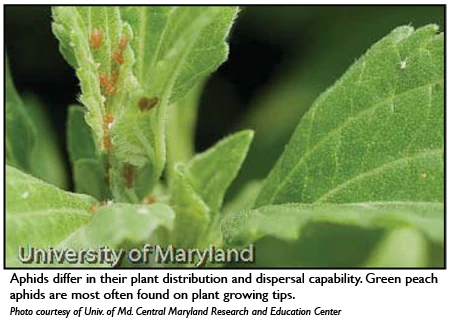
Members of the Central Maryland Research and Education Center are starting to receive plant samples from growers that are infested with aphids. The most common aphids found on ornamental plants include green peach aphid, melon aphid, potato aphid and foxglove aphid. These 4 species can reproduce rapidly. Extension personnel said in the spring aphid populations can explode in greenhouses that are filled with tightly spaced plants. Aphid populations can build up and spread rapidly going unnoticed by growers who are focused on plant production and shipping.
Certain plants species, including sage, dianthus, coleus, basil, snapdragon, zinnia and ornamental pepper, are more susceptible to aphids and should be monitored frequently.
The key to early aphid detection is to find the locations in the greenhouse where populations build up.
Aphids differ in their plant distribution and dispersal capability which can influence monitoring techniques. A 10-20 X hand lens can be used to closely examine foliage and stems at least weekly to detect populations early enough so that appropriate controls can be implemented. Yellow sticky cards will capture winged aphids which can develop when populations build up to very high levels on plants.
Aphids excrete honeydew, which is an excellent growing medium for black sooty mold fungi. The mold can cover foliage and flowers. Look for shiny foliage since it is something that can be spotted easily.
Latest from Greenhouse Management
- The Growth Industry Episode 10: State of the Horticulture Industry
- Millennium Pacific Greenhouses launches California Grown Cucumber Program
- Scientists develop vitamin A-enriched tomato to fight global deficiency
- Tennessee Green Industry Field Day scheduled for June 11
- UTIA and UT Knoxville research teams will develop automated compost monitoring system
- Ken and Deena Altman receive American Floral Endowment Ambassador Award
- [SNEAK PEEK] Leading Women of Horticulture: The women of Fairview Greenhouses & Garden Center
- [SNEAK PEEK] Leading Women of Horticulture: The inventive women of TPIE ’26