Poinsettia bracts are coloring up and plants are crowded on benches and greenhouse floors. Univ. of Md. plant pathologist Karen Rane said Botrytis can be particularly difficult to control at this time of year. Most growers are focused on shipping and not on scouting for diseases and insects.
Leaves, bracts and broken stems left on benches and floors become easy hosts for the ever-present Botrytis fungi that can produce millions of spores. These spores can easily be spread to the rest of the plants in the greenhouse.
Rane said cultural practices that inhibit Botrytis infection are main means of controlling the disease. The relative humidity should be maintained at below 80% and keep the foliage as dry as possible. Avoid sudden temperature fluctuations that can result in condensation forming on the plants. Condensation dripping from glazing or overhead pipes can contribute to Botrytis development.
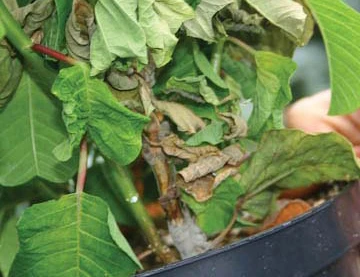
Rane said growers should scout for dead areas on the bracts and leaves which can signal Botrytis infection. Stems that appear to be suddenly wilted should be examined for tan or brown stem cankers caused by the fungus. The gray-brown, fuzzy growth of the pathogen may be seen on infected tissue when examined with a hand lens.
Symptomatic plants and plant debris should be placed in sealed plastic bags, removed from the greenhouse and discarded. This will help to keep spore dispersal at a minimum.
Pictured: Botrytis on poinsettia leaves and stems.
Photo by Karen Rane, Univ. of Md.
Latest from Greenhouse Management
- The Growth Industry Episode 10: State of the Horticulture Industry
- Millennium Pacific Greenhouses launches California Grown Cucumber Program
- Scientists develop vitamin A-enriched tomato to fight global deficiency
- Tennessee Green Industry Field Day scheduled for June 11
- UTIA and UT Knoxville research teams will develop automated compost monitoring system
- Ken and Deena Altman receive American Floral Endowment Ambassador Award
- [SNEAK PEEK] Leading Women of Horticulture: The women of Fairview Greenhouses & Garden Center
- [SNEAK PEEK] Leading Women of Horticulture: The inventive women of TPIE ’26