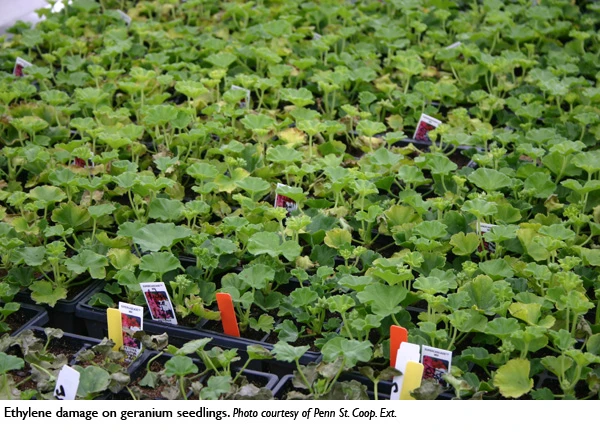
Greenhouse growers who use gas-fired unit heaters need to be sure they are operating properly to avoid generating air pollutants that impact plant growth. Unvented heaters have no flue connection resulting in heat and fuel combustion products being exhausted into the greenhouse. The flue gases may contain pollutants and added moisture that can damage plants. Ethylene is an odorless, colorless gas that acts as a plant hormone that can cause injury. Symptoms range from misshapen leaves and flowers, thickened stems, stunted growth, flower or leaf abortion to epinasty.
The effects of ethylene on crops vary with the plant species and growth stage, temperature, length of exposure, and the gas concentration. Tom Dudek, Mich. St. Univ. Ext. senior district ext. horticulture and marketing educator, said he has seen injury symptoms more often in plastic greenhouses compared to glass greenhouses, due to the airtight nature of poly-covered houses.
Tomato plants can be used as an indicator for ethylene. They are highly sensitive, showing injury within 24 hours, and will twist or wilt when exposed to ethylene.
Latest from Greenhouse Management
- Jackson & Perkins expands into Canadian market
- Green & Growin’ 26 brings together North Carolina’s green industry for education, connection and growth
- Marion Ag Service announces return of Doug Grott as chief operating officer
- Cincinnati Zoo & Botanical Garden debuting new perennial section at 2026 Breeder Showcase
- The Garden Conservancy hosting Open Days 2026
- Registration open for 2026 Perennial Plant Association National Symposium
- Resource Innovation Institute and North Dakota State University explore co-location of data center and greenhouses
- Fred C. Gloeckner Foundation Research Fund calls for 2026 research proposals