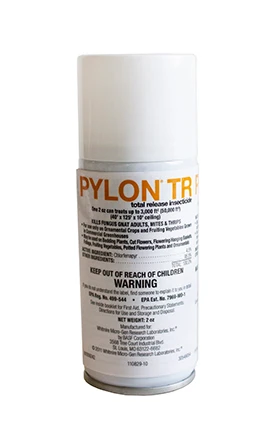
.jpg) BASF launched Pylon TR total release insecticide and Trinity TR total release fungicide. These two products are the first two to deliver BASF proprietary active ingredients using total release (TR) technology since the acquisition of Whitmire Micro-Gen. The total release product line enables growers to save on labor costs and benefit from flexible reentry times while controlling target pests.
BASF launched Pylon TR total release insecticide and Trinity TR total release fungicide. These two products are the first two to deliver BASF proprietary active ingredients using total release (TR) technology since the acquisition of Whitmire Micro-Gen. The total release product line enables growers to save on labor costs and benefit from flexible reentry times while controlling target pests.
Commonly known as aerosol foggers, BASF total release technology is packaged in small canisters. To use, a grower places the product in the greenhouse, closes all greenhouse vents, windows and doors, presses the release button and leaves for a specified amount of time.
Pylon TR total release insecticide controls mites, thrips and adult fungus gnats. One 2-ounce canister of this miticide/insecticide treats up to 3,000 square feet.
Trinity TR total release fungicide provides broad-spectrum control of several plant diseases such as botrytis, cylindrocladium, powdery mildew, rhizoctonia and fusarium. Available in a 3-ounce canister, Trinity TR total release fungicide can treat up to 3,000 square feet of a commercial greenhouse.
Both products are on sale now and are labeled for use in commercial greenhouses on bedding plants, cut flowers, hanging baskets, foliage, potted flowering plants and ornamentals. Trinity TR total release fungicide is also labeled for use on perennials, and Pylon TR total release insecticide can be used for fruiting vegetables grown in commercial greenhouses.
For more information, visit www.betterplants.basf.us.
Latest from Greenhouse Management
- Jackson & Perkins expands into Canadian market
- Green & Growin’ 26 brings together North Carolina’s green industry for education, connection and growth
- Marion Ag Service announces return of Doug Grott as chief operating officer
- Cincinnati Zoo & Botanical Garden debuting new perennial section at 2026 Breeder Showcase
- The Garden Conservancy hosting Open Days 2026
- Registration open for 2026 Perennial Plant Association National Symposium
- Resource Innovation Institute and North Dakota State University explore co-location of data center and greenhouses
- Fred C. Gloeckner Foundation Research Fund calls for 2026 research proposals