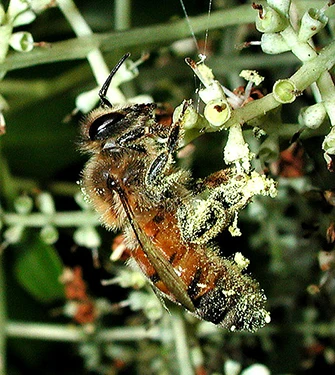
In August, EPA announced label changes to “better protect bees and other pollinators” from dinotefuran, imidacloprid, clothianidin and thiamethoxam. It cited a comprehensive report released in May by EPA and the U.S. Department of Agriculture showing scientific consensus that pesticide exposure is one of the stressors associated with honey bee declines.
EPA intends to have the new label language on “as many products as possible by the 2014 use season.”
The new labeling only applies to products with outdoor foliar applications that might result in exposure to bees; granular products are exempt. It features a “pollinator protection box” and bee icon with information on routes of exposure and spray drift precautions.
The bulk of the new language concerns pesticide applications to food crops using pollination services (hired honey bees) and to crops and ornamentals not under pollination service but attractive to bees.
Language for non-agricultural products is as follows:
Do not apply [insert name of product] while bees are foraging. Do not apply [insert name of product] to plants that are flowering. Only apply after all flower petals have fallen off.
In addition to the new label language, registrants also were required to submit efficacy data and pollinator stewardship plans to EPA by Sept. 30. EPA said it will have a better understanding of any industry concerns after it reviews those materials.
There is some room for label improvement, experts say. The label of the product used in the Oregon bee kill says not to “apply the product or allow it to drift to blooming crops or weeds if bees are visiting the treatment area.”
Research to date has found the bee die-off in Oregon was caused by inappropriate application, said Joe Bischoff, director of government relations at ANLA.
“It’s not enough to just read the label,” he said. “You have to understand the label. It’s the law.”
New label language should provide clarity.
Steven Dwinell, Florida Department of Agriculture & Consumer Services, said the label revisions were “a great step forward.” EPA has done “a great job identifying some of the factors that can affect bees if pesticides aren’t used properly.”
In general, the language used in the new EPA labels is flexible enough for the green industry to work within the new guidelines and still be able to use neonicotinoids, Bischoff said.
“Neonicotinoids are an important part of our industry’s IPM strategy,” Bischoff said. “EPA recognizes that neonicotinoids are a useful tool for growers.”
The industry must learn from these experiences and be a better practitioner.
“As an industry, we are stewards of these chemistries just as we are of the land,” Bischoff said. “We must be responsible and use them for their intended purpose and for their benefits.”
Read the rest of the story here, and see an example of the new EPA Bee Advisory Box.
Latest from Greenhouse Management
- The Growth Industry Episode 10: State of the Horticulture Industry
- Millennium Pacific Greenhouses launches California Grown Cucumber Program
- Scientists develop vitamin A-enriched tomato to fight global deficiency
- Tennessee Green Industry Field Day scheduled for June 11
- UTIA and UT Knoxville research teams will develop automated compost monitoring system
- Ken and Deena Altman receive American Floral Endowment Ambassador Award
- [SNEAK PEEK] Leading Women of Horticulture: The women of Fairview Greenhouses & Garden Center
- [SNEAK PEEK] Leading Women of Horticulture: The inventive women of TPIE ’26