Root-knot nematodes are tiny parasitic worms that infect plant roots. They form galls or knots on the roots that block the flow of nutrients and photosynthesis products. The nematodes can reduce yields and quality of ornamental plants such as roses that have been started from rootstock, tomatoes, cucumbers, pumpkins, sweet potatoes, beets, carrots, peaches, watermelons and okra.
Texas AgriLife Extension Service plant pathologist Karl Steddom said one of the biggest problems with the nematodes that their eggs can lay dormant in the soil for years.
“They’re very difficult to get rid of, and once a grower gets nematodes in a field it can be a big issue for their production for years to come,” he said.
A small infestation initially may not cause significant losses in crop yield or quality, Steddom said. But if the field is left untreated, the nematode population will increase and spread throughout the field.
One of the treatments tested was Vapam and Vydate, a chemical combination considered an industry standard. Another fumigant was Paladin, a relatively new product. The other two products were biological controls. Actinovate, which is commercially available, is a biological fungicide that uses the bacteria Streptomyces lydicus to control nematodes. NI-9, an experimental biological control product not yet on the market, was also trialed at various rates by itself as well as a mixture with Actinovate.
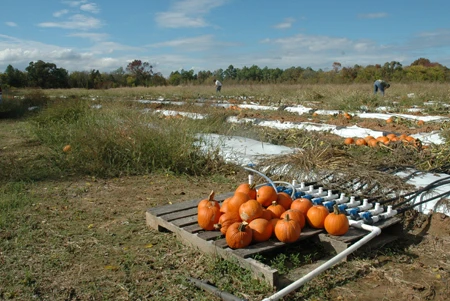
Steddom trialed the controls products on pumpkins in raised beds under plastic mulching. Although Steddom did not find pumpkin yield differences among the various treatments, there were differences in the amount of visible galling on roots and the counts of root-knot nematode eggs per ounce of root. In terms of eggs per ounce of root and visible root galls, the best control was achieved by Actinovate at the lowest rate (6 oz. per acre). The 18-oz. rate of NI-9 achieved similar results on number of root galls.
Pictured: Two biological controls were found to be as effective at controlling root knot nematodes as labeled chemical controls.
Photo by Robert Burns
Latest from Greenhouse Management
- Jackson & Perkins expands into Canadian market
- Green & Growin’ 26 brings together North Carolina’s green industry for education, connection and growth
- Marion Ag Service announces return of Doug Grott as chief operating officer
- Cincinnati Zoo & Botanical Garden debuting new perennial section at 2026 Breeder Showcase
- The Garden Conservancy hosting Open Days 2026
- Registration open for 2026 Perennial Plant Association National Symposium
- Resource Innovation Institute and North Dakota State University explore co-location of data center and greenhouses
- Fred C. Gloeckner Foundation Research Fund calls for 2026 research proposals