Aphids spread diseases that cost growers hundreds of millions of dollars each year. Because aphids are developing insecticide resistance, some growers are being forced to use more chemicals.
USDA-Agricultural Research Service scientists are working with chemical signals known as neuropeptides that aphids and other organisms use to control and regulate a wide range of body functions, including digestion, respiration, water intake and excretions. The effect triggered by the chemical signal is normally turned off when the neuropeptide is broken down by enzymes in the insect’s body.
Researchers are developing neuropeptide mimics, or analogues, with slightly altered molecular structures that won’t break down. The goal is to kill pests by disrupting their digestion, water intake or some other biological function.
Working with pea aphids, scientists prepared several analogues and fed each one to pea aphid (Acyrthosiphon pisum) nymphs. One of the formulations killed 90%-100% of the aphids within 3 days, at a rate and potency comparable to insecticides now on the market. The study was recently published in the journal Peptides.
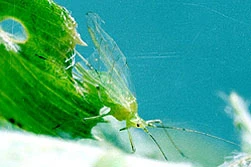
Pictured: Scientists have found that feeding insects chemicals that control their biological functions could be an effective means of killing them.
Photo courtesy of Clemson Univ., USDA Coop. Ext. slide series, Bugwood.org.
Latest from Greenhouse Management
- The Growth Industry Episode 10: State of the Horticulture Industry
- Millennium Pacific Greenhouses launches California Grown Cucumber Program
- Scientists develop vitamin A-enriched tomato to fight global deficiency
- Tennessee Green Industry Field Day scheduled for June 11
- UTIA and UT Knoxville research teams will develop automated compost monitoring system
- Ken and Deena Altman receive American Floral Endowment Ambassador Award
- [SNEAK PEEK] Leading Women of Horticulture: The women of Fairview Greenhouses & Garden Center
- [SNEAK PEEK] Leading Women of Horticulture: The inventive women of TPIE ’26