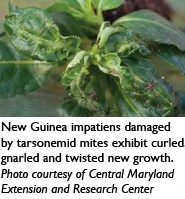
Officials with the Central Maryland Extension and Research Center report receiving New Guinea impatiens loaded with tarsonemid mites, commonly called broad mites. Plants displayed curled, gnarled and twisted new growth. Extension personnel said plant damage is noticeable before actually seeing the mites.
A pocket magnifier microscope or a dissecting microscope with at least 30x magnification is needed to see the mites. Most mite species that damage plants are colorless and are often translucent. Both males and females have a flattened body configuration that allows them to feed easily in confined spaces, such as in bulb sheaths, between the surfaces of unexpanded leaves or near leaf buds.
Most tarsonemid species feed on fungi or algae and do not feed on higher plants. The two species known to feed on greenhouse and interiorscape plants are the Phytonemus pallidus (commonly called the cyclamen mite) and Polyphagotarsonemus latus (commonly called broad mite). These two mites flourish under high humidity and overcast weather conditions. These mites feed on a wide range of plants including ipomoea, gerbera, snapdragon, petunia, daisy and begonia.
Extension officials said control products include Pylon, Sanmite, Judo and Avid.
Latest from Greenhouse Management
- The Growth Industry Episode 10: State of the Horticulture Industry
- Millennium Pacific Greenhouses launches California Grown Cucumber Program
- Scientists develop vitamin A-enriched tomato to fight global deficiency
- Tennessee Green Industry Field Day scheduled for June 11
- UTIA and UT Knoxville research teams will develop automated compost monitoring system
- Ken and Deena Altman receive American Floral Endowment Ambassador Award
- [SNEAK PEEK] Leading Women of Horticulture: The women of Fairview Greenhouses & Garden Center
- [SNEAK PEEK] Leading Women of Horticulture: The inventive women of TPIE ’26