Chicago Botanic Garden has released the results of a long-term study of spiderwort (Tradescantia), in its 34th issue of Plant Evaluation Notes: “A Comparative Study of Tradescantia Cultivars.” Between 2005 and 2009, the Garden evaluated 31 taxa of Tradescantia in full-sun trials. The goal of the comparative trial was to identify outstanding spiderworts for the upper Midwest. The study concentrated on the Andersoniana Group because of their adaptability to a variety of cultural conditions.
Twenty-six of the 31 taxa finished the 5-year trial. Final performance ratings were based on flower production, habit quality (prior to and following midsummer decline), plant health, and winter hardiness. Fourteen hardy garden spiderworts received four-star good ratings for their strong habits, good flower production and greater resistance to fungal leaf spotting.
‘Red Cloud’, which was the most robust of the cultivars, had the highest flower coverage (70% at peak). Good floral displays were also consistently observed on ‘Blue Stone’, ‘Concord Grape’, ‘Innocence’, ‘Karminglut’, ‘Mariella’, ‘Perinne’s Pink’, ‘Snowcap’, ‘Sylvana’, ‘White Doll’ and ‘Zwanenburg Blue’.
Taxa with blue-green leaves were generally less troubled by leaf spotting than green-leaved plants. Winter hardiness was not a concern. With the exception of ‘Blushing Bride,’ the majority of taxa are listed hardy to at least USDA Hardiness Zone 5.
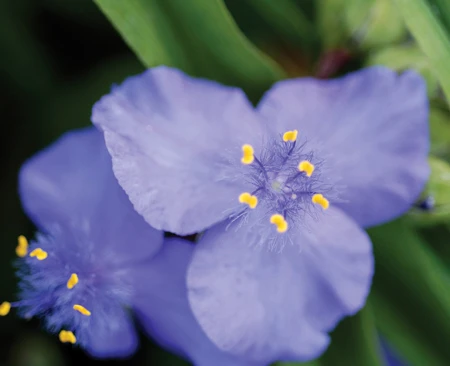
Pictured: Tradescantia ‘Blue Stone’ was one of the cultivars in the Chicago Botanic Garden trial that consistently showed good floral display in a 5-year study of spiderworts.
Photo courtesy of Chicago Botanic Garden
Latest from Greenhouse Management
- The Growth Industry podcast Episode 10: State of the Horticulture Industry
- Millennium Pacific Greenhouses launches California Grown Cucumber Program
- Scientists develop vitamin A-enriched tomato to fight global deficiency
- Incubating invention
- Tennessee Green Industry Field Day scheduled for June 11
- UTIA and UT Knoxville research teams will develop automated compost monitoring system
- Ken and Deena Altman receive American Floral Endowment Ambassador Award
- [WATCH] Taking root: The green industry’s guide to successful internships