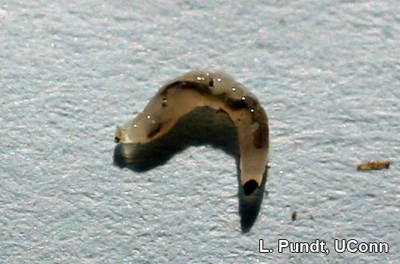
Growing media stays moist during cool, cloudy weather and/or cool greenhouse temperatures. Univ. of Mass. floriculture extension specialist Tina Smith and Univ. of Conn. extension horticulture and greenhouse IPM specialist Leanne Pundt said this can favor the growth of algae on the medium surface as well as fungus gnats. Adult fungus gnats are attracted to newly planted crops, where the females lay their eggs in moist growing medium. Eggs hatch into larvae that feed on young roots, developing callus of cuttings and even bore into the stems of succulent plants such as sedum, coleus and geraniums.
Smith and Pundt said cultural practices can help to discourage fungus gnats. These include keeping the top few inches of the medium drier, if the crop can tolerate it, and avoiding overwatering. Dry, level, weed-free, well-drained floors help eliminate breeding areas under greenhouse benches.
Yellow sticky cards can be used to monitor fungus gnat adults. Place the cards horizontally at the medium surface. Check and change the cards weekly to see if numbers are increasing or decreasing. Larvae can be monitored by placing chunks, plugs or slices of peeled potatoes on the medium surface. Check the potato after 48 hours for the presence or absence of larvae.
Smith and Pundt said treatments against fungus gnats are best directed against the larval stage, which is the stage of development that causes the damage. If fungus gnats are well established, applications of an adulticide may also help.
Latest from Greenhouse Management
- Jackson & Perkins expands into Canadian market
- Green & Growin’ 26 brings together North Carolina’s green industry for education, connection and growth
- Marion Ag Service announces return of Doug Grott as chief operating officer
- Cincinnati Zoo & Botanical Garden debuting new perennial section at 2026 Breeder Showcase
- The Garden Conservancy hosting Open Days 2026
- Registration open for 2026 Perennial Plant Association National Symposium
- Resource Innovation Institute and North Dakota State University explore co-location of data center and greenhouses
- Fred C. Gloeckner Foundation Research Fund calls for 2026 research proposals