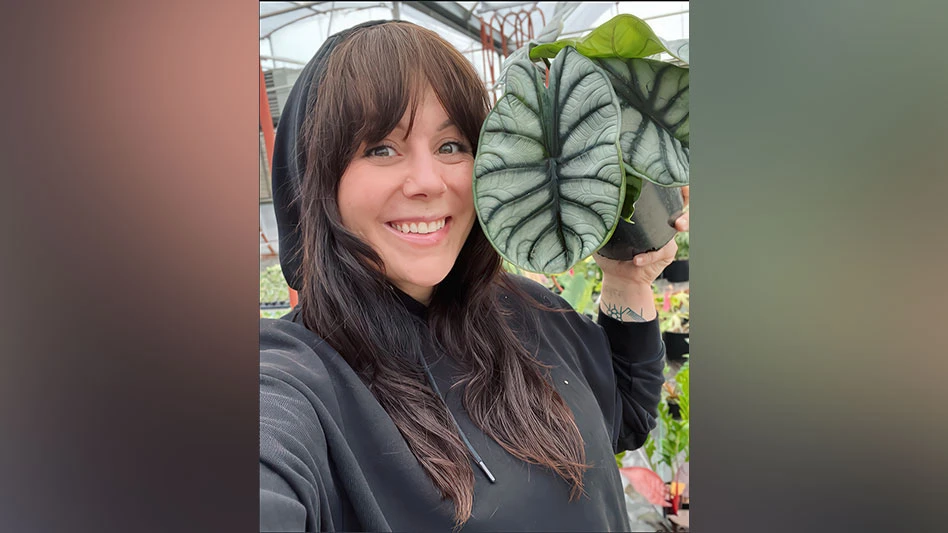
Nora Catlin, floriculture specialist at Cornell Cooperative Extension of Suffolk County, has received an “Excellence in IPM” award from the New York State Integrated Pest Management Program (NYS IPM). The award honors Catlin for her work with commercial greenhouse growers who, on Long Island alone, contribute nearly $80 million to New York’s economy. Catlin received her award at the Long Island Horticultural Research and Extension Center’s Plant Science Day on July 15.
“In the greenhouse industry, pests don’t hold 9 to 5 jobs,” says Elizabeth Lamb, a greenhouse specialist with NYS IPM. “They don’t take holidays or weekends off. That’s why dealing with pests requires tactics that stay on the job 24/7.”
With its focus on preventing pest problems before they take hold, Lamb says, IPM is the method of choice for many large growers — and Catlin is the go-to person for bringing them the latest knowhow and techniques that help dramatically reduce pesticide use while keeping plants healthy and pest-free.
At C.J. Van Bourgondien Greenhouses, with nearly four acres under glass, Catlin taught staff how to use biological controls: the parasites or predators that eat pests for breakfast, lunch and dinner. The results? Steeply reduced pesticide use and beautiful flowers. Now the Van Bourgondien’s have opened their greenhouses to neighboring operations for Catlin’s workshops and demos on biocontrols.
IPM is working for Bianchi-Davis Greenhouses “because Nora helps us identify problems, then solve them,” says William Bianchi. “We’re grateful to Nora for doing such a good job of steering us in this direction.”
Robert Anderson at Emerald Flora feels much the same. “We’re in the business of producing ornamental plants that have to look pretty,” Anderson says. “We’re constantly battling pests that aren’t just difficult to see, they’re nearly impossible for us to identify correctly.” Without Catlin, Anderson says, quality would suffer and costs such as pesticides would be higher. Now Emerald Flora is ready to take IPM to the next level — learning how biological controls can manage pests.
Catlin brings IPM expertise to some of the largest operations in the Northeast, Lamb says. “Whether it’s bugs, pathogens, or production techniques that inadvertently create inviting places for pests to call home, Catlin is there with solutions.”
Learn more about IPM at nysipm.cornell.edu.
Latest from Greenhouse Management
- The Growth Industry Episode 10: State of the Horticulture Industry
- Millennium Pacific Greenhouses launches California Grown Cucumber Program
- Scientists develop vitamin A-enriched tomato to fight global deficiency
- Tennessee Green Industry Field Day scheduled for June 11
- UTIA and UT Knoxville research teams will develop automated compost monitoring system
- Ken and Deena Altman receive American Floral Endowment Ambassador Award
- [SNEAK PEEK] Leading Women of Horticulture: The women of Fairview Greenhouses & Garden Center
- [SNEAK PEEK] Leading Women of Horticulture: The inventive women of TPIE ’26