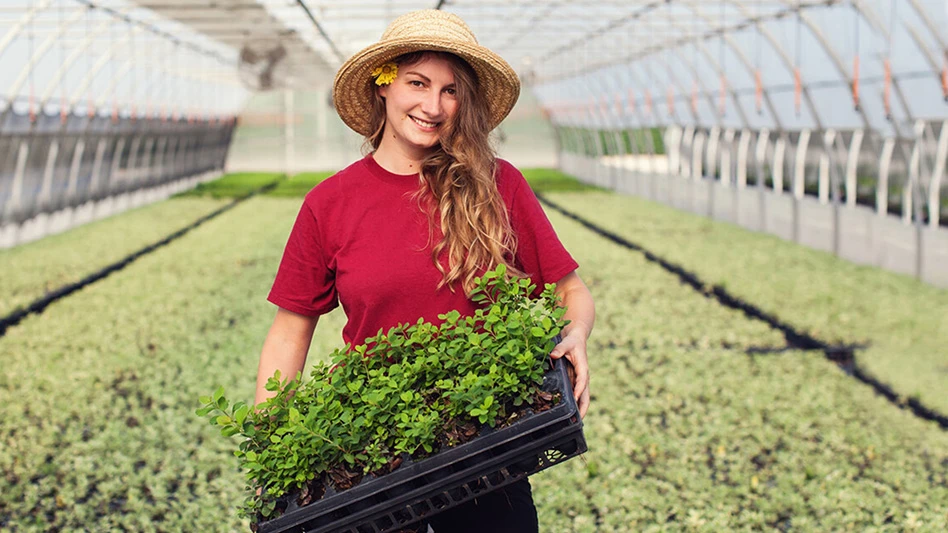
Naturally low in fat, sodium, calories and cholesterol, cucumbers have gained in popularity with consumers. But they’re also great crops for greenhouse growers, who can use them as a primary crop or as a supplement to their existing production.
Produce Grower spoke to Steve Froelich, a greenhouse grower and consultant for CropKing, about what makes cucumbers such great crops for growers.
Produce Grower: Why are cucumbers popular with growers?
Steve Froelich: Cucumbers are relatively easy to grow. We have quite a few growers that grow them in conjunction with tomato crops. Cucumbers grow very rapidly in a greenhouse under favorable conditions. They set fruit relatively easy and you can be picking quite a few columns of cucumbers off of plants in short-order. Quite a few of my growers have used cucumbers as a fill-in crop.
If growers get in trouble with, say, a tomato plant due to bugs, or whatever reason, and had to terminate the crop early; cucumbers might be an option that you can get back into business pretty quickly.
PG: Are cucumbers commonly grown with tomatoes?
SF: Quite a few growers that I work with grow them in conjunction with tomatoes. Environmental conditions are similar for the two crops. So, many of the growers I work with will grow tomatoes as their primary crop and use cucumbers as a supplement, that they can sell into their marketplace.
There are growers that are strictly cucumber growers. My personal experience with small growers is that they are tomato growers first and cucumber growers second.
PG: What is the turnaround time for cucumbers?
SF: They grow very rapidly hydroponically. Some of the old-timers joke that if you stand-around long enough near cucumber plants, they’ll encompass you. You’ll become part of the plant. They grow that rapidly. The turnaround time from plant-to-finish is about 30-days. They grow very quickly.
PG: Which hydroponic system are they grown in most commonly?
SF: For the most part, and certainly if you’re a CropKing grower, they’d be grown in the Dutch buckets. Some of the big Dutch houses use other medias such as rockwool or coco coir but most small growers are using perlite in a Dutch bucket.
The system layout would be very similar to what it would be for a tomato crop. You’ve got your container which has your growing media, you have a similar dripper and feed system, and you’d still need to have wires overhead that you drop and twine down because you’re training that cucumber plant to grow up the twine.
PG: Who are small growers selling their cucumbers to?
SF: Really small growers are selling cucumbers at farmers markets. Many times they’ll pick them that morning, pick them off the vine and sell direct to consumer. It’s probably split 50-50 between farmers markets and supplementing tomato business with grocery stores. If you’re selling them at grocery stores you’re running them through a shrink wrap machine to control water loss.
PG: Are there particular diseases or pests that affect cucumber production?
SF: Powdery mildew is the most common disease. If you’ve experienced powdery mildew in the past on a tomato or lettuce crop, you’ll likely have it on your cucumbers. Whiteflies, spider mites and aphids all can do damage to the crop but powdery mildew is the number one problem.
You can use some sprays to counteract it. Many growers will just terminate the crop and start it over because of how quickly it grows. Powdery mildew is frequently seasonal, so if you can get the house cleaned out, get the spores out, and start over, you might be able to get around it.
Latest from Greenhouse Management
- The Growth Industry Episode 10: State of the Horticulture Industry
- Millennium Pacific Greenhouses launches California Grown Cucumber Program
- Scientists develop vitamin A-enriched tomato to fight global deficiency
- Tennessee Green Industry Field Day scheduled for June 11
- UTIA and UT Knoxville research teams will develop automated compost monitoring system
- Ken and Deena Altman receive American Floral Endowment Ambassador Award
- [SNEAK PEEK] Leading Women of Horticulture: The women of Fairview Greenhouses & Garden Center
- [SNEAK PEEK] Leading Women of Horticulture: The inventive women of TPIE ’26