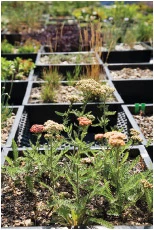
A 2-year green roof study conducted at the Univ. of Minn. looked at developing guidelines for low maintenance plants that could survive the cold and often dry Minnesota weather and still reduce building energy costs. Horticulture graduate student Jonathan Hensley and professor John Erwin sought to create a low maintenance roof that could reflect light and absorb heat during the summer and insulate buildings during the winter. Hensley and Erwin trialed a variety of grasses, bulb crops and perennials on the roof of the university’s Williamson Hall.
Hensley said the savings are hard to quantify especially since a green roof can cost 2-3 times as much as a conventional roof. However, a green roof can last 2-3 times longer.
Erwin, who is a commissioner of the Minneapolis Parks and Recreation Board, has supplied the city with a list of approved plants to develop a city-recommended green roof guide. The Target Center in Minneapolis has a 2½-acre green roof that was completed in September 2009 and cost $5.3 million.
University landscape architect Tom Ritzer said the results of Hensley’s and Erwin’s research will be a part of the school’s facility management discussion about the practicality of green roofs. He said the key to the university installing other green roofs will be cost effectiveness.
Pictured: University of Minnesota researchers trialed a variety of plants on the university’s Williamson Hall to determine which ones could be used in green roofs and survive in Minnesota’s climate.
Photo courtesy of Univ. of Minn.
Latest from Greenhouse Management
- The Growth Industry Episode 10: State of the Horticulture Industry
- Millennium Pacific Greenhouses launches California Grown Cucumber Program
- Scientists develop vitamin A-enriched tomato to fight global deficiency
- Tennessee Green Industry Field Day scheduled for June 11
- UTIA and UT Knoxville research teams will develop automated compost monitoring system
- Ken and Deena Altman receive American Floral Endowment Ambassador Award
- [SNEAK PEEK] Leading Women of Horticulture: The women of Fairview Greenhouses & Garden Center
- [SNEAK PEEK] Leading Women of Horticulture: The inventive women of TPIE ’26