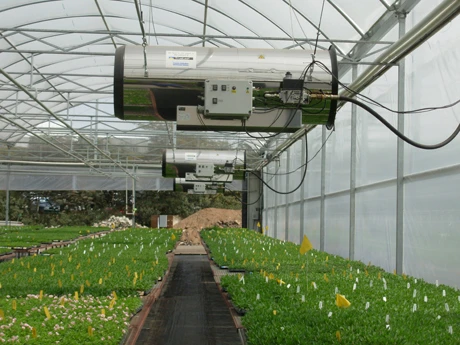
Greenhouse growers looking to replace unit heaters this year should look at installing direct-fired unit heaters which are 99% efficient in their fuel consumption. Even with their high efficiency, Morris Brink at Trueleaf Technologies recommends that growers look at different models. Brink said that in addition to generating heat, direct-fired heaters also produce carbon dioxide and water vapor. He said carbon dioxide in the right doses can benefit plants, but too much can be problematic.
If a greenhouse is located in a very cold climate with a Delta T greater than 60°F, and only direct-fired heaters are being used, there is a potential to create too much carbon dioxide and water vapor, Brink said. In this case, a solution is to use a percentage of direct-fired heaters in combination with conventional indirect-fired heaters.
Brink said growers in warmer climates can use direct-fired heaters more easily without the concern of creating too much carbon dioxide and water vapor. He said growers should check with their plant suppliers to find out what carbon dioxide levels are acceptable for the plants they are producing.
Pictured: Growers interested in installing direct-fired unit heaters need to be aware that the units also generate carbon dioxide and water vapor that can impact plant growth.
Photo courtesy of Trueleaf Technologies
Latest from Greenhouse Management
- The Growth Industry Episode 10: State of the Horticulture Industry
- Millennium Pacific Greenhouses launches California Grown Cucumber Program
- Scientists develop vitamin A-enriched tomato to fight global deficiency
- Tennessee Green Industry Field Day scheduled for June 11
- UTIA and UT Knoxville research teams will develop automated compost monitoring system
- Ken and Deena Altman receive American Floral Endowment Ambassador Award
- [SNEAK PEEK] Leading Women of Horticulture: The women of Fairview Greenhouses & Garden Center
- [SNEAK PEEK] Leading Women of Horticulture: The inventive women of TPIE ’26