Downy mildew (Peronospora sp.) on basil was a major problem on both field- and greenhouse-grown basil during 2008 and 2009. High humidity and extended leaf wetness favor pathogen development.
Univ. of Mass. plant pathologists Rob Wick and Bess Dicklow said the production practices of increasing spacing between plants and watering earlier in the day can help to reduce the amount of time leaves remain wet. Increasing air movement in the greenhouse with horizontal air flow fans can help to reduce condensation. Infected plants should be removed and destroyed to hinder further spread of the disease.
Field trials conducted in New Jersey in 2009 determined that commonly produced sweet basil (Ocimum basilicum) cultivars including ‘Poppy Joe’ and ‘Nufar’ were the most susceptible to downy mildew. Least susceptible basils include the lemon and spice types such as O. x citriodorum and O. americanum cultivars, including ‘Lemon’, ‘Lime’, ‘Spice’, ‘Blue Spice’ and ‘Blue Spice Fil’.
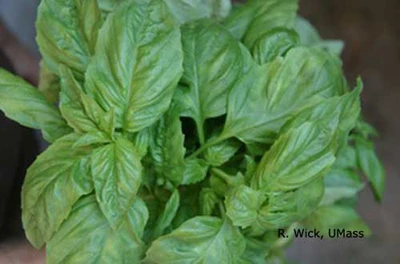
Pictured: The discolored foliage on the upper leaf surface of a basil plant caused by downy mildew could be confused with a nutritional deficiency.
Photo by Rob Wick, Univ. of Mass.
Latest from Greenhouse Management
- Jackson & Perkins expands into Canadian market
- Green & Growin’ 26 brings together North Carolina’s green industry for education, connection and growth
- Marion Ag Service announces return of Doug Grott as chief operating officer
- Cincinnati Zoo & Botanical Garden debuting new perennial section at 2026 Breeder Showcase
- The Garden Conservancy hosting Open Days 2026
- Registration open for 2026 Perennial Plant Association National Symposium
- Resource Innovation Institute and North Dakota State University explore co-location of data center and greenhouses
- Fred C. Gloeckner Foundation Research Fund calls for 2026 research proposals