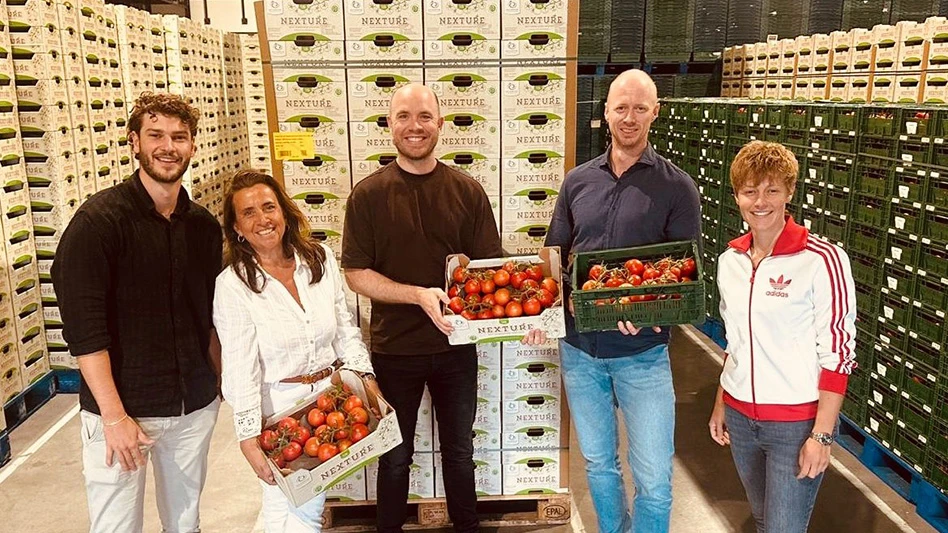
Photo courtesy of Ledgnd
Following the success of the first LED optimization trial at Dutch tomato grower Duijvestijn Tomaten in the Dutch town of Pijnacker, Duijvestijn, Dutch software company Ledgnd and horticultural lighting company Gavita International are launching a second research phase to be conducted over the coming year.
The partnership among Duijvestijn Tomaten, Ledgnd and Gavita International focuses on refining lighting strategies using plant feedback and climate data. By continuously monitoring both plant and environmental parameters, the parties aim to achieve maximum energy efficiency, crop balance and production results, marking another step forward in sustainable greenhouse cultivation.
The results of the initial trial were presented to an exclusive international audience during GreenTech in June. The new trial officially started in early October.
“LED is not a plug-and-play solution,” said Kees Weerheim, senior plant physiologist at Ledgnd. “It requires different cultivation decisions; you are not just changing the lighting, but the entire microclimate.”
During the first trial, Duijvestijn examined how the crop responded to that shift. Measurements of plant feedback, such as fluorescence and transpiration, were linked to climate settings, revealing where performance gains or limitations occurred.
“In our data platform MyLedgnd, we observed that two days with the same daily light integral (DLI) could show up to 50% difference in photosynthesis, purely due to a different ventilation strategy,” Weerheim said. “The data revealed irregularities days before they became visible to the naked eye. The MyScore graph even showed that a small adjustment in the RTR strategy led to higher assimilate consumption but lower production. Plants can fall out of balance faster than you think. Only by continuously measuring plant feedback can you truly optimize.”
“In this second trial, we aim to further improve light use efficiency (LUE),” added Kim Oosterom, project manager at Duijvestijn. “We are investigating how lighting strategies, pipe heating and air circulation affect crop activity and head temperature, crucial factors for growth rate and plant balance. We will also examine how to optimize dehumidification during the winter period. Two varieties will be continuously monitored throughout the trial.”
Maarten van Bemmel, co-founder of Ledgnd, said this collaboration demonstrates the real-world power of data:
“This project has been running for nearly three years and shows how effectively a grower, lighting supplier and data platform can work together. It all began with a sharp question from Gavita International: What does our lighting actually do in tomatoes at Duijvestijn?” he said. “By collecting data from plants and the microclimate using cameras and sensors, and integrating everything into MyLedgnd, we translate data directly into concrete cultivation actions. That’s from data to practice. Thanks to Duijvestijn’s pioneering spirit as an early adopter, we are showing how data makes an impact where it truly matters: inside the greenhouse.”
“Efficiency and a hands-on approach are the key to our collaboration,” added Talitha Timmerman, global sales director of Gavita International.Duijvestijn is a leading and sustainable tomato grower and our first Agrolux Wega Full LED customer. We are proud of that. Tomatoes are our largest illuminated crop worldwide, so further research into optimization will contribute directly to sustainable growth. With the inspiring team of Ledgnd, we are now taking the step towards a data-driven approach in which knowledge sharing is just as important as innovation.”
Latest from Greenhouse Management
- Blue Grass Farms acquires Brehob Nursery
- OHP expands sales team with new hire and internal promotion
- Seed Your Future aims to double 2025 total for 'Round-Up at the Register' 2026 campaign
- Beacon Impatiens partners with Roots for Youth in 2026
- Inner visions
- New internship data empowers horticulture employers
- American Horticultural Society announces winners of 2026 Great American Gardeners Awards
- Sustainabloom releases new sustainability template for wholesale florists