E. coli can live for weeks around the roots of produce plants and transfer to the edible portions. Purdue Univ. researchers found the threat of contamination can be minimized if growers don't harvest the plants too soon.
Purdue scientists added E. coli to soil through manure application and water treated with manure and showed that the bacteria can survive and are active in the rhizosphere (area around the roots) of lettuce and radishes. E. coli eventually gets onto the above ground surfaces of the plants, where it can live for several weeks.
“E. coli is actually quite active in the rhizosphere. They're eating something there - probably plant exudates,” said Ron Turco, a professor of agronomy and co-author of the study published in the November issue of the Journal of Food Protection.
E. coli didn't survive on the plants' surfaces more than 40 days after seeds were planted. Harvesting produce at least 40 days after planting should reduce the possibility of contamination. However, Turco warned that E. coli could still come from other sources.
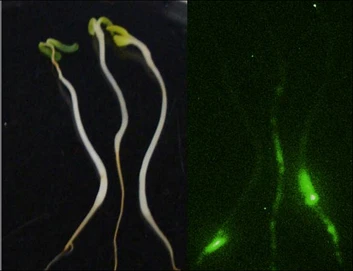
Pictured: Plants grown in a substrate with a bioluminescent E. coli, which emits light (right) when active.
Photo by Bruce Applegate
Latest from Greenhouse Management
- The Growth Industry Episode 10: State of the Horticulture Industry
- Millennium Pacific Greenhouses launches California Grown Cucumber Program
- Scientists develop vitamin A-enriched tomato to fight global deficiency
- Tennessee Green Industry Field Day scheduled for June 11
- UTIA and UT Knoxville research teams will develop automated compost monitoring system
- Ken and Deena Altman receive American Floral Endowment Ambassador Award
- [SNEAK PEEK] Leading Women of Horticulture: The women of Fairview Greenhouses & Garden Center
- [SNEAK PEEK] Leading Women of Horticulture: The inventive women of TPIE ’26