 From Stanton Gill, University of Maryland Extension:
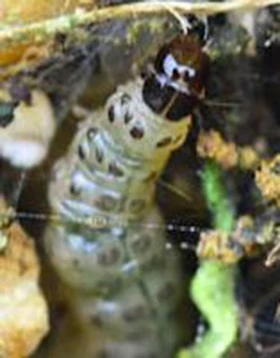
Photo: European pepper moth. University of Maryland Extension.
The European pepper moth (EPM), Duponchelia fovealis (Zeller), a relatively new invasive species, has been confirmed in a Maryland greenhouse operation. Greenhouse managers and Extension people working with greenhouse growers should be alert and monitor for this new pest. How much economic damage the European pepper moth might cause in the United States is still unknown but we do know that this pest is being detected in many states in greenhouse operations.
Since this pest has rapidly spread across the United States and Canada, traditional containment through quarantine, has been discarded as impractical. In 2011 extensive monitoring was conducted in several counties in Georgia and Florida. The European pepper moth has been found infesting lantana plants in a greenhouse in Georgia. While EPM was found in greenhouses in those states, it has not been found in field production of fruits or vegetables.
It might be that the insect is adapted to the close growing conditions in a greenhouse environment and not suited for most field production situations. In greenhouse environments the foliage touching the substrate surface may make ideal conditions for this moisture loving pest. The moth is native to both freshwater and saltwater marshlands of southern Europe, the eastern Mediterranean region, the Canary Islands, Syria and Algeria. The larvae of this moth have been recorded on more than 70 host species in a wide range of plants families.
In the United States, the moth was first detected on begonia in San Diego County, California in 2004. This population was eradicated. In 2010, it showed up again in San Diego County. By September 2011 it had been detected in 17 counties in California. It has also been detected in Alabama, Arizona, Colorado, Florida, Georgia, Kentucky, Mississippi, New York, North Carolina, Oklahoma, Oregon, South Carolina, Tennessee, Texas and Washington. European pepper moth has also been recorded as a problem in greenhouse grown chrysanthemums and other cut flower species in Ontario. It is not known whether this pest is mainly a greenhouse problem or whether it could cause damage in field and landscape plantings.
In June 2013, European pepper moth larvae were found infesting zonal geraniums and petunias in Central Maryland in a commercial greenhouse. Two alert greenhouse managers found the caterpillars boring in the base stems of plants and submitted samples to our lab. We identified the caterpillars with help from Lance Osborne who is an entomologist at University of Florida and USDA-ARS. A Maryland Department of Agriculture taxonomist, Gaye Williams, has subsequently confirmed our identification of this pest. We are working with the growers to bring this infestation under control.
Read the rest of the story here.
Latest from Greenhouse Management
- The Growth Industry Episode 10: State of the Horticulture Industry
- Millennium Pacific Greenhouses launches California Grown Cucumber Program
- Scientists develop vitamin A-enriched tomato to fight global deficiency
- Tennessee Green Industry Field Day scheduled for June 11
- UTIA and UT Knoxville research teams will develop automated compost monitoring system
- Ken and Deena Altman receive American Floral Endowment Ambassador Award
- [SNEAK PEEK] Leading Women of Horticulture: The women of Fairview Greenhouses & Garden Center
- [SNEAK PEEK] Leading Women of Horticulture: The inventive women of TPIE ’26