Drawing from his illustrious career in floriculture that has spanned more than four decades so far, Dr. P. Allen Hammer, technical advisor at Dümmen Orange, offers five tips for cuttings success.
1. Be ready for the cuttings.
The first step for properly rooting cuttings is to be prepared, Hammer says. Growers can prepare to root their cuttings by cleaning their propagation area and making sure their bottom heat is working ahead of time. They need to purchase a rooting hormone. Hammer suggests they use water-soluble spray rooting hormones and spray the cuttings after they stick them.
2. Follow the right sticking order.
Growers need to stick the most sensitive cuttings first, Hammer says, depending on which “group” they fit in. Cutting “Group A,” or cuttings that growers should stick on their arrival day, include crossandra, euphorbia, heliotrope, lantana, purslane, yellow sweet potato and thunbergia. “Group B” includes agastache, dahlia, dipladenia, erysimum, zonal geranium, lavandula and mandevilla. Groups C and D are lower in priority, respectively, and include significantly larger numbers of plant types than the first two groups.
3. Make contact with the rooting media.
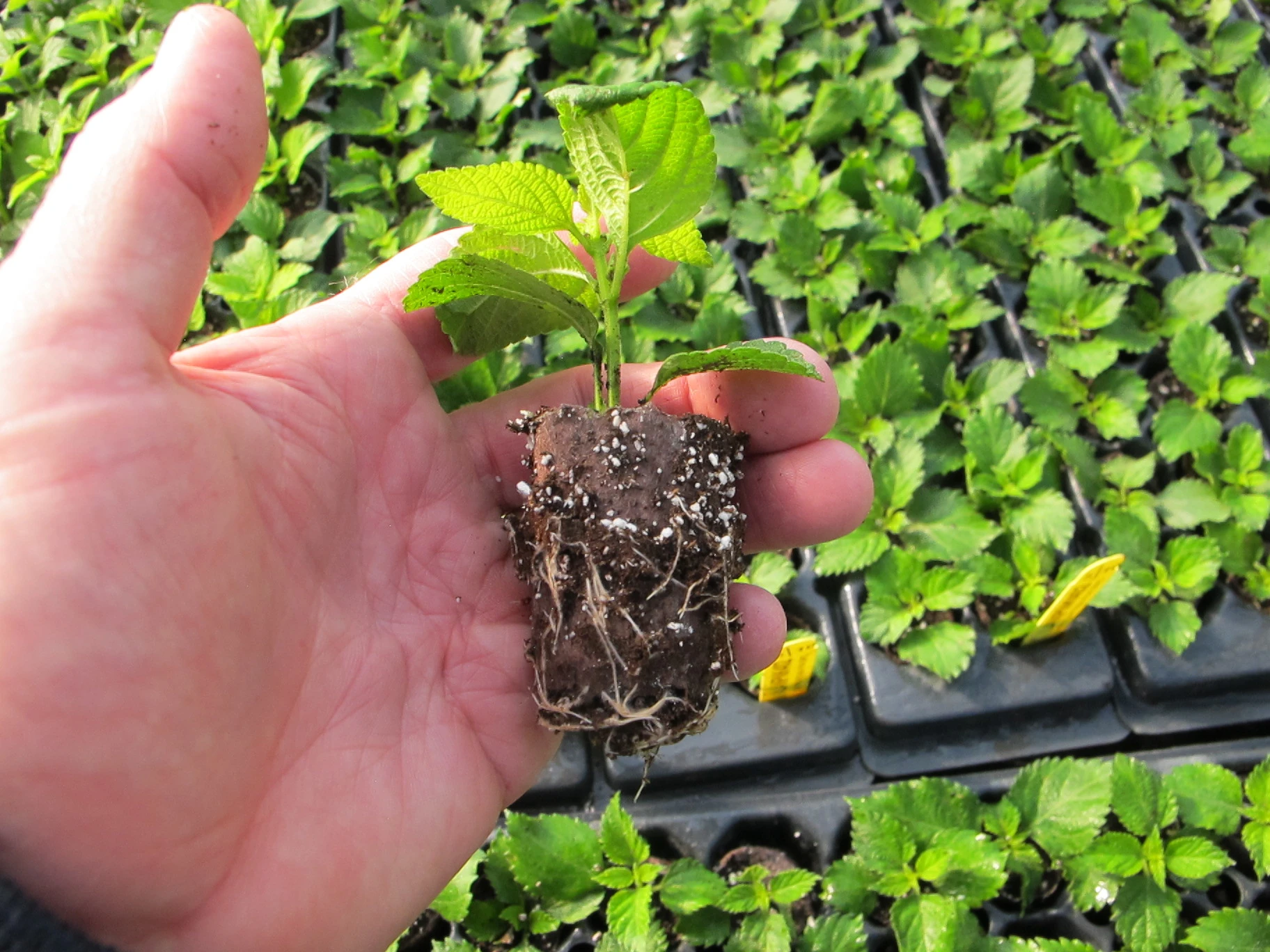
Many growers dibble large holes to simplify the sticking process, Hammer says. “If they make the dibble hole too big or with too much depth on it, then the rooting of the cutting does not seat in that, and it just sort of hangs in the air,” he says. He calls this “seating the cutting.” At least the bottom of the cutting needs to touch the rooting media, he says. With the right size hole, growers can effectively water their cuttings in.
4. Mist to prevent wilting, but don’t mist too much.
Applying mist to cuttings prevents them from wilting, Hammer says. Many growers, though, mist too much, such as on cloudy days. “I have lots of favorite expressions but the old one is that, ‘The mist clock controls the mist, but the grower has control of the mist clock,’” he says. “So, if it’s really cloudy, you probably don’t need it; you can turn the clock off and not put mist on.”
5. “Tone” the cutting.
As quickly as possible after rooting, growers should turn off the mist and reduce the temperature and humidity to “tone” the cutting, Hammer says. He makes the analogy of weaning a baby. “Just as soon as you form roots, you want to tone it,” he says. “You want to find an environment that is cooler and drier, so that cutting sort of acclimates to the real growing conditions.”
Photo courtesy of Dr. P. Allen Hammer
Latest from Greenhouse Management
- Jackson & Perkins expands into Canadian market
- Green & Growin’ 26 brings together North Carolina’s green industry for education, connection and growth
- Marion Ag Service announces return of Doug Grott as chief operating officer
- Cincinnati Zoo & Botanical Garden debuting new perennial section at 2026 Breeder Showcase
- The Garden Conservancy hosting Open Days 2026
- Registration open for 2026 Perennial Plant Association National Symposium
- Resource Innovation Institute and North Dakota State University explore co-location of data center and greenhouses
- Fred C. Gloeckner Foundation Research Fund calls for 2026 research proposals