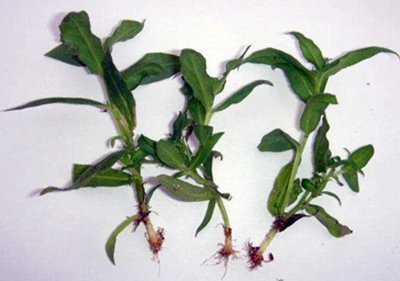
Fungus gnat larvae can burrow into plant roots and into stems of cuttings that are being propagated. This can result in root damage and eventually plant death, said Tom Dudek, senior Mich. St. Univ. Extension horticulture and marketing educator. He said there have also been reports that fungus gnat adults can carry fungal pathogen spores of Botrytis, Pythium, Fusarium, Phoma and Verticillium.
Monitoring of adult fungus gnats can be done with yellow sticky cards laid horizontally near the plant pot surface. Dudek said this card orientation generally collects twice as many adults as a vertically placed card on a stake.
The adults are easily identified with a 10X or 15X hand lens. Fungus gnat adults are dark-bodied, slender, long-legged, mosquito-like insects. The larvae are wormlike with a black head capsule and a white to transparent body.
Once cuttings have rooted, Dudek said allowing the growing medium to dry between waterings is the best way to reduce fungus gnat infestations. Both insecticides and biological controls are available for fungus gnat control.
Fungus gnat larvae can burrow into plant roots of cuttings being propagated, which can result in root damage and eventually plant death.
Photo by Thomas Dudek, Mich. St. Univ. Extension
Latest from Greenhouse Management
- Jackson & Perkins expands into Canadian market
- Green & Growin’ 26 brings together North Carolina’s green industry for education, connection and growth
- Marion Ag Service announces return of Doug Grott as chief operating officer
- Cincinnati Zoo & Botanical Garden debuting new perennial section at 2026 Breeder Showcase
- The Garden Conservancy hosting Open Days 2026
- Registration open for 2026 Perennial Plant Association National Symposium
- Resource Innovation Institute and North Dakota State University explore co-location of data center and greenhouses
- Fred C. Gloeckner Foundation Research Fund calls for 2026 research proposals