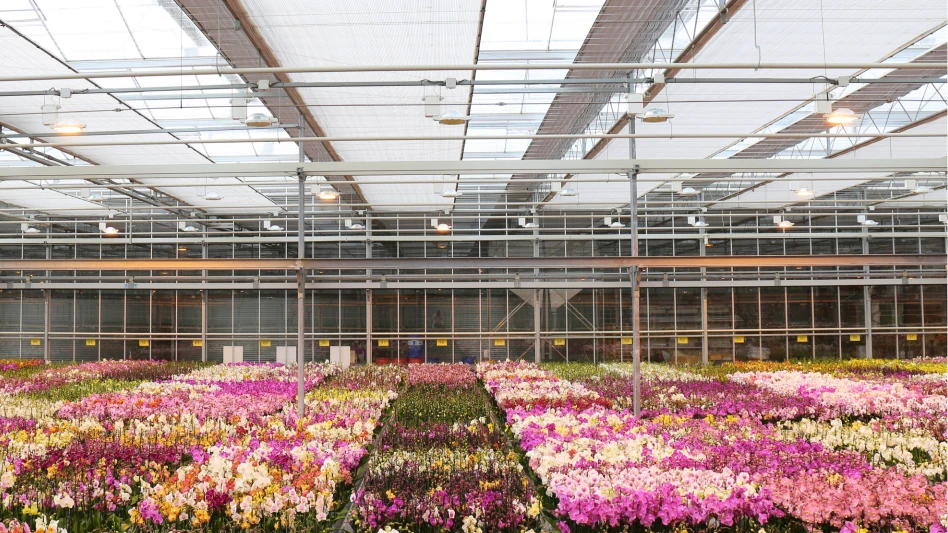
Photo courtesy of Svensson
For horticulture professionals, optimizing light in greenhouses is essential to maximizing crop yield, ensuring quality and maintaining overall plant health. However, traditional light management methods often present growers with difficult compromises. Modern screen systems — like Svensson’s Harmony and PARperfect solutions — offer growers a more sophisticated approach to precisely manage optimal light levels and improve uniformity across diverse growing zones within the greenhouse.
Precisely tailored light levels
Steven Bryant, director of drowing at The Plant Company in Stuarts Draft, Virginia, notes the company has relied on Hoogendoorn Control Solutions since its inception to manage its greenhouse environment. Since his arrival in April 2024, Bryant has specifically leveraged the company’s IIVO system's PAR+ and Green Wise technologies. The primary objective of adopting and integrating Svensson's PARperfect shading screens was to ensure uniform lighting across The Plant Company’s entire greenhouse facility.
Achieving consistent light distribution presents a challenge due to greenhouse obstructions like vents and scaffolding, which can create uneven light pockets. To counter this, The Plant Company utilizes multiple light sensors in various bays. However, Bryant emphasized that a single light reading from a sensor might not accurately represent the overall conditions in that greenhouse area. If the environmental control system relies on an inaccurate reading, it can lead to significant discrepancies.
“We want to make sure that we’re not creating bands of light in the greenhouse,” Bryant says. “We want to make sure that all the plants underneath the screen are getting equal light — from above and from the sides — as much as possible.”
This is vital since The Plant Company cultivates a wide array of tissue culture tropical varieties, each with distinct light requirements. The Plant Company is the primary licensee for Proven Winners' leafjoy line of houseplants.
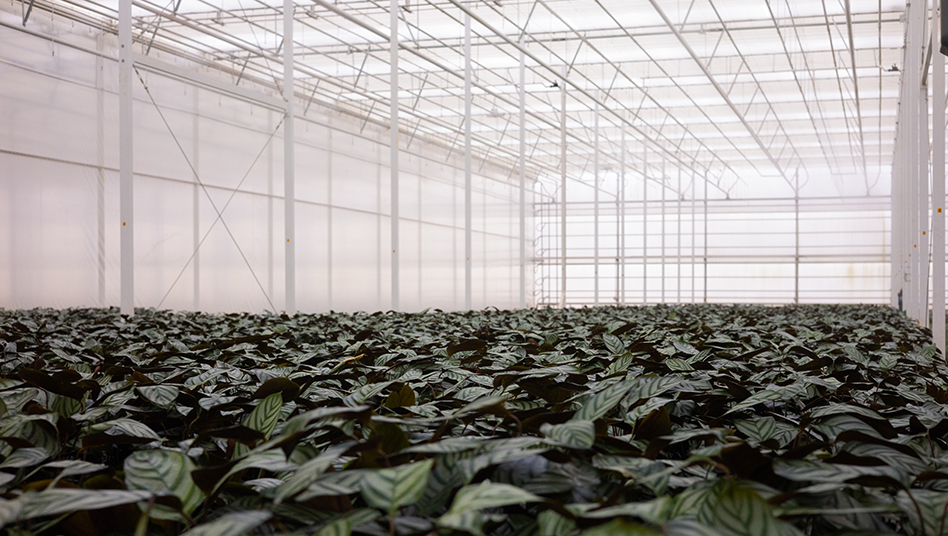
This diverse inventory ranges from plants like Plutonia, which thrive in as little as 50 micromoles of light, to Monstera and Ficus, capable of tolerating more than 300 micromoles, according to Bryant. Between these extremes, The Plant Company grows numerous other crops, including Pothos, Scindapsus and various Philodendron species, all demanding precise light management.
Given these varied needs, Bryant emphasized that unless a greenhouse has custom-tailored environmental compartments for each plant type, flexible control over curtains and screens is essential to deliver precisely tailored light levels.
“For example, with Philodendron, you have dark green or even burgundy-leaved varieties that can take a little bit more light than some of your chartreuse or neon light-yellow leaf varieties, which can take a lot less light,” Bryant says. “So, you can't have these big swings of light in the greenhouse. Otherwise, you're eventually going to burn something, or you're not going to be providing enough light to speed the crop up.”
The ability to "dial in" a narrow and precise band of light using automated screen systems is crucial. This precision also allows The Plant Company to rapidly adapt to changing environmental conditions outside the greenhouse, a task Bryant says would be incredibly difficult without sophisticated modern shading systems, like those from Svensson.
Optimized production and efficiency
Svensson’s Harmony family of screens offers growers a multifaced solution, providing essential shading, significant energy savings and a notable cooling effect, says Paul Arena, a greenhouse consultant with Svensson.
Unlike other greenhouse shade screens that often feature white plastic strips, Svensson’s Harmony screens are designed to deliver lower temperatures within the greenhouse environment. Furthermore, their open-structured design allows for continuous airflow even when the screens are fully closed, Arena notes. The Harmony family offers a wide range of shading capabilities, from 20% to an impressive 85% shade with a single screen, providing growers with considerable flexibility for diverse cultivation needs within a greenhouse.
“Providing shade but still allowing direct light to come into the greenhouse is another consideration that growers need to make when thinking about shading materials,” Arena says. “It’s the material themselves and which strips are within the screens that determine whether or not it’s going to reflect light or diffuse light.”
Superior light diffusion and uniformity
Svensson also champions the PARperfect concept, an advanced double-screen system engineered for optimal light management, particularly during periods of high light intensity and elevated temperatures. The “PAR” in the moniker refers to Photosynthetically Active Radiation, which is the wavelengths of light (400 to 700 nanometers) that plants can utilize for photosynthesis.
According to Arena, this system comprises two distinct screens: an upper screen with at least 50% shade or higher (up to 100% or blackout) and a lower screen with less than 50% shade that features a high Hortiscatter diffusion, ideally at least 80%.
Hortiscatter diffusion refers to a level of light scattering within the greenhouse environment. This light scattering is achieved through specific greenhouse coverings or materials that diffuse the incoming sunlight. For example, clear glass has a very low Hortiscatter value (near zero), whereas a material with a high Hortiscatter value (closer to 100%) acts like a diffuser, scattering light in multiple directions and creating a more uniform light environment throughout the greenhouse, ultimately benefiting the plants.
According to Arena, PARperfect’s strategic combination of these screens ensures superior light diffusion and uniformity. The lower diffusion screen is designed to capture and scatter incoming light broadly across the bay, effectively mitigating shadows cast by the upper screen.
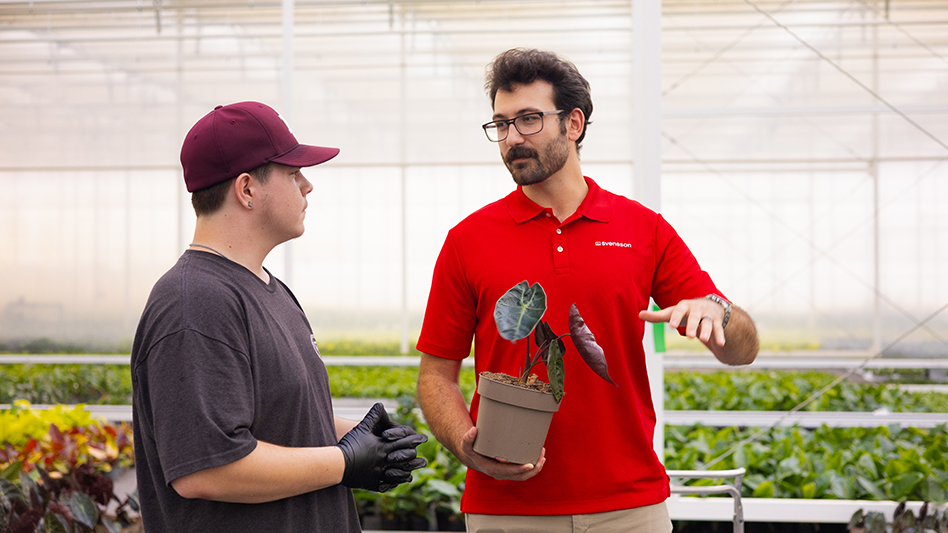
“Growers would expect there to be black lines or large shadows going across the bay because they’re closing that top screen more and more,” he says. “But the diffusion of the lower screen accommodates for that. So, whatever light is hitting that lower screen is going to cover the shadows that the blackout screen would make.”
Even as growers adjust the top screen to control light intensity, the diffused light from the lower screen ensures consistent, uniform illumination throughout the growing area. As long as direct light strikes the diffusion screen, Arena says uniform light is maintained, allowing growers to precisely adjust light quantity from 900 micromoles (the measure of light photons used to quantify PAR) down to 100 micromoles without compromising even distribution across the entire bay.
Successful crop cultivation hinges entirely on implementing precise growing practices. And in a mass production facility, adhering to strict schedules is paramount. Crops often follow a defined progression, moving through different zones for specific durations. A failure to manage light, for instance, by forgetting to close a shade screen, can disrupt a crop's growth at a critical stage.
“One small mistake can result in burning an entire track of propagated cuttings just because they didn't shut their shade screen,” Arena says. “That's hundreds of thousands of dollars in profit gone just because (the grower) failed to provide the correct amount of light to the crop that it needed at that stage.”
Improved light management to ensure crop health and quality
The skillful use of screens is integral to maintaining production timing and ensuring quality. These are critical production features at Carpinteria, California-based Westerlay Orchids, where CEO Toine Overgaag has collaborated with Svensson on its innovative climate screen solutions for its greenhouses.
“Over the last four years, we have upgraded all of our energy curtains to Harmony screens and are very pleased with the results,” Overgaag says. “For orchid production, we use a high-transparency, high-diffusion screen in combination with a low-transparency energy screen and are able to achieve uniform diffused light on the crop at the desired light intensity no matter the outdoor light level.”
Arena says maturing plants follow a defined progression, moving through different zones for specific durations. A failure to manage light — for instance, by forgetting to close a shade screen — can disrupt a crop's growth at a critical stage. This forces the crop to remain in a zone longer than planned or necessitates starting an entirely new growth cycle, significantly impacting production timelines, he says.
Beyond scheduling, Arena adds that proper screen deployment is vital for other cultivation practices, such as chemical applications. He further notes that screens designed for greater light diffusion and reduced direct heat lead to less crop stress and more consistent and uniform growth across the entire greenhouse, eliminating "wavy bays." Ultimately, shading and diffusion screens provide the consistency that growers need to optimize their operations.
Growers achieve further energy savings by using shading screens to minimize the need for active cooling systems (like fans or evaporative coolers) during peak solar radiation.
The bottom line is these shading systems allow growers to produce happy plants, which results in even happier clients, Bryant says.
“Vendors come (to the greenhouse), and they’re always blown away by the wide assortment of products that we have mixed not just in one area but throughout the entire greenhouse,” he says. “Having a system that is so flexible to custom-tailor your growing needs allows the grower the flexibility to control the precise conditions (the plants) need when they need it.”
The strategic implementation of light-diffusing and shading screens, particularly advanced integrated systems like Svensson's Harmony and PARperfect, empowers horticulture professionals with unparalleled control over their greenhouse light environment. This precise management not only enhances light uniformity and optimizes photosynthesis but also significantly reduces factors contributing to plant stress and crop loss, ultimately leading to improved yields, better quality and greater economic efficiency in greenhouse operations.
Mike Zawacki is a Cleveland-based journalist and frequent contributor to the GIE Media Horticulture Group who has covered various aspects of the green, horticultural, sports turf and irrigation industries for the last 20 years.
Latest from Greenhouse Management
- Quality Horticulture to acquire Hydrofarm Canada distribution
- Portrait of progress
- Blue Grass Farms acquires Brehob Nursery
- OHP expands sales team with new hire and internal promotion
- The inventive women of TPIE ’26
- Seed Your Future aims to double 2025 total for 'Round-Up at the Register' 2026 campaign
- [WATCH] Remix: Sakata Playlist Combos and New Variety Spotlight
- Beacon Impatiens partners with Roots for Youth in 2026