Photo courtesy of W. Garrett Owen
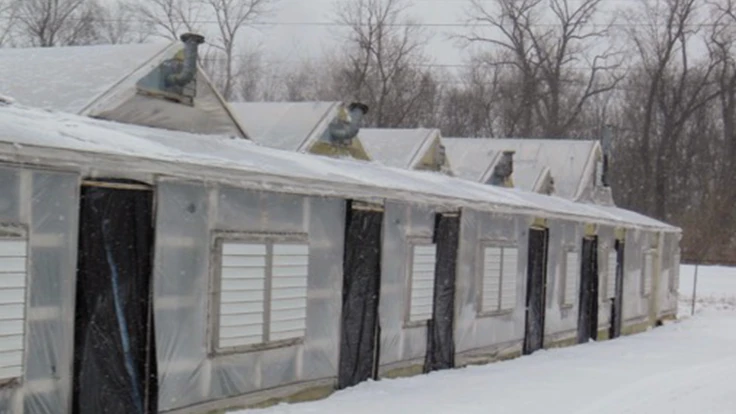
Last week, the great polar vortex of 2019 brought extreme sub-zero temperatures to the mid-western and eastern United States. Extreme temperatures ranging from -2° F were recorded in Washington DC to -51° F in Cotton, Minnesota.
During the winter, including sub-zero temperatures, most greenhouse operators strive to maintain temperatures set points between 60 to 72° F to ensure crop growth and development. In order to not to delay crops and mitigate heat loss and prevent potential chilling injury or freezing damage to crops, operators and growers should consider the following tips and techniques we have put together.
Insulate not in-use exhaust fans with insulation boards (Fig. 1) end walls with spray foam (Fig. 2).
Inspect growing structures, glazing materials, exhaust fans and louvers, and doors for air leaks, cracks (Fig. 3A), or holes and other passageways for heat loss (exfiltration) or cold entry (infiltration). Consider repairing, replacing polyethylene, polycarbonate, acrylic, or glass panes, or patching holes or tears to prevent heat loss (Fig. 3B).
Cover exhaust fan (Fig. 4A) and louver openings (Fig. 4B) inside the greenhouse with plastic. Ensure the exhaust fans and louvers are powered off or not in-use when covered. Cover greenhouse exit doors (Fig. 5) that are not in use to prevent heat loss and cold air from leaking into the greenhouse. Note, for emergencies and the safety of employees, ensure that not all greenhouse doors or exits are covered. Updated emergency plans or routes may be required.
Construct cold air barriers or temporary walls made of greenhouse material (Fig. 6) to protect plants from chilling injury or freezing damage (Fig. 7). This technique is often used when plants are grown on the floor near high-traffic greenhouse doors that lead outside.
a larger area than needed.
Deploy thermal energy curtains to retain heat (Fig. 9).
RELATED: Q&A: Walters Gardens' Laura Robles discusses growing in freezing weather
Ensure double-poly inflation or blower fans are installed correctly and the two layers of double-poly are inflated creating an insulation barrier. Inflation fans that are installed correctly, pull air from outside the greenhouse. In some instances, inflation fans may be installed incorrectly, thus pulling air from inside the greenhouse causing condensation in between the layers, water accumulation and freezing (Fig. 10). Other times, inflation fan may have failed or the intake or exhaust manifolds are closed, thus preventing the inflation between the two layers of double-poly. For more information, refer to e-GROAlert 3.33: Is Your Double-Poly Greenhouse Properly Inflated with Outside Air?
Minimally heat greenhouses that are not in use to prevent frozen pipes and excessive snow loads (Fig. 10). Consider these tips and techniques, we hope you will be able to mitigate heat loss and protect your greenhouse crops from potential chilling injury or freezing damage. For more information, refer to e-GRO Alert 4.9: Checklist for Reducing Greenhouse Heating Costs this Winter or the Michigan State University extension article, “Inspect greenhouses to mitigate heat loss during sub-zero temperatures.”
Figure photos in video, see below for corresponding captions.
Fig. 1. Example of insulating greenhouse end walls or unused exhaust fans with insulation boards.
Fig. 2. Example of insulating north facing walls with spray foam or insulation board.
Figs. 3A & 3B. (A) Inspect and repair, (B) patch, and/or replace polycarbonate, acrylic, or other glazing materials that have holes, cracks or tears that may allow heat to escape.
Fig. 4A & 4B. Cover exhaust fan (A) and louver openings (B) inside the greenhouse with plastic, but ensure the fans and/or louvers are off or not in use.
Fig. 5. Greenhouse exit doors covered and sealed to prevent heat loss and cold air from leaking into the greenhouse.
Fig. 6. Example of a waist-high cold air barrier used to protect plants from cold or freeze injury.
Fig. 7. Cold injury and delayed development of coleus because plants were placed and grown on the floor near an high-traffic greenhouse exit door that lead outside.
Fig. 8. A ‘false’ or temporary wall (A) or ceiling (B) can be created with plastic to reduce heating a larger area than needed.
Fig. 9. Energy curtains should be deployed to retain heat.
Fig. 10. An inflation fan installed incorrectly, pulling air from inside the greenhouse causing condensation to occur in between the layers and freezing.
Editor's note: This article originally ran as an e-Gro and was published by Greenhouse Management with permission from both authors. You can read the original here.
Lopez can be reached at rglopez@msu.edu and Owen can be reached at wgowen@msu.edu
Photos courtesy of Roberto Lopez and W. Garrett Owen
Latest from Greenhouse Management
- Jackson & Perkins expands into Canadian market
- Green & Growin’ 26 brings together North Carolina’s green industry for education, connection and growth
- Marion Ag Service announces return of Doug Grott as chief operating officer
- Cincinnati Zoo & Botanical Garden debuting new perennial section at 2026 Breeder Showcase
- The Garden Conservancy hosting Open Days 2026
- Registration open for 2026 Perennial Plant Association National Symposium
- Resource Innovation Institute and North Dakota State University explore co-location of data center and greenhouses
- Fred C. Gloeckner Foundation Research Fund calls for 2026 research proposals