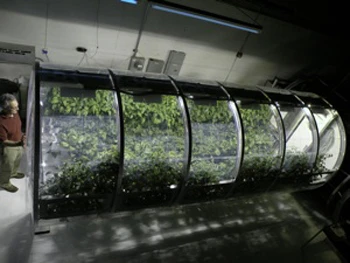
Researchers at the Univ. of Ariz. Controlled Environment Agriculture Center (CEAC) in Tucson, are demonstrating that plants could be grown hydroponically on the moon or other planets that astronauts may eventually explore. The research team has built a prototype 18-foot lunar greenhouse.
The tubular structure would be buried beneath the moon’s surface to protect the plants and astronauts from solar flares, micrometeorites and cosmic rays. The membrane-covered module can be collapsed to a 4-foot-wide disk for space travel. It contains water-cooled sodium vapor lamps and long seed envelopes that would be ready to sprout hydroponically.
Giacomelli told Earth Sky that the lunar greenhouse would need to get its water from the moon and also from the recycled waste of humans (urine and wash water).
The light to grow the vegetables would come two sources. A solar collector which would direct light rays to a fiberoptic cable that would transmit the light to the plants growing beneath the surface. The other light source would be a solar collector that makes electricity (photovoltaics) that would power grow lights.
The lunar greenhouse based on a structure university researchers built at the South Pole. Giacomelli told Earth Sky that the extreme conditions of the South Pole helped his team fine-tune the lunar greenhouse. It also allowed them to determine how to remotely control conditions like temperature, humidity and light. He said similar technologies could someday be used in cities to build a greenhouse within a skyscraper.
Pictured: This prototype lunar greenhouse could someday be used by astronauts to grow vegetables on the moon.
Photo by Gene Giacomelli, Univ. of Ariz.
Latest from Greenhouse Management
- Jackson & Perkins expands into Canadian market
- Green & Growin’ 26 brings together North Carolina’s green industry for education, connection and growth
- Marion Ag Service announces return of Doug Grott as chief operating officer
- Cincinnati Zoo & Botanical Garden debuting new perennial section at 2026 Breeder Showcase
- The Garden Conservancy hosting Open Days 2026
- Registration open for 2026 Perennial Plant Association National Symposium
- Resource Innovation Institute and North Dakota State University explore co-location of data center and greenhouses
- Fred C. Gloeckner Foundation Research Fund calls for 2026 research proposals